Kirjojen hintavertailu. Mukana 12 363 183 kirjaa ja 12 kauppaa.

Kirjailija

Tim Watkins

Kirjat ja teokset yhdessä paikassa: 20 kirjaa, julkaisuja vuosilta 2013-2018, suosituimpien joukossa Smart Fundraising. Vertaile teosten hintoja ja tarkista saatavuus suomalaisista kirjakaupoista.

20 kirjaa

Kirjojen julkaisuhaarukka 2013-2018.

Defeat Depression

Defeat Depression

Tim Watkins

Createspace Independent Publishing Platform
2018
pokkari
Following a debilitating episode of depression 25 years ago, mental health campaigner Tim Watkins set out to learn from those who had recovered from depression what worked for them. The result is a more holistic understanding of the condition than usually appears in the medical literature. More practically, the result was an award-winning self-management training course and a series of mental health publications.Defeat Depression is the latest self-help book from Tim Watkins. It builds upon his earlier Depression Workbook and incorporates information on the new science of willpower. This explains why so many of us fall back into habits of thought and behaviour that exacerbate depression; and what we can do to overcome them. The book offers the reader a comprehensive approach to self-help for depression that actually works.Defeat Depression is written in plain language, and provides the reader with 80 self-help techniques that can be easily included in a daily routine in order to begin the journey out of depression. The publication of Defeat Depression is timely, as its author, Tim Watkins explains: "Depression has always been with us. But since the economic downturn in 2008, more and more people have developed the condition. Sadly, the consequence of this is that therapies like CBT (cognitive behavioural therapy) and mindfulness have become even harder to access. Far too many people are being left with little more than a packet of pills and a sicknote."However, many people affected by depression by depression - myself included - have struggled to understand what helps and what hinders recovery. Drawing on both my own experience and my research among many others affected by depression, I have developed a structure that allows individuals with depression to understand the self-help process and to develop simple lifestyle changes that promote recovery."As Watkins explains in Defeat Depression, self-help is neither an alternative nor a complement to conventional treatments like antidepressants and talking therapies. Rather, conventional treatments are an important part of a much broader process of self-help in which we learn to promote our own mental wellbeing and manage our own recovery from common mental illnesses like anxiety and depression.

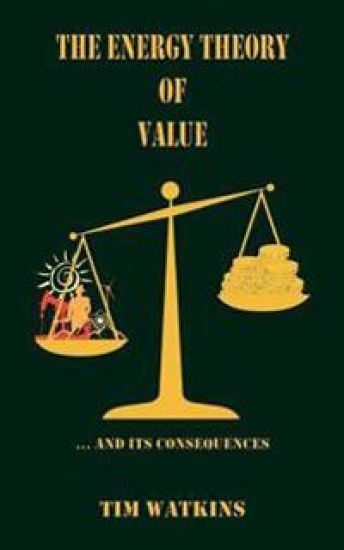
The Energy Theory of Value

The Energy Theory of Value

Tim Watkins

Waye Forward (Publishing) Ltd
2016
nidottu
What is the basis of all of the wealth in our modern global economy?For some it is merely the product of trade in a free market. The followers of Karl Marx, however, have enshrined the belief that all value, wealth and profit is generated by the working class and then stolen by the capitalist elites. The Marxist "Labour Theory of Value" lay at the heart of the communist revolutions that led to conflict and division throughout the twentieth century.Marx was 90 percent correct when he reasoned that one or more of the inputs into production must be paid far less than the value it generates in order to produce profit or "surplus value" at the end. Marx arrived at the bindingly obvious - and entirely wrong - conclusion that this input was labour.What Marx began to see toward the end of his life was that while labour could be exploited, automation meant that something else must be generating surplus value. In The Energy Theory of Value sociologist Tim Watkins argues that the "something else" that Marx missed was energy - in particular the one-time gift (and curse) of fossil carbon fuels.This understanding leads to a very different - and far more urgent - politics for the twenty-first century.
The Root of all Evil

The Root of all Evil

Tim Watkins

Waye Forward (Publishing) Ltd
2016
nidottu
When the Mafia make money they use the same plates, paper and ink as the government. The include the same security features and use the same serial numbers. Even to the most trained eyes this counterfeit currency is physically indistinguishable from the real thing.This being the case, why - exactly - is this Mafia money a crime? Who are its victims? Why should we care?The answers to these questions draw us into the fraud at the heart of our contemporary financial system; a fraud so vast in its scope yet so cleverly disguised that almost all of us treat it as normal while less than one in a million ever sees it. It is the fraud of debt-based money.In The Root of all Evil, social scientist Tim Watkins walks us through the way the debt-based money system operates, and explains the dire consequences that await us if we refuse to change the way our money works.
Britain's Coming Energy Crisis

Britain's Coming Energy Crisis

Tim Watkins

Waye Forward (Publishing) Ltd
2015
nidottu
We dare not talk about this... Politicians dare not discuss it for fear of causing mass panic... North Sea oil and gas production peaked in 1999. The oil bonanza is over - the oil income spent. Britain is once again an energy importer. Worse still, we are increasingly dependent upon imports from the world's trouble spots and hostile regimes - Libya, Nigeria, several Gulf States and Russia.Even worse, successive governments have failed to invest in new electricity generation; let alone a switch from petroleum-powered vehicles. What they have done is closed most of the coal-fired power stations and destroyed the UK coal industry.Just at the point where we - and our EU partners - need to import growing quantities of oil, we face growing competition from fast developing countries such as China and India.Add to these problems the fact that the oil exporting countries are using a growing proportion of their dwindling oil and gas production to grow their own economies, and you have the end of cheap, fossil fuel-based energy.Nobody can predict with any certainty what the world beyond cheap oil will be like. One of the problems with many of the peak-oilers is that they tend to talk about the consequences in apocalyptic terms, as if the entire world will come crashing down around our ears within months of oil production peaking. This is, perhaps, understandable when we consider that the early peak-oilers were oil industry insiders concerned that the world was sleep-walking to a potential catastrophe.One response to this - one I personally hold to - is that if you want to see what a world without cheap oil looks like, go and look out of your window (or look at a newspaper): * A million families using food banks is what a world without cheap oil looks like* The replacement of high-paid/high-skilled employment with low-paid/low-skilled jobs is what a world without cheap oil looks like* The inability of the developed economies to stimulate economic growth is what a world without cheap oil looks like* Governments' (including those pursuing austerity policies) failure to avoid running up massive government debts is what a world without cheap oil looks like * The dramatic slowdown in the Chinese economy (which was meant to be the engine for global growth) is what a world without cheap oil looks like* The multi-trillion pound misallocation of funds to inflate asset bubbles and property speculation (because the real economy has gone into reverse) is what a world without cheap oil looks like.This is, of course, just the beginning. As supplies of cheap fossil fuels dwindle even as humanity's insatiable demand increases exponentially, our life-support systems will begin to fall apart, causing the biggest disaster to hit the UK since the Black Death
Austerity: Will Kill The Economy

Austerity: Will Kill The Economy

Tim Watkins

Createspace Independent Publishing Platform
2015
nidottu
"We must pay off the debt" "We have to balance the books" "We should have fixed the roof when the sun was shining" The same message has been trotted out time and again by economists and politicians from all parties: Only by cutting public spending can we hope to return to economic growth. But what is clear from the experience of 2010-15 is that austerity has failed to deliver. In 2010, the coalition government inherited a public debt of 0.76 trillion. By 2015, despite savage austerity cuts and an assault on social security, they managed to raise the public debt to 1.36 trillion. The new Tory government will argue that the failure is because we did not have enough austerity. We did not have enough public spending cuts. We shall soon find out what full blown austerity cuts can do to an economy What if they are wrong? What if austerity causes recession? The early cuts triggered a recession, and economic growth has been anaemic ever since. What if these are the direct consequence of a misguided policy of austerity? In this essential guide to Austerity, Tim Watkins explains how politicians' fundamental misunderstanding of the way money is created has brought about the conditions for the biggest economic crash in human history... and why we should all be worried.
What's Wrong With Charity?: How modern charity practices are undermining our communities, democracy and public trust
Charity - the voluntary giving of one's time or money to alleviate suffering, to improve the conditions of our fellows for the common good - has been a key element of civil society for centuries. However, at the beginning of the 21st century a series of scandals has created growing unease about contemporary charities. What's Wrong With Charity sets out why we need to examine the system that creates fraud and mismanagement rather than treating each case as if it were solely caused by corrupt or incompetent individuals. What's Wrong With Charity makes the case that there are six interweaving processes within the contemporary charity sector that are conspiring to create a massive - often bureaucratic - "infrastructure of welfare" that undermines the very notion of charity itself: 1. Poor legislation and a lack of regulation 2. The end of voluntarism and the growth of employment and self-interest within charities 3. Increased fraud and corruption 4. Tax avoidance 5. The creation of "astroturf", "sock puppet" and "moral entrepreneur" charities to hi-jack public discourse and undermine the democratic process 6. The growth of corporate business-emulating charities 7. The problem of charities investing in the corporations and states that cause most of the suffering in the first place.
Smart Fundraising

Smart Fundraising

Tim Watkins

Createspace Independent Publishing Platform
2013
pokkari
Over the last decade, Tim Watkins has raised more than 600,000 for small charities. He has helped them to develop systems for running their charity effectively. And helped them to win awards in recognition of the work they do.In Smart Fundraising, Tim Watkins shows you the most cost-effective fundraising methods. You will also see how to harness the energy of your supporter, donor and beneficiary networks to develop multiple low-input/high-return funding streams.If you want your charity to survive and thrive, Smart Fundraising is essential reading. (Includes an A to Z of 342 fundraising ideas).