Kirjojen hintavertailu. Mukana 12 390 323 kirjaa ja 12 kauppaa.

Kirjailija

Timo Eskola

Kirjat ja teokset yhdessä paikassa: 9 kirjaa, julkaisuja vuosilta 1998-2021, suosituimpien joukossa New Testament Semiotics: Linguistic Signs, the Process of Signification, and the Hermeneutics of Discursive Resistance. Vertaile teosten hintoja ja tarkista saatavuus suomalaisista kirjakaupoista.

9 kirjaa

Kirjojen julkaisuhaarukka 1998-2021.

New Testament Semiotics: Linguistic Signs, the Process of Signification, and the Hermeneutics of Discursive Resistance
Focusing on linguistic signs, New Testament Semiotics navigates through different realist and nominalist traditions. From this perspective, Saussure's and Peirce's traditions exhibit similarities. Questioning Derrida's and Eco's semiotics based on their misuse of Peirce's innovations, Dr. Privatdozent Timo Eskola rehabilitates Benveniste and Ricoeur. A sign is about conditions and functions. Sign as a role is a manifestation of participation. Serving as a sign entails participation in a web of relations, participation in a network of meanings, and adoption of a set of rules. We should focus on sentences and networks, not primitive reference or binary oppositions. Enunciations are postulations producing evanescent meanings. Finally, the study suggests a linguistic approach to metatheology that is based on hermeneutics of discursive resistance.
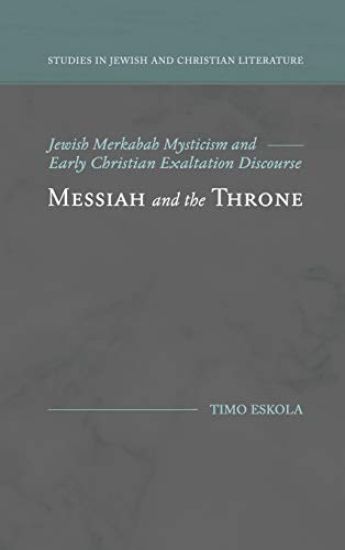
Messiah and the Throne

Messiah and the Throne

Timo Eskola

Fontes Press
2019
sidottu
Did Jewish throne mysticism, the so-called 'merkabah mysticism', influence the emergence and formation of the earliest exaltation Christology? The author presents resurrection Christology as a part of Jewish Christian merkabah tradition.Christ's exaltation was described as a heavenly journey that culminated in his enthronement on the divine throne of glory. Christian writers did exploit the symbolic world, the images and metaphors of Second Temple Judaism. The exaltation discourse that they present, however, is completely new. A simple typological explanation is unable to explain the nature of early Christology. Christ was not depicted as a heavenly angelic figure or an exalted patriarch. He was described as the enthroned Son of God whose reign is eternal.By exploiting linguistic and literary methods Eskola reconstructs the narrative structure of christological statements. Several different narratives were discerned, each one of which expresses one form of a so-called Christian merkabah tradition. In the New Testament, Christ's resurrection has been interpreted in terms of exaltation discourse, cultic discourse, and judicial discourse.Each one of these produced a different narrative about the exalted Christ. Further, the new approach sheds light for instance on the idea of the so-called adoptionist Christology. There was no concept of adoption in early Jewish Christian exaltation Christology. Exalted Christ on the throne of Glory was not considered merely as a pious Jew making a heavenly journey, but as the divine Savior of the world. The intertextual transformation of Jewish concepts underlined the Lordship of Christ as a heavenly king. The confessing of Christ as Lord realized simultaneously the core of traditional Jewish devotion - faith in and faithfulness to God as a heavenly King.
Messiah and the Throne

Messiah and the Throne

Timo Eskola

Fontes Press
2019
pokkari
Did Jewish throne mysticism, the so-called 'merkabah mysticism', influence the emergence and formation of the earliest exaltation Christology? The author presents resurrection Christology as a part of Jewish Christian merkabah tradition.Christ's exaltation was described as a heavenly journey that culminated in his enthronement on the divine throne of glory. Christian writers did exploit the symbolic world, the images and metaphors of Second Temple Judaism. The exaltation discourse that they present, however, is completely new. A simple typological explanation is unable to explain the nature of early Christology. Christ was not depicted as a heavenly angelic figure or an exalted patriarch. He was described as the enthroned Son of God whose reign is eternal.By exploiting linguistic and literary methods Eskola reconstructs the narrative structure of christological statements. Several different narratives were discerned, each one of which expresses one form of a so-called Christian merkabah tradition. In the New Testament, Christ's resurrection has been interpreted in terms of exaltation discourse, cultic discourse, and judicial discourse.Each one of these produced a different narrative about the exalted Christ. Further, the new approach sheds light for instance on the idea of the so-called adoptionist Christology. There was no concept of adoption in early Jewish Christian exaltation Christology. Exalted Christ on the throne of Glory was not considered merely as a pious Jew making a heavenly journey, but as the divine Savior of the world. The intertextual transformation of Jewish concepts underlined the Lordship of Christ as a heavenly king. The confessing of Christ as Lord realized simultaneously the core of traditional Jewish devotion - faith in and faithfulness to God as a heavenly King.
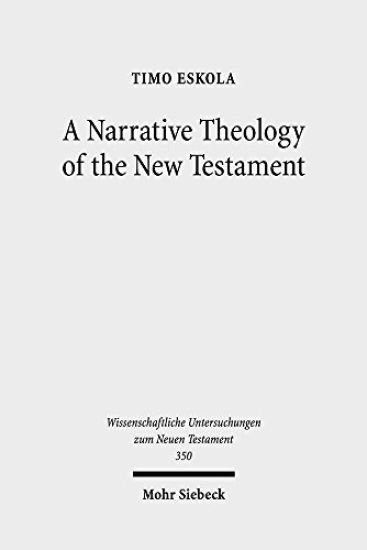
A Narrative Theology of the New Testament
Focusing on the metanarrative of exile and restoration Timo Eskola claims that a post-liberal, narrative New Testament theology is both consistent and explanative. Combining a post-New Quest perspective on Jesus with an eschatological reading of Paul, the author states that Jesus' temple criticism aims at restoration eschatology. Jesus starts a priestly community that expects God's jubilee to begin with Jesus' work, and proceed with the preaching of the new gospel. The reception of this message in the post-Easter church results in resurrection Christology that proclaims Jesus' Davidic kingship on God's throne of glory. Both Paul and Jewish Christian teachers later present Christ's community as a new temple where believers serve the Lord as priests of the new covenant. Furthermore, restoration eschatology provides a new basis for understanding Paul's contrast with the words of the law, and his teaching of justification."Eskola […] has written by far the most erudite and helpful of the narrative theologies to date for NT study."Craig L. Blomberg in Journal of the Evangelical Theological Society 59 (2016), S. 869-871"Eskola has accomplished the aims of this study. He has skillfully demonstrated how the metanarrative of exile and restoration is at work in Jesus's message and in the early Christian proclamation of the gospel. He has also well demonstrated and discussed the Jewish background that undergirds such theological appropriation through extensive and deft interactions with the Old Testament and Second Temple writings."Abson Joseph in Review of Biblical Literature, https://www.bookreviews.org (8/2017)
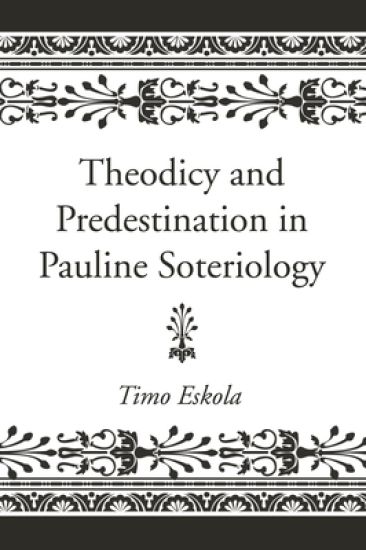
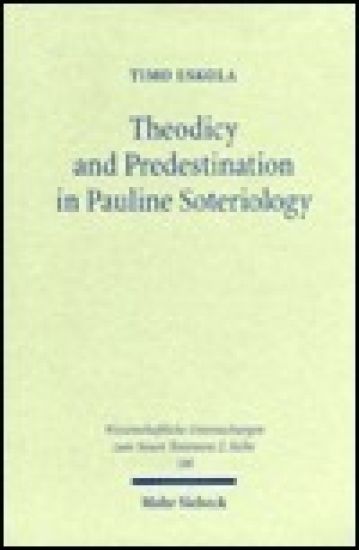
Theodicy and Predestination in Pauline Soteriology
Timo Eskola presents a new way of understanding Paul's soteriology as a theology of predestination: God has cosigned all people to sin and condemnation. There is no basic dualism between the good and the bad. Since everybody needs salvation, the atonement of Christ is proof of God's ultimate faithfulness. Timo Eskola is Privatdozent of New Testament in the Faculty of Theology at the University of Helsinki, and a doctoral candidate in comparative literature at the University of Helsinki. He is the author of Theodicy and Predestination in Pauline Soteriology (1998) and Messiah and the Throne (2001).
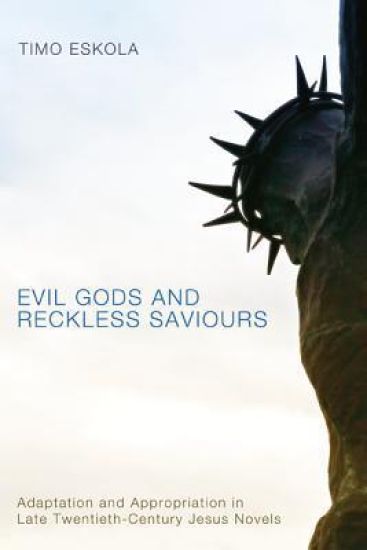
Evil Gods and Reckless Saviours

Evil Gods and Reckless Saviours

Timo Eskola

Wipf Stock Publishers
2011
muu
Late twentieth-century Jesus novels carve out a completely new picture of Jesus. Those written by Norman Mailer, Jose Saramago, Michele Roberts, Marianne Fredriksson, and Ki Longfellow, among others, provide inversive revisions of the canonical Gospels. Their adaptations often turn into a critique of the whole of Christian history. The contrast novels investigated in this study end up with appropriations that are based on prototypical rewriting. They aim at the rehabilitation of Judas, and some of them make Mary Magdalene the key figure of Christianity. Saramago describes God as a bloodthirsty tyrant, and Mailer makes God battle the devil in a ""Manichaen"" sense as with an equal. The main result of this intertextual analysis is that these authors have adopted Nietzschean ideas in their writing. An attack on the so-called biblical slave morality and violent concept of God deprives Jesus of his Jewish messianic identity, makes Old Testament law a contradiction of life, calls sacrificial soteriology a violent paradigm supporting oppression, and presents God as a cruel monster. As a result, Jewish faith appears in a negative light. Apparently, Western culture still harbours anti-Judaic attitudes, albeit hidden beneath sentiments of equality and tolerance. Timo Eskola skillfully shows that despite the evident post-Holocaust consciousness present in the novels, they actually adopt an arrogant and ironic refutation of Jewish beliefs and Old Testament faith. ""Not since Theodore Ziolkowski's Fictional Transfiguration of Jesus have Jesus novels been subjected to such a searching critique. Eskola emphasizes contrasting, revisionist, even atheist fictional gospels centered on Judas, Mary Magdalene, or a human, fallible Jesus. He takes us in the opposite direction of Ziolkowski's heroes and humane moral exemplars towards contemporary fictions that displace Jesus from the center of his own story, or depict him as a deluded victim of a monstrous torturer God."" -Suzanne Keen Thomas Broadus Professor of English Washington and Lee University ""Timo Eskola provides a provocative examination of contemporary Jesus novels, arguing that they not only reinterpret but also frequently pervert traditional notions of Jesus. He marshals an impressive knowledge of literary adaptations of the Gospels, present-day literary theories, and theology. His insightful analysis of the Nietzschean roots of Jesus novels as well as their submerged anti-Judaism will invite discussion and debate about the nature of God and faith."" -Heta Pyrhonen Associate Professor University of Helsinki Timo Eskola is Privatdozent of New Testament in the Faculty of Theology at the University of Helsinki, and a doctoral candidate in comparative literature at University of Helsinki. He is the author of Theodicy and Predestination in Pauline Soteriology (1998) and Messiah and the Throne (2001).

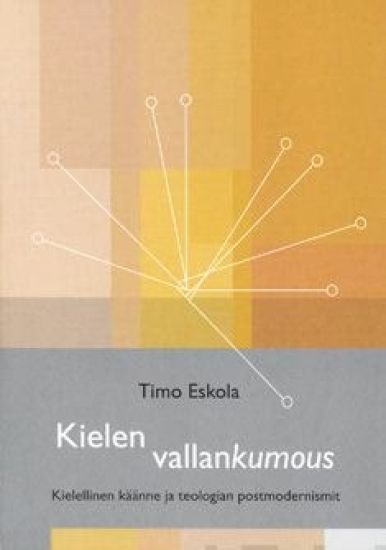
Kielen vallankumous

Kielen vallankumous

Timo Eskola

Suomalainen teologinen kirjallisuusseura
2009
nidottu
Kulttuurissa ja jopa tieteissä kaikki näyttää muuttuneen puhetavoiksi. Kirkossa ja teologiassa keskustellaan siitä, miten erilaiset diskurssit kiistelevät toistensa kanssa. Jotkut purkavat patriarkalismia kaikkialla, missä sellaista näkevät. Pitäisikö Jumalaa kutsua äidiksi? Onko sukupuoli pelkkä diskurssi, eräänlainen mielipide? Tuleeko kirkon toiminta tulkita valtapeliksi erilaisten kielenkäyttöjen välillä? Tavoittaako kieli todellisuutta - tai totuutta? Eskolan kirja selittää muutoksen taustoja 1960-luvun Pariisista aina Yhdysvaltojen laajaan jälkistrukturalismiin. Joku linjoista omaksuu merkityksen täydellisen hävittämisen ja ajautuu suorastaan Jumalan kuoleman teologiaan. Toiset taas nostavat esille teologian uudet mahdollisuudet irtautua historismista ja sekularisoituneesta ideologiasta. Teologia hakee tällöin omaa ääntään uudella tavalla. Pelastaako kielen vallankumous teologian vai johdattaako se sen vain negaatioihin ja merkityksen loittonemisen yöhön?