Kirjojen hintavertailu. Mukana 12 390 323 kirjaa ja 12 kauppaa.

Kirjailija

Timo Särkkä

Kirjat ja teokset yhdessä paikassa: 3 kirjaa, julkaisuja vuosilta 2020-2025, suosituimpien joukossa Paper and the British Empire. Vertaile teosten hintoja ja tarkista saatavuus suomalaisista kirjakaupoista.

3 kirjaa

Kirjojen julkaisuhaarukka 2020-2025.

Mining and Financial Imperialism

Mining and Financial Imperialism

Timo Särkkä

TAYLOR FRANCIS LTD
2025
sidottu
Mining finance houses were substantial public corporations with access to money markets in the City of London, the world’s leading capital market for mining. These institutions became dominant at the inception of colonial rule and, in varying forms, remained so throughout the twentieth century.Drawing on a rich corpus of primary sources, this book analyses the Western colonial origins of the mining industry and its post-colonial legacies in the Central African Copperbelt. It provides insights into the operations of the global business of mining: in particular, how these processes took place, why they were considered desirable by various interest groups, and the impact that these processes continue to have on physical and human environments in parts of the world where they took place. It also turns its gaze to the City of London looking at who the financiers were and the nature of the power which they wielded. A long-term perspective on mining finance reveals that thus far the colonial governments have been the main focus in the history of imperialism in Central Africa, with little focus in many instances on the mining finance houses which have outlived them.The book is a significant contribution to the economic, financial and business history of mining and extractive industries, Central Africa, the City of London and early forms of financial capitalism.
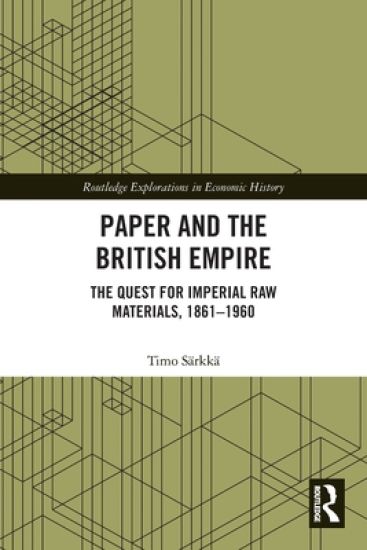
Paper and the British Empire

Paper and the British Empire

Timo Särkkä

TAYLOR FRANCIS LTD
2022
nidottu
Paper and the British Empire examines the evolution of the paper industry within British organisational frameworks and highlights the role of the Empire as a market and business-making area in a world of shrinking commerce and rising trade barriers.Drawing on a valuable range of primary sources, this book covers the period 1861–1960 and examines events from the establishment of free trade backed by the gold standard to Britain’s membership of the European Free Trade Association. In the field of the paper industry, the speed and intensity of the industrialisation process around the globe have been shaped by a wide variety of variables, including the surrounding institutional framework; entrepreneurial and organisational strategies; the cost and accessibility of transport; and the availability of capital, knowledge, energy resources, and technology. The supply of papermaking raw materials has also been key and has historically been the most important determinant for geographical location and dominance. The research in this work focuses on the roles played by such variants, on the one hand, and demand characteristics on the other. In particular, it considers developments connected to a quest for Empire-grown raw materials in order to tackle the problem of the lack of indigenous raw materials and the resulting dependence on Scandinavian wood pulp imports.This text is of considerable interest to advanced students and researchers in economic history, business history, and the paper industry, and will also be useful to organisations working within the pulp and paper industries.
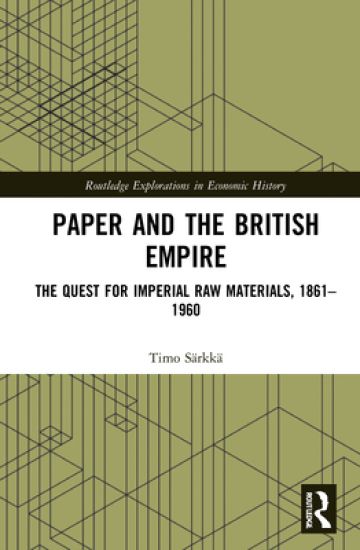
Paper and the British Empire

Paper and the British Empire

Timo Särkkä

Routledge
2020
sidottu
Paper and the British Empire examines the evolution of the paper industry within British organisational frameworks and highlights the role of the Empire as a market and business-making area in a world of shrinking commerce and rising trade barriers.Drawing on a valuable range of primary sources, this book covers the period 1861–1960 and examines events from the establishment of free trade backed by the gold standard to Britain’s membership of the European Free Trade Association. In the field of the paper industry, the speed and intensity of the industrialisation process around the globe have been shaped by a wide variety of variables, including the surrounding institutional framework; entrepreneurial and organisational strategies; the cost and accessibility of transport; and the availability of capital, knowledge, energy resources, and technology. The supply of papermaking raw materials has also been key and has historically been the most important determinant for geographical location and dominance. The research in this work focuses on the roles played by such variants, on the one hand, and demand characteristics on the other. In particular, it considers developments connected to a quest for Empire-grown raw materials in order to tackle the problem of the lack of indigenous raw materials and the resulting dependence on Scandinavian wood pulp imports.This text is of considerable interest to advanced students and researchers in economic history, business history, and the paper industry, and will also be useful to organisations working within the pulp and paper industries.