
Kirjailija
Timothy Campbell
Kirjat ja teokset yhdessä paikassa: 9 kirjaa, julkaisuja vuosilta 2006-2026, suosituimpien joukossa Body By Design. Vertaile teosten hintoja ja tarkista saatavuus suomalaisista kirjakaupoista.
9 kirjaa
Kirjojen julkaisuhaarukka 2006-2026.

Weavings
Wava & Roger Campbell; Timothy Campbell; Cheryl Campbell Powell
Trilogy Christian Publishing
2020
pokkari
Who among us has not found "tidings of comfort and joy" in the Psalms or the timeless lyrics of our favorite hymns, carols, and choruses? And yet, we often forget that the heartbeat of every hymn is a poem; the soul of each psalm is a poem.Poetry's power to inspire, challenge, and encourage people flows through the pens of the Campbell family and the pages of their collection, Weavings - Some Times It Takes a Poem.Rediscover this power for yourself in their Rhymes for Great Reasons and All of Life's Seasons.And may the Lord put gladness in your heart (Psalm 4:7).


Everywhere You Go There's a Zacchaeus Up a Tree – Small–Town Faith and Words of Wisdom from Roger Campbell's Newspaper Columns
Roger Campbell; Timothy Campbell
Kregel Publications,U.S.
2017
nidottu
The wholesome, winsome wit and wisdom of columnist Roger Campbell Every week for nearly forty years, Roger Campbell took up his pen to craft a newspaper column that would make a difference in the lives of his readers. His tales of fishing, family, friends, and fun helped them to trade their fears for faith, their sorrows for songs, and their doubts for certainties. Everywhere You Go There's a Zacchaeus Up a Tree is an anthology edited by his son, drawn from these weekly columns. Based on Roger's experiences in the world at large, the pastorate, his community, and his family, these brief but wise essays are enriching, instructive, and gently challenging. Roger's habit of humbly talking with people from all walks of life wherever he went provided ample opportunity to impact generations of folks. His warm words still bear witness to the truth that God meets us where we are and uses us when we are willing. Always starting with a Scripture reference, these short entries can be read as a daily or weekly devotion. For those longing for a simpler time and the flavor of small-town life, Everywhere You Go There's a Zacchaeus Up a Tree shares a deep, abiding, homespun faith that knows, as Campbell wrote, that "God loves you no matter which way the wind blows."

Organizational Behaviour
Timothy Campbell; Timothy Judge; Stephen Robbins
Pearson Education Limited
2017
pokkari
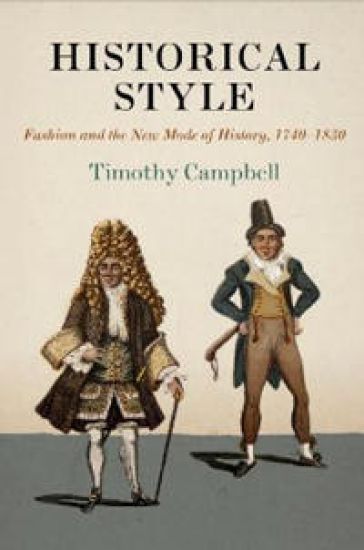
Historical Style connects the birth of eighteenth-century British consumer society to the rise of historical self-consciousness. Prior to the eighteenth century, British style was slow to change and followed the cultural and economic imperatives of monarchical regimes. By the 1750s, however, a growing fashion press extolled, in writing and illustration, the new phenomenon of periodized fashion trends. As fashion fads came in and out of style, and as fashion texts circulated and obsolesced, Britons were forced to confront the material persistence of out-of-date fashions. Timothy Campbell argues that these fashion texts and objects shaped British perception of time and history by producing new curiosity about the very recent past, as well as a new self-consciousness about the means by which the past could be understood. In a panoptic sweep, Historical Style brings together art history, philosophy, and literary history to portray an era increasingly aware of itself. Burgeoning consumer society, Campbell contends, highlighted the distinction between the past and the present, created an expectation of continual change, and forged a sense of history as something that could be tracked through material objects. Campbell assembles a wide range of writings, images, and objects to render this eighteenth-century landscape: commercial dress displays and David Hume's ideas of novelty as historical form; popular illustrations of recent fashion trends and Sir Joshua Reynolds's aesthetic precepts; fashion periodicals and Sir Walter Scott's costume-saturated historical fiction. In foregrounding fashion to trace eighteenth-century historicism, Historical Style draws upon the interdisciplinary, multimedia archival impressions that fashionable dress has left behind, as well as the historical and conceptual resources within the field of fashion studies that literary and cultural historians of eighteenth-century and Romantic Britain have often neglected.


This book correlates Italian and European modernism with early wireless technology. Wireless technology has become deeply embedded in everyday life, but its impact cannot be fully understood without probing the contributions of the Italian inventor Guglielmo Marconi (1874-1937), who ushered in the beginning of wireless communication. Marconi produced and detected sound waves over long distances, using the curvature of the earth for direction, and laid the foundations for what we know as radio - the original mobile, voice-activated, and electronic media community. Timothy C. Campbell demonstrates that Marconi's invention of the wireless telegraph was not simply a technological act but also had an impact on poetry and aesthetics and linked the written word to the rise of mass politics. Reading influential works such as F. T. Marinetti's futurist manifestos, Rudolf Arnheim's 1936 study "Radio", writings by Gabriele D'Annunzio, and Ezra Pound's "Cantos", Campbell reveals how the newness of wireless technology was inscribed in the ways modernist authors engaged with typographical experimentation, apocalyptic tones, and newly minted models for registering voices. "Wireless Writing in the Age of Marconi" presents an alternative history of modernism that listens as well as looks and bears in mind the altered media environment brought about by the emergence of the wireless.

Wireless technology has become deeply embedded in everyday life, but its impact cannot be fully understood without probing the contributions of the Italian inventor Guglielmo Marconi (1874-1937), who ushered in the beginning of wireless communication. Marconi produced and detected sound waves over long distances, using the curvature of the earth for direction, and laid the foundations for what we know as radio-the original mobile, voice-activated, and electronic media community. Timothy C. Campbell demonstrates that Marconi’s invention of the wireless telegraph was not simply a technological act but also had an impact on poetry and aesthetics and linked the written word to the rise of mass politics. Reading influential works such as F. T. Marinetti’s futurist manifestos, Rudolf Arnheim’s 1936 study Radio, writings by Gabriele D’Annunzio, and Ezra Pound’s Cantos, Campbell reveals how the newness of wireless technology was inscribed in the ways modernist authors engaged with typographical experimentation, apocalyptic tones, and newly minted models for registering voices. Wireless Writing in the Age of Marconi presents an alternative history of modernism that listens as well as looks and bears in mind the altered media environment brought about by the emergence of the wireless. Timothy C. Campbell is associate professor of Italian at Cornell University.