Kirjojen hintavertailu. Mukana 12 390 323 kirjaa ja 12 kauppaa.

Kirjailija

Timothy F. H. Allen

Kirjat ja teokset yhdessä paikassa: 2 kirjaa, julkaisuja vuosilta 1986-2003, suosituimpien joukossa Supply-Side Sustainability. Vertaile teosten hintoja ja tarkista saatavuus suomalaisista kirjakaupoista.

Mukana myös kirjoitusasut: Timothy F.H. Allen

2 kirjaa

Kirjojen julkaisuhaarukka 1986-2003.

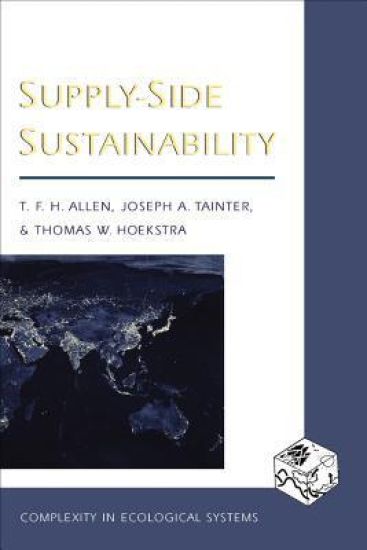
Supply-Side Sustainability

Supply-Side Sustainability

Timothy F. H. Allen; Joseph A. Tainter; Thomas W. Hoekstra

Columbia University Press
2003
pokkari
While environmentalists insist that lower rates of consumption of natural resources are essential for a sustainable future, many economists dismiss the notion that resource limits act to constrain modern, creative societies. The conflict between these views tinges political debate at all levels and hinders our ability to plan for the future. Supply-Side Sustainability offers a fresh approach to this dilemma by integrating ecological and social science approaches in an interdisciplinary treatment of sustainability. Written by two ecologists and an anthropologist, this book discusses organisms, landscapes, populations, communities, biomes, the biosphere, ecosystems and energy flows, as well as patterns of sustainability and collapse in human societies, from hunter-gatherer groups to empires to today's industrial world. These diverse topics are integrated within a new framework that translates the authors' advances in hierarchy and complexity theory into a form useful to professionals in science, government, and business. The result is a much-needed blueprint for a cost-effective management regime, one that makes problem-solving efforts themselves sustainable over time. The authors demonstrate that long-term, cost-effective resource management can be achieved by managing the contexts of productive systems, rather than by managing the commodities that natural systems produce.
A Hierarchical Concept of Ecosystems

A Hierarchical Concept of Ecosystems

Robert V. O'Neill; Donald Lee Deangelis; J. B. Waide; Timothy F.H. Allen

Princeton University Press
1986
pokkari
"Ecosystem" is an intuitively appealing concept to most ecologists, but, in spite of its widespread use, the term remains diffuse and ambiguous. The authors of this book argue that previous attempts to define the concept have been derived from particular viewpoints to the exclusion of others equally possible. They offer instead a more general line of thought based on hierarchy theory. Their contribution should help to counteract the present separation of subdisciplines in ecology and to bring functional and population/community ecologists closer to a common approach. Developed as a way of understanding highly complex organized systems, hierarchy theory has at its center the idea that organization results from differences in process rates. To the authors the theory suggests an objective way of decomposing ecosystems into their component parts. The results thus obtained offer a rewarding method for integrating various schools of ecology.