Kirjojen hintavertailu. Mukana 12 528 295 kirjaa ja 12 kauppaa.

Kirjailija

Timothy G. Mattson

Kirjat ja teokset yhdessä paikassa: 4 kirjaa, julkaisuja vuosilta 2009-2023, suosituimpien joukossa The OpenMP Common Core. Vertaile teosten hintoja ja tarkista saatavuus suomalaisista kirjakaupoista.

4 kirjaa

Kirjojen julkaisuhaarukka 2009-2023.

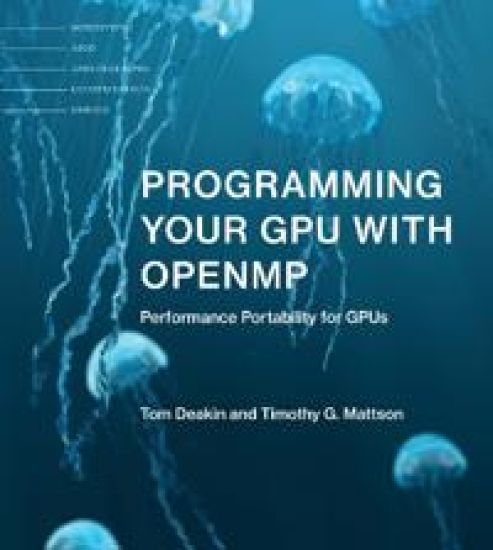
Programming Your GPU with OpenMP

Programming Your GPU with OpenMP

Tom Deakin; Timothy G. Mattson

MIT PRESS LTD
2023
nidottu
The essential guide for writing portable, parallel programs for GPUs using the OpenMP programming model. Today's computers are complex, multi-architecture systems: multiple cores in a shared address space, graphics processing units (GPUs), and specialized accelerators. To get the most from these systems, programs must use all these different processors. In Programming Your GPU with OpenMP, Tom Deakin and Timothy Mattson help everyone, from beginners to advanced programmers, learn how to use OpenMP to program a GPU using just a few directives and runtime functions. Then programmers can go further to maximize performance by using CPUs and GPUs in parallel--true heterogeneous programming. And since OpenMP is a portable API, the programs will run on almost any system. Programming Your GPU with OpenMP shares best practices for writing performance portable programs. Key features include: The most up-to-date APIs for programming GPUs with OpenMP with concepts that transfer to other approaches for GPU programming.Written in a tutorial style that embraces active learning, so that readers can make immediate use of what they learn via provided source code.Builds the OpenMP GPU Common Core to get programmers to serious production-level GPU programming as fast as possible.Additional features: A reference guide at the end of the book covering all relevant parts of OpenMP 5.2.An online repository containing source code for the example programs from the book--provided in all languages currently supported by OpenMP: C, C++, and Fortran.Tutorial videos and lecture slides.
The OpenMP Common Core

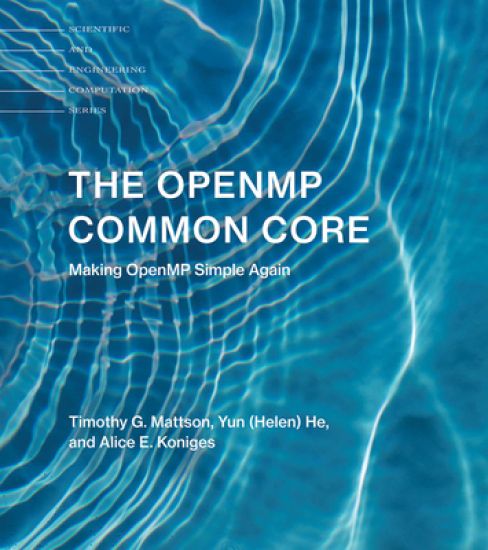
The OpenMP Common Core

Timothy G. Mattson; Yun (Helen) He; Alice E. Koniges

MIT Press
2019
pokkari
How to become a parallel programmer by learning the twenty-one essential components of OpenMP.This book guides readers through the most essential elements of OpenMP-the twenty-one components that most OpenMP programmers use most of the time, known collectively as the "OpenMP Common Core." Once they have mastered these components, readers with no prior experience writing parallel code will be effective parallel programmers, ready to take on more complex aspects of OpenMP. The authors, drawing on twenty years of experience in teaching OpenMP, introduce material in discrete chunks ordered to support effective learning. OpenMP was created in 1997 to make it as simple as possible for applications programmers to write parallel code; since then, it has grown into a huge and complex system. The OpenMP Common Core goes back to basics, capturing the inherent simplicity of OpenMP. After introducing the fundamental concepts of parallel computing and history of OpenMP's development, the book covers topics including the core design pattern of parallel computing, the parallel and worksharing-loop constructs, the OpenMP data environment, and tasks. Two chapters on the OpenMP memory model are uniquely valuable for their pedagogic approach. The key for readers is to work through the material, use an OpenMP-enabled compiler, and write programs to experiment with each OpenMP directive or API routine as it is introduced. The book's website, updated continuously, offers a wide assortment of programs and exercises.
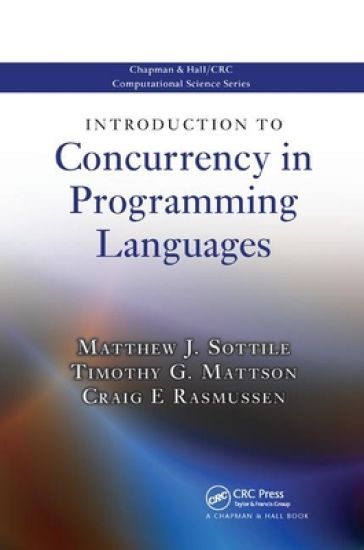
Introduction to Concurrency in Programming Languages

Introduction to Concurrency in Programming Languages

Matthew J. Sottile; Timothy G. Mattson; Craig E Rasmussen

CRC Press
2019
nidottu
Exploring how concurrent programming can be assisted by language-level techniques, Introduction to Concurrency in Programming Languages presents high-level language techniques for dealing with concurrency in a general context. It provides an understanding of programming languages that offer concurrency features as part of the language definition.The book supplies a conceptual framework for different aspects of parallel algorithm design and implementation. It first addresses the limitations of traditional programming techniques and models when dealing with concurrency. The book then explores the current state of the art in concurrent programming and describes high-level language constructs for concurrency. It also discusses the historical evolution of hardware, corresponding high-level techniques that were developed, and the connection to modern systems, such as multicore and manycore processors. The remainder of the text focuses on common high-level programming techniques and their application to a range of algorithms. The authors offer case studies on genetic algorithms, fractal generation, cellular automata, game logic for solving Sudoku puzzles, pipelined algorithms, and more. Illustrating the effect of concurrency on programs written in familiar languages, this text focuses on novel language abstractions that truly bring concurrency into the language and aid analysis and compilation tools in generating efficient, correct programs. It also explains the complexity involved in taking advantage of concurrency with regard to program correctness and performance.
Introduction to Concurrency in Programming Languages

Introduction to Concurrency in Programming Languages

Matthew J. Sottile; Timothy G. Mattson; Craig E Rasmussen

Chapman Hall/CRC
2009
sidottu
Exploring how concurrent programming can be assisted by language-level techniques, Introduction to Concurrency in Programming Languages presents high-level language techniques for dealing with concurrency in a general context. It provides an understanding of programming languages that offer concurrency features as part of the language definition.The book supplies a conceptual framework for different aspects of parallel algorithm design and implementation. It first addresses the limitations of traditional programming techniques and models when dealing with concurrency. The book then explores the current state of the art in concurrent programming and describes high-level language constructs for concurrency. It also discusses the historical evolution of hardware, corresponding high-level techniques that were developed, and the connection to modern systems, such as multicore and manycore processors. The remainder of the text focuses on common high-level programming techniques and their application to a range of algorithms. The authors offer case studies on genetic algorithms, fractal generation, cellular automata, game logic for solving Sudoku puzzles, pipelined algorithms, and more. Illustrating the effect of concurrency on programs written in familiar languages, this text focuses on novel language abstractions that truly bring concurrency into the language and aid analysis and compilation tools in generating efficient, correct programs. It also explains the complexity involved in taking advantage of concurrency with regard to program correctness and performance.