Kirjojen hintavertailu. Mukana 12 595 353 kirjaa ja 12 kauppaa.

Kirjailija

Timothy J. Colton

Kirjat ja teokset yhdessä paikassa: 7 kirjaa, julkaisuja vuosilta 1979-2016, suosituimpien joukossa Moscow. Vertaile teosten hintoja ja tarkista saatavuus suomalaisista kirjakaupoista.

Mukana myös kirjoitusasut: Timothy J Colton

7 kirjaa

Kirjojen julkaisuhaarukka 1979-2016.

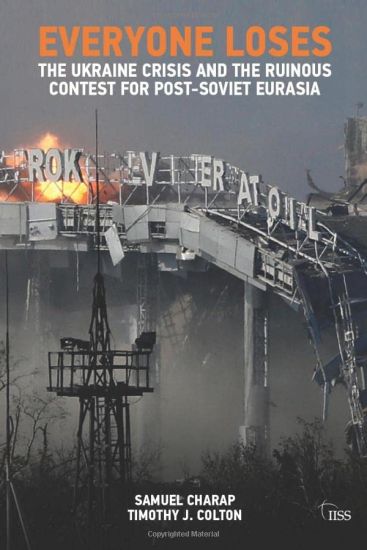
Everyone Loses

Everyone Loses

Samuel Charap; Timothy J. Colton

Routledge
2016
nidottu
Disorder erupted in Ukraine in 2014, involving the overthrow of a sitting government, the Russian annexation of the Crimean peninsula, and a violent insurrection, supported by Moscow, in the east of the country.This Adelphi book argues that the crisis has yielded a ruinous outcome, in which all the parties are worse off and international security has deteriorated. This negative-sum scenario resulted from years of zero-sum behaviour on the part of Russia and the West in post-Soviet Eurasia, which the authors rigorously analyse. The rivalry was manageable in the early period after the Cold War, only to become entrenched and bitter a decade later. The upshot has been systematic losses for Russia, the West and the countries caught in between.All the governments involved must recognise that long-standing policies aimed at achieving one-sided advantage have reached a dead end, Charap and Colton argue, and commit to finding mutually acceptable alternatives through patient negotiation.
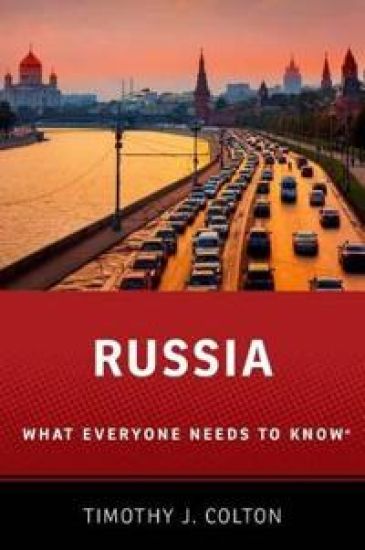
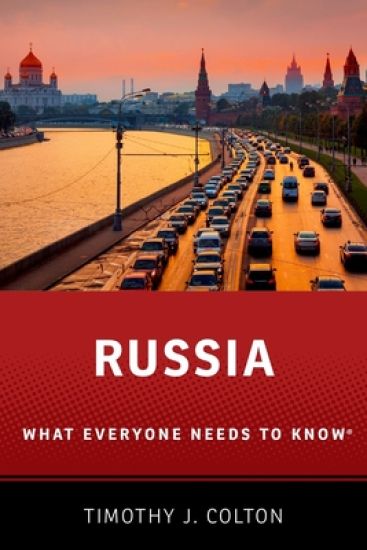
Russia

Russia

Timothy J. Colton

Oxford University Press Inc
2016
nidottu
Today's Russia, also known as the Russian Federation, is often viewed as less powerful than the Soviet Union of the past. When stacked against other major nations in the present, however, the new Russia is a formidable if flawed player. Russia: What Everyone Needs to Know® provides fundamental information about the origins, evolution, and current affairs of the Russian state and society. The story begins with Russia's geographic endowment, proceeds through its experiences as a kingdom and empire, and continues through the USSR's three-quarters of a century, and finally the shocking breakup of that regime a generation ago. Chapters on the failed attempt to reform Communism under Mikhail Gorbachev, the halting steps toward democratization under Boris Yeltsin, and the entrenchment of central controls under Vladimir Putin bring the reader into the contemporary scene and to headline-grabbing events such as Russia's annexation of the Crimean Peninsula from Ukraine and its military intervention in Syria. Drawing on trends within Russia and on ratings and rankings compiled by international organizations, Colton discusses the challenges facing the country--ranging from economic recession to demographic stress, political stagnation, and overextension in foreign policy--and to the realistic options for coping with them. The book shows that, although Russia is not imprisoned by its history, it is heavily influenced by it. Colton illustrates Russia's greatest strength and, ironically, its greatest weakness: the ability of its people to adapt themselves to difficult circumstances beyond their immediate control. Russia, as Putin has asserted, will not soon be a second edition of the United States or Britain. But, Colton shows, there are ways in which it could become a better version of itself.
Russia

Russia

Timothy J. Colton

Oxford University Press Inc
2016
sidottu
Today's Russia, also known as the Russian Federation, is often viewed as less powerful than the Soviet Union of the past. When stacked against other major nations in the present, however, the new Russia is a formidable if flawed player. Russia: What Everyone Needs to Know® provides fundamental information about the origins, evolution, and current affairs of the Russian state and society. The story begins with Russia's geographic endowment, proceeds through its experiences as a kingdom and empire, and continues through the USSR's three-quarters of a century, and finally the shocking breakup of that regime a generation ago. Chapters on the failed attempt to reform Communism under Mikhail Gorbachev, the halting steps toward democratization under Boris Yeltsin, and the entrenchment of central controls under Vladimir Putin bring the reader into the contemporary scene and to headline-grabbing events such as Russia's annexation of the Crimean Peninsula from Ukraine and its military intervention in Syria. Drawing on trends within Russia and on ratings and rankings compiled by international organizations, Colton discusses the challenges facing the country--ranging from economic recession to demographic stress, political stagnation, and overextension in foreign policy--and to the realistic options for coping with them. The book shows that, although Russia is not imprisoned by its history, it is heavily influenced by it. Colton illustrates Russia's greatest strength and, ironically, its greatest weakness: the ability of its people to adapt themselves to difficult circumstances beyond their immediate control. Russia, as Putin has asserted, will not soon be a second edition of the United States or Britain. But, Colton shows, there are ways in which it could become a better version of itself.
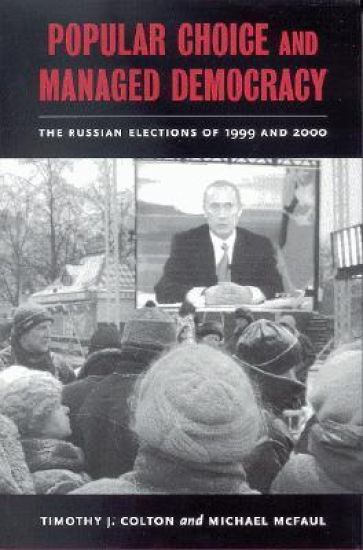
Popular Choice and Managed Democracy

Popular Choice and Managed Democracy

Timothy J. Colton; Michael McFaul

Brookings Institution
2003
nidottu
"Twice in the winter of 1999-2000, citizens of the Russian Federation flocked to their neighborhood voting stations and scratched their ballots in an atmosphere of uncertainty, rancor, and fear. This book is a tale of these two elections—one for the 450-seat Duma, the other for President. Despite financial crisis, a national security emergency in Chechnya, and cabinet instability, Russian voters unexpectedly supported the status quo. The elected lawmakers prepared to cooperate with the executive branch, a gift that had eluded President Boris Yeltsin since he imposed a post-Soviet constitution by referendum in 1993. When Yeltsin retired six months in advance of schedule, the presidential mantle went to Vladimir Putin—a career KGB officer who fused new and old ways of doing politics. Putin was easily elected President in his own right. This book demonstrates key trends in an extinct superpower, a troubled country in whose stability, modernization, and openness to the international community the West still has a huge stake."
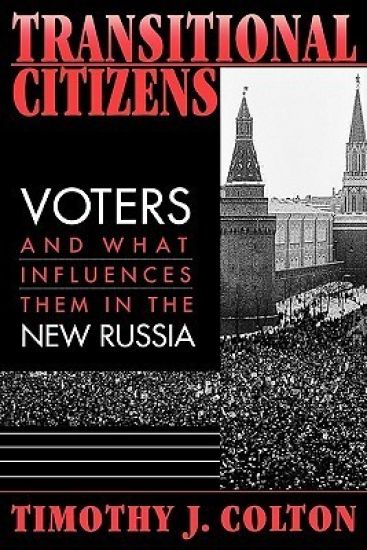
Transitional Citizens

Transitional Citizens

Timothy J. Colton

Harvard University Press
2000
nidottu
Subjects obey. Citizens choose. Transitional Citizens looks at the newly empowered citizens of Russia's protodemocracy facing choices at the ballot box that just a few years ago, under dictatorial rule, they could not have dreamt of.The stakes in post-Soviet elections are extraordinary. While in the West politicians argue over refinements to social systems in basically good working order, in the Russian Federation they address graver concerns--dysfunctional institutions, individual freedom, nationhood, property rights, provision of the basic necessities of life in an unparalleled economic downswing. The idiom of Russian campaigns is that of apocalypse and mutual demonization. This might give an impression of political chaos. However, as Timothy Colton finds, voting in transitional Russia is highly patterned. Despite their unfamiliarity with democracy, subjects-turned-citizens learn about their electoral options from peers and the mass media and make choices that manifest a purposiveness that will surprise many readers.Colton reveals that post-Communist voting is not driven by a single explanatory factor such as ethnicity, charismatic leadership, or financial concerns, but rather by multiple causes interacting in complex ways. He gives us the most sophisticated and insightful account yet of the citizens of the new Russia.
Moscow

Moscow

Timothy J Colton

Harvard University Press
1995
sidottu
Once the hub of the tsarist state, later Brezhnev's "model Communist city"--home of the Kremlin, Red Square, and St. Basil's Cathedral--Moscow is for many the quintessence of everything Russian. Timothy Colton's sweeping biography of this city at the center of Soviet life reveals what such a position has meant to Moscow and ultimately to Russia itself. Linchpin of the Soviet system and exemplar of its ideology, Moscow was nonetheless instrumental in the Soviet Union's demise. It was in this metropolis of nine million people that Boris Yeltsin, during two frustrating years as the city's party boss, began his move away from Communist orthodoxy. Colton charts the general course of events that led to this move, tracing the political and social developments that have given the city its modern character. He shows how the monolith of Soviet power broke down in the process of metropolitan governance, where the constraints of censorship and party oversight could not keep up with proliferating points of view, haphazard integration, and recurrent deviation from approved rules and goals. Everything that goes into making a city--from town planning, housing, and retail services to environmental and architectural concerns--figures in Colton's account of what makes Moscow unique. He shows us how these aspects of the city's organization, and the actions of leaders and elite groups within them, coordinated or conflicted with the overall power structure and policy imperatives of the Soviet Union. Against this background, Colton explores the growth of the anti-Communist revolution in Moscow politics, as well as fledgling attempts to establish democratic institutions and a market economy. As it answers persistent questions about Soviet political history, this lavishly illustrated volume may also point the way to understanding Russia's future.
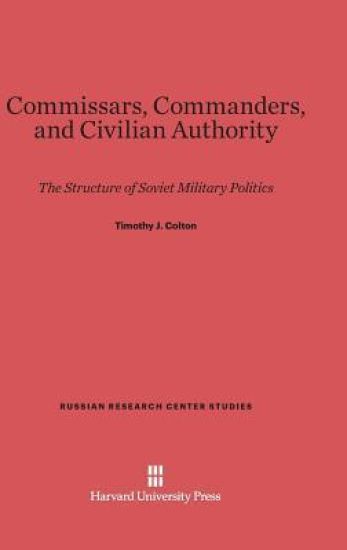
Commissars, Commanders, and Civilian Authority

Commissars, Commanders, and Civilian Authority

Timothy J Colton

Harvard University Press
1979
sidottu
For six decade the Soviet system has been immune to military rebellion and takeover, which often characterizes modernizing countries. How can we explain the stability of Soviet military politics, asks Timothy Colton in his compelling interpretation of civil-military relations in the Soviet Union. Hitherto most western scholars have posited a basic dichotomy of interests between the Soviet army and the Communist party. They view the two institutions as conflictprone, with civilian supremacy depending primarily upon the party's control of officers through its organs within the military establishment. Colton challenges this thesis and argues that the military party organs have come to possess few of the attributes of an effective controlling device, and that the commissars and their heirs have operated as allies rather than adversaries of the military commanders. In explaining the extraordinary stability in army-party relations in terms of overlapping interests rather than controlling mechanisms, Colton offers a major case study and a new model to students of comparative military politics.