Kirjojen hintavertailu. Mukana 12 326 391 kirjaa ja 12 kauppaa.
Kirjailija
Timothy W. Richardson
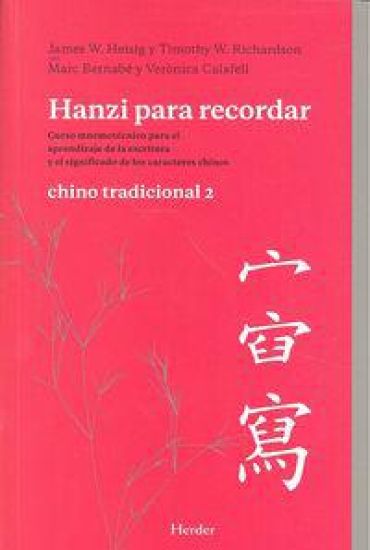
Kirjat ja teokset yhdessä paikassa: 9 kirjaa, julkaisuja vuosilta 2008-2023, suosituimpien joukossa Hanzi para recordar. Chino tradicional 2. Vertaile teosten hintoja ja tarkista saatavuus suomalaisista kirjakaupoista.
Dieser zweite Teil von "Vereinfachte Hanzi lernen und behalten" bringt Bedeutung und Schreibweise weiterer 1500 der haufigsten 3000 chinesischen Schriftzeichen. Die seit Jahrzehnten bewahrte, revolutionare Methode von James W. Heisig fuhrt behutsam in die phantasievolle Welt des bildhaften Gedachtnisses ein, erschliesst das Reich der Schriftzeichen anhand kleiner Erzahlungen und mnemotechnischer Elemente, die nicht mehr auswendig gelernt, sondern nur neu verknupft werden. Diese Methode ist keine Krucke, sondern eine andere Art zu laufen: Die ermudenden Wiederholungen und Schreibubungen entfallen. So ist es nicht nur moglich, die chinesischen Schriftzeichen zu lernen, sondern sie auch nachhaltig ins Gedachtnis zu brennen.
Nach dem grossen Erfolg der Bucher von James W. Heisig und Robert Rauther zu den japanischen Kanji eroffnet dieser Band eine Reihe von Banden zum Erlernen und Behalten der chinesischen Schriftzeichen, der Hanzi. Die seit Jahrzehnten bewahrte, revolutionare Methode von James W. Heisig fuhrt behutsam in die phantasievolle Welt des bildhaften Gedachtnisses ein, erschliesst das Reich der Schriftzeichen anhand kleiner Erzahlungen und mnemotechnischer Elemente, die nicht mehr auswendig gelernt, sondern nur neu verknupft werden. Diese Methode ist keine Krucke, sondern eine andere Art zu laufen: Die ermudenden Wiederholungen und Schreibubungen entfallen. So ist es nicht nur moglich, die chinesischen Schriftzeichen zu lernen, sondern sie auch nachhaltig ins Gedachtnis zu brennen.
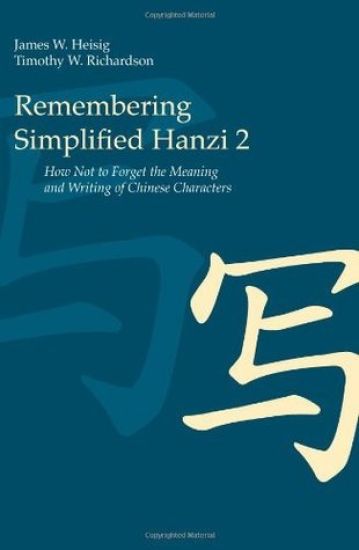
This book is the second of two volumes designed to help students learn the meaning and writing of the 3,000 most frequently used simplified Chinese characters. (A parallel set of volumes has been prepared for traditional characters.) The 1,500 characters introduced in Book 1 include the top 1,000 by frequency, plus another 500 best learned at an early stage. Book 2 adds the remaining 1,500 characters to complete the set.The lessons of Book 2 have been arranged in such a way that they may be studied either after those of Book 1 or simultaneously with them. Students who wish to focus initially on the 1,000 most frequently used characters in the language can do so by studying Book 1 before moving on to Book 2. Many, if not most, learners will find this preferable. Students who wish to apply the logical ordering found in these pages to the entire list of 3,000 characters from the very beginning can take the more exacting, but also more rationally satisfying, approach of studying the parallel lessons of the two volumes together.The lessons in this book are followed by two short, additional sections, one that introduces a number of “compounds,” or characters that are best learned in pairs, and another that adds two “postscripts.” The book also includes a number of comprehensive indexes that are designed to facilitate work with both volumes. Of central importance to the approach found in these pages is the systematic arranging of characters in an order best suited to memory. In the Chinese writing system, strokes and simple components are nested within relatively simple characters. These characters, in turn, can serve as parts of more complicated characters, and so on. Taking advantage of this allows a logical ordering, making it possible for students to approach most new characters with prior knowledge that can greatly facilitate the learning process.Guidance and detailed instructions are provided all along the way. Students are taught to employ “imaginative memory” to associate each character’s component parts or “primitive elements” with one another and with a key word that has been carefully selected to represent an important meaning of the character. This is accomplished through creation of a “story” that engagingly ties the primitive elements and key word together. In this way, the collections of dots, strokes and components that make up the characters are associated in memorable ways, dramatically shortening the time required for learning and helping prevent characters from slipping out of memory.
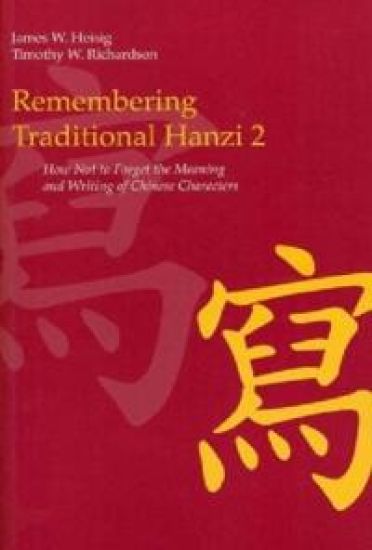
This book is the second of two volumes designed to help students learn the meaning and writing of the 3,000 most frequently used traditional Chinese characters. (A parallel set of volumes has been prepared for simplified characters.) The 1,500 characters introduced in Book 1 include the top 1,000 by frequency, plus another 500 best learned at an early stage. Book 2 adds the remaining 1,500 characters to complete the set.The lessons of Book 2 have been arranged in such a way that they may be studied either after those of Book 1 or simultaneously with them. Students who wish to focus initially on the 1,000 most frequently used characters in the language can do so by studying Book 1 before moving on to Book 2. Many, if not most, learners will find this preferable. Students who wish to apply the logical ordering found in these pages to the entire list of 3,000 characters from the very beginning can take the more exacting, but also more rationally satisfying, approach of studying the parallel lessons of the two volumes together.The lessons in this book are followed by two short, additional sections, one that introduces a number of “compounds,” or characters that are best learned in pairs, and another that adds two “postscripts.” The book also includes a number of comprehensive indexes that are designed to facilitate work with both volumes. Of central importance to the approach found in these pages is the systematic arranging of characters in an order best suited to memory. In the Chinese writing system, strokes and simple components are nested within relatively simple characters. These characters, in turn, can serve as parts of more complicated characters, and so on. Taking advantage of this allows a logical ordering, making it possible for students to approach most new characters with prior knowledge that can greatly facilitate the learning process.Guidance and detailed instructions are provided all along the way. Students are taught to employ “imaginative memory” to associate each character’s component parts or “primitive elements” with one another and with a key word that has been carefully selected to represent an important meaning of the character. This is accomplished through creation of a “story” that engagingly ties the primitive elements and key word together. In this way, the collections of dots, strokes and components that make up the characters are associated in memorable ways, dramatically shortening the time required for learning and helping prevent characters from slipping out of memory.
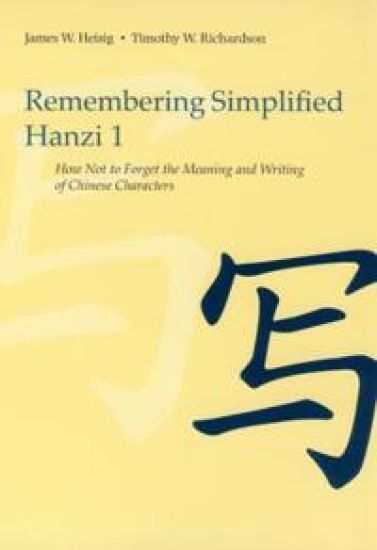
At long last the approach that has helped thousands of learners memorize Japanese kanji has been adapted to help students with Chinese characters. ""Book 1 of Remembering Simplified Hanzi"" covers the writing and meaning of the 1,000 most commonly used characters in the simplified Chinese writing system, plus another 500 that are best learned at an early stage. (Book 2 adds another 1,500 characters for a total of 3,000.) Of critical importance to the approach found in these pages is the systematic arranging of characters in an order best suited to memorization. In the Chinese writing system, strokes and simple components are nested within relatively simple characters, which can, in turn, serve as parts of more complicated characters and so on. Taking advantage of this allows a logical ordering, making it possible for students to approach most new characters with prior knowledge that can greatly facilitate the learning process.Guidance and detailed instructions are provided along the way. Students are taught to employ 'imaginative memory' to associate each character's component parts, or 'primitive elements', with one another and with a key word that has been carefully selected to represent an important meaning of the character. This is accomplished through the creation of a 'story' that engagingly ties the primitive elements and key word together. In this way, the collections of dots, strokes, and components that make up the characters are associated in memorable fashion, dramatically shortening the time required for learning and helping to prevent characters from slipping out of memory.
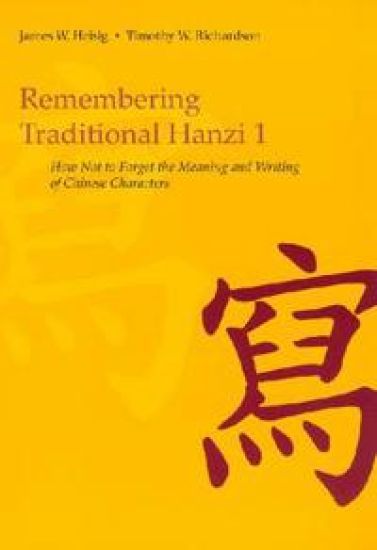
At long last the approach that has helped thousands of learners memorize Japanese kanji has been adapted to help students with Chinese characters. Book 1 of ""Remembering Simplified Hanzi"" and ""Remembering Traditional Hanzi"" covers the writing and meaning of the 1,000 most commonly used characters in the Chinese writing system, plus another 500 that are best learned at an early stage. (Book 2 adds another 1,500 characters for a total of 3,000.) Of critical importance to the approach found in these pages is the systematic arranging of characters in an order best suited to memorization. In the Chinese writing system, strokes and simple components are nested within relatively simple characters, which can, in turn, serve as parts of more complicated characters and so on. Taking advantage of this allows a logical ordering, making it possible for students to approach most new characters with prior knowledge that can greatly facilitate the learning process. Guidance and detailed instructions are provided along the way. Students are taught to employ 'imaginative memory' to associate each character's component parts, or 'primitive elements', with one another and with a key word that has been carefully selected to represent an important meaning of the character. This is accomplished through the creation of a 'story' that engagingly ties the primitive elements and key word together. In this way, the collections of dots, strokes, and components that make up the characters are associated in memorable fashion, dramatically shortening the time required for learning and helping to prevent characters from slipping out of memory.