Kirjojen hintavertailu. Mukana 12 595 353 kirjaa ja 12 kauppaa.

Kirjailija

Todd Kontje

Kirjat ja teokset yhdessä paikassa: 11 kirjaa, julkaisuja vuosilta 1992-2025, suosituimpien joukossa Georg Forster. Vertaile teosten hintoja ja tarkista saatavuus suomalaisista kirjakaupoista.

11 kirjaa

Kirjojen julkaisuhaarukka 1992-2025.

Georg Forster

Georg Forster

Todd Kontje

Pennsylvania State University Press
2022
sidottu
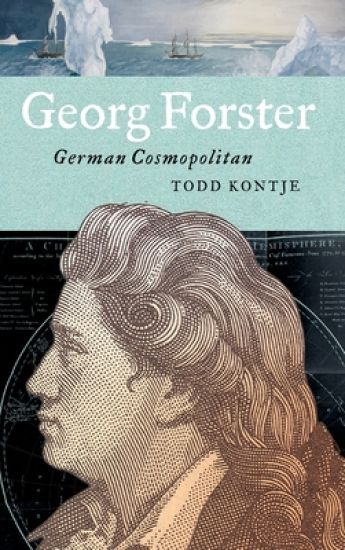
Georg Forster (1754–1794) was famous during his lifetime, notorious after his death, and largely forgotten by the later nineteenth century. Remembered today as the young man who sailed around the world with Captain Cook and as one of the leading figures in the revolutionary Republic of Mainz, Forster was also a prolific writer and translator who left behind two travelogues, a series of essays on diverse topics, and numerous letters. This in-depth look at Forster’s work and life reveals his importance for other writers of the age. Todd Kontje traces the major intellectual themes and challenges found in Forster’s writings, interweaving close textual analysis with his rich but short life. Each chapter engages with themes that reflect the current debates in eighteenth-century literary and cultural studies, including changing notions of authorship, multilingualism, the representation of so-called primitive societies, Enlightenment ideas about race, and early forms of ecological thinking. As Kontje shows, Forster’s peripatetic life, malleable sense of national identity, and fluency in multiple languages contrast with the image of the solitary genius in the “age of Goethe.” In this way, Forster provides a different model of authorship and citizenship better understood in the context of an increasingly globalized world.Compellingly argued and engagingly written, this book restores Forster to his rightful place within the German literary tradition, and in so doing, it urges us to reconsider the age of Goethe as multilingual and malleable, local and cosmopolitan, dynamic and decentered. It will be welcomed by specialists in German studies and the Enlightenment.
Global Germany Circa 1800

Global Germany Circa 1800

Todd Kontje

Pennsylvania State University Press
2025
sidottu
Global Germany Circa 1800 asks two interrelated questions: How did Germans participate in the European conquest of the world, and how were they different from other imperial powers? In other words, what is the relation between the German form of empire, the old Reich, and the modern European empires that emerged in the global age?In this book, Todd Kontje presents a revisionist literary and intellectual history, inviting readers to consider how we might understand “Germany” at the turn of the nineteenth century if we remove the nation-state as the inevitable goal of cultural and political development. Focusing on the pivotal years around 1800, when many of the concepts that define the modern era first came into being, Kontje investigates how thinkers in and around Weimar—from Goethe, Schiller, and Kant to Georg Forster, Heinrich von Kleist, and Alexander von Humboldt—worked within existing political structures to make sense of the region’s place in the world. Ultimately, he reveals how Weimar, a remote artist hub long thought to exemplify the insularity of a soon-to-be-unified nation, was in fact utterly worldly, and in a manner very different from the political capitals of imperial nation-states like London and Paris.Accessible and entertaining, this literary history is essential reading for German studies students and scholars, and it will appeal to audiences in world history, empire studies, intellectual history, and comparative literature.
Georg Forster

Georg Forster

Todd Kontje

Pennsylvania State University Press
2024
pokkari
Georg Forster (1754–1794) was famous during his lifetime, notorious after his death, and largely forgotten by the later nineteenth century. Remembered today as the young man who sailed around the world with Captain Cook and as one of the leading figures in the revolutionary Republic of Mainz, Forster was also a prolific writer and translator who left behind two travelogues, a series of essays on diverse topics, and numerous letters. This in-depth look at Forster’s work and life reveals his importance for other writers of the age. Todd Kontje traces the major intellectual themes and challenges found in Forster’s writings, interweaving close textual analysis with his rich but short life. Each chapter engages with themes that reflect the current debates in eighteenth-century literary and cultural studies, including changing notions of authorship, multilingualism, the representation of so-called primitive societies, Enlightenment ideas about race, and early forms of ecological thinking. As Kontje shows, Forster’s peripatetic life, malleable sense of national identity, and fluency in multiple languages contrast with the image of the solitary genius in the “age of Goethe.” In this way, Forster provides a different model of authorship and citizenship better understood in the context of an increasingly globalized world.Compellingly argued and engagingly written, this book restores Forster to his rightful place within the German literary tradition, and in so doing, it urges us to reconsider the age of Goethe as multilingual and malleable, local and cosmopolitan, dynamic and decentered. It will be welcomed by specialists in German studies and the Enlightenment.
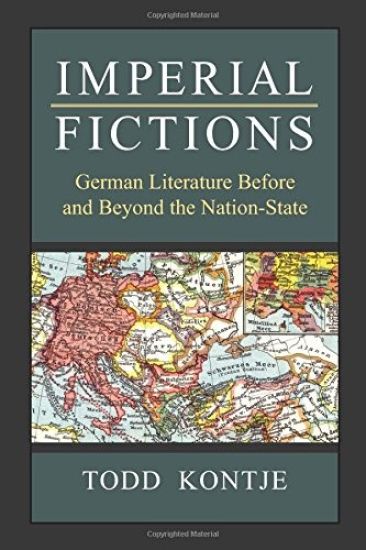
Imperial Fictions

Imperial Fictions

Todd Kontje

The University of Michigan Press
2018
sidottu
Imperial Fictions explores ways in which writers from late antiquity to the present have imagined communities before and beyond the nation-state. It takes as its point of departure challenges to the discrete nation-state posed by globalization, migration, and European integration today, but then circles back to the beginnings of European history after the fall of the Roman Empire. Unlike nationalist literary historians of the nineteenth century, who sought the tribal roots of an allegedly homogeneous people, this study finds a distant mirror of analogous processes today in the fluid mixtures and movements of peoples. Imperial Fictions argues that it is time to stop thinking about today’s multicultural present as a deviation from a culturally monolithic past. We should rather consider the various permutations of “German” identities that have been negotiated within local and imperial contexts from the early Middle Ages to the present.
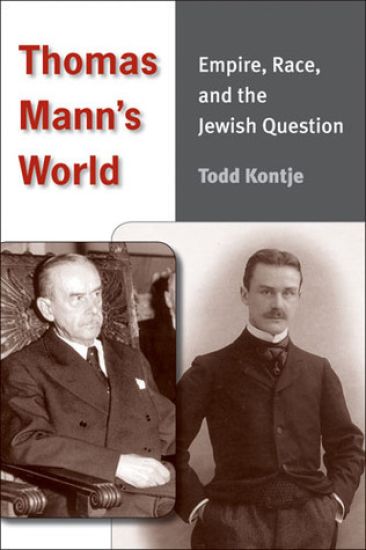
Thomas Mann's World

Thomas Mann's World

Todd Kontje

The University of Michigan Press
2011
sidottu
Praise for Todd Kontje". . . a refreshing example of what literary discourse can teach us about national identity, even historical events and trends---those aspects of a nation's evolving heritage and tradition usually reserved for other disciplines."---Colloquia Germanica"Kontje has pulled off the amazing feat of a grand narrative: from the epic literature of the Middle Ages to very recent texts on the emerging multicultural Germany. Kontje's grand narrative, it should be noted, is not at all simplistic or reductionistic. He gets at the individual texts in complex ways . . . he displays an enviable erudition and scholarship, tracing lines through centuries when most scholars today limit themselves to narrow specialties."---Russell Berman, Stanford UniversityExactly how Thomas Mann's significance registers with the scholarly and general public has been subject to change. For many, Mann retains the aura of the "good German," the Nobel Laureate who was the most vocal leader of the exile community against Hitler and the Third Reich. His diaries, however, contain some rather nasty comments about Mann's many Jewish friends and acquaintances, inspiring a renewed look at the negative Jewish stereotypes in his fiction. The man once venerated as a voice of reason and cosmopolitan tolerance against racist bigotry has been eviscerated as a clandestine anti-Semite.Thomas Mann's World is a comprehensive reevaluation of Mann as the representative German author of the Age of Empire, placing Mann's comments about Jews and the Jewish characters in his fiction in the larger context of his attentiveness to racial difference, both in the world at large and in himself. Kontje argues that Mann is a worldly author---not in the benign sense that he was an eloquent spokesman for a pan-European cosmopolitanism who had witnessed the evils of nationalism gone mad, although he was that, too---but in the sense of a writer whose personal prejudices reflected those of the world around him, a writer whose deeply autobiographical fiction expressed not only the concerns of the German nation, as he liked to claim, but also of the world in an era of imperial conquest and global conflict.Todd Kontje is Professor of German and Comparative Literature and Chair of the German Department at the University of California, San Diego. He is the author of German Orientalisms (University of Michigan Press, 2004).Jacket photographs: Thomas Mann, approximately 1900 and 1955, reproduced with the generous permission of the Buddenbrookhaus, Kulturstiftung Hansestadt Lübeck.
The Cambridge Introduction to Thomas Mann

The Cambridge Introduction to Thomas Mann

Todd Kontje

Cambridge University Press
2010
sidottu
Nobel Prize-winner Thomas Mann (1875–1955) is not only one of the leading German novelists of the twentieth century, but also one of the few to transcend national and language boundaries to achieve major stature in the English-speaking world. Famous from the time that he published his first novel in 1901, Mann became an iconic figure, seen as the living embodiment of German national culture. Leading scholar Todd Kontje provides a succinct introduction to Mann's life and work, discussing key moments in Mann's personal life and his career as a public intellectual, and giving readers a sense of why he is considered such an important - and controversial - writer. At the heart of the book is an informed appreciation of Mann's great literary achievements, including the novel The Magic Mountain and the haunting short story Death in Venice.
The Cambridge Introduction to Thomas Mann

The Cambridge Introduction to Thomas Mann

Todd Kontje

Cambridge University Press
2010
pokkari
Nobel Prize-winner Thomas Mann (1875–1955) is not only one of the leading German novelists of the twentieth century, but also one of the few to transcend national and language boundaries to achieve major stature in the English-speaking world. Famous from the time that he published his first novel in 1901, Mann became an iconic figure, seen as the living embodiment of German national culture. Leading scholar Todd Kontje provides a succinct introduction to Mann's life and work, discussing key moments in Mann's personal life and his career as a public intellectual, and giving readers a sense of why he is considered such an important - and controversial - writer. At the heart of the book is an informed appreciation of Mann's great literary achievements, including the novel The Magic Mountain and the haunting short story Death in Venice.
Women, the Novel, and the German Nation 1771–1871

Women, the Novel, and the German Nation 1771–1871

Todd Kontje

Cambridge University Press
2006
pokkari
In this 1998 book, Todd Kontje surveys novels by German women over the one-hundred-year period that stretches from the beginnings of a German national literature to the founding of its nation-state. Introducing readers to the lives and works of fourteen women writers of the period, he shows the historical and thematic coherence of a body of fiction by women that has been obscured by traditional literary histories. He explores ways in which novels about traditionally feminine domestic concerns also comment on patriarchal politics in the German fatherland. Finally, he argues that we must view the history of the German novel in the context of both the history of sexuality and the rise of German nationalism, and that novels by German women, often marginalized or trivialized, played a central role in shaping attitudes toward class, gender and the nation.
German Orientalisms

German Orientalisms

Todd Kontje

The University of Michigan Press
2004
sidottu
Todd Kontje's German Orientalisms offers a fresh examination of the role of the East in the "Kontje has pulled off the amazing feat of a grand narrative: from the epic literature of the Middle Ages to very recent texts on the emerging multicultural Germany. Kontje's grand narrative, it should be noted, is not at all simplistic or reductionistic. He gets at the individual texts in complex ways, and he can tease out multidimensional features of the German texts' treatments of the 'East.' Nonetheless, he displays an enviable erudition and scholarship, tracing lines through centuries when most scholars today limit themselves to narrow specialties."-Russell Berman, Stanford University"Intellectually rigorous and conceptually nuanced, Todd Kontje's German Orientalisms is a valuable contribution to the debate on identity politics in German cultural history. Through an erudite and insightful analysis of the German fictions of a broadly defined 'Orient' from the Middle Ages to the present, Kontje illustrates how German literature situated itself within a 'symbolic geography,' whose coordinates are defined by both its representations of the Orient and its affiliation with the Occident. German Orientalisms offers not only an admirable synthesis of the scholarship on German linguistic and cultural nationalism but also sophisticated interpretive strategies for a better understanding of our perceptions and misconceptions of alterity."-Azade Seyhan, Bryn Mawr College"This is a fascinating topic, and the book opens new scholarly vistas. In an age of increased specialization, Kontje takes a macro view, looking at German literature almost from its beginnings to the present, from Wolfram to Özdamar. He also has the courage to link his well-researched work to topics like globalization, the culture wars, and canon formation. He doesn't merely proclaim literature's importance, he shows by example how the literary imagination-creative as it is, dodging dogmatism, and able to confound ideologies-can thrive in an era of cultural studies." -Sara Friedrichsmeyer, University of CincinnatiTodd Kontje's German Orientalisms offers a fresh examination of the role of the East in German literary imagination, ranging from the Middle Ages to the present. In its wide historical sweep, this book offers important new insights into many of the most famous writers in the German language, from Goethe to Thomas Mann to Günter Grass. Building on Edward Said's Orientalism-which defined Orientalism as a form of Western knowledge directly linked to imperial power-Kontje offers a more nuanced version as seen through the lens of German literature of the last thousand years.Said's focus was on British and French Orientalists-two nations with colonial interests in the East. Germany was different in that it had no stake in the Orient. Far from diminishing an Orientalist perspective, however, the absence of a German empire in the East produced a peculiarly German brand of Orientalism, one in which German writers alternated between identification with the rest of Europe and allying themselves with parts of the East against the West.Above all, Kontje asks how German writers conceived of their place in "the land of the center" (das Land der Mitte) and how their literary works help to create the imagined community of the German nation.
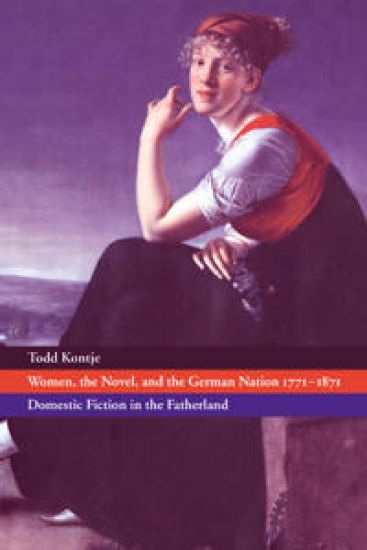
Women, the Novel, and the German Nation 1771–1871

Women, the Novel, and the German Nation 1771–1871

Todd Kontje

Cambridge University Press
1998
sidottu
Todd Kontje surveys novels by German women over the one-hundred-year period that stretches from the beginnings of a German national literature to the founding of its nation-state. Introducing readers to the lives and works of fourteen women writers of the period, he shows the historical and thematic coherence of a body of fiction by women that has been obscured by traditional literary histories. He explores ways in which novels about traditionally feminine domestic concerns also comment on patriarchal politics in the German fatherland. Finally, he argues that we must view the history of the German novel in the context of both the history of sexuality and the rise of German nationalism, and that novels by German women, often marginalised or trivialised, played a central role in shaping attitudes toward class, gender, and the nation.
Private Lives in the Public Sphere

Private Lives in the Public Sphere

Todd Kontje

Pennsylvania State University Press
1992
pokkari
Private Lives in the Public Sphere examines the Bildungsroman in the context of the rapid changes that affected the German literary revolution that made up for its belatedness in its rapidity and scope. The nature and quantity of reading material produced, the social status of the writer, and the reading habits of the public changed dramatically within a few decades. At the beginning of the century the new texts that appeared at the annual book fairs were primarily written in Latin and devoted to theology. By the end of the century the number of new publications each year has increased almost exponentially, with the novel leading the way. This new institution of literature constituted an important part of what Jürgen Habermas has termed the "public sphere," a forum for public debate in which members of the middle class, although still limited in their direct access to political power, could at least begin to articulate their problems and formulate their hopes. The Bildungsroman emerged during this period.This study focuses on moments of literary self-consciousness in the Bildungsroman as reflections on the rapid transformation of the German literary institution. The novels are viewed as examples of what Patricia Waugh has called "metafiction," that is, "fictional writing which self-consciously and systematically draws attention to its status as an artifact in order to pose questions about the relationship between fiction and reality." By concentrating on the interaction between literary form and institutional context in these novels, it becomes possible to mediate between the extremes of those who would view literature as a mere reflection of historical conditions and those who would maintain the purity of the aesthetic object. Literature in this view neither re-creates reality nor does it escape reality; instead, it transforms reality, and the Bildungsroman is the genre that examines this transformation.