Kirjojen hintavertailu. Mukana 12 657 676 kirjaa ja 12 kauppaa.

Kirjailija

Tom Boellstorff

Kirjat ja teokset yhdessä paikassa: 10 kirjaa, julkaisuja vuosilta 2005-2024, suosituimpien joukossa Intellivision. Vertaile teosten hintoja ja tarkista saatavuus suomalaisista kirjakaupoista.

10 kirjaa

Kirjojen julkaisuhaarukka 2005-2024.

Intellivision

Intellivision

Tom Boellstorff; Braxton Soderman

MIT PRESS LTD
2024
nidottu
The engaging story of Intellivision, an overlooked videogame system from the late 1970s and early 1980s whose fate was shaped by Mattel, Atari, and countless others who invented the gaming industry. Astrosmash, Snafu, Star Strike, Utopia--do these names sound familiar to you? No? Maybe? They were all videogames created for the Intellivision videogame system, sold by Mattel Electronics between 1979 and 1984. This system was Atari's main rival during a key period when videogames were moving from the arcades into the home. In Intellivision, Tom Boellstorff and Braxton Soderman tell the fascinating inside story of this overlooked gaming system. Along the way, they also analyze Intellivision's chips and code, games, marketing and business strategies, organizational and social history, and the cultural and economic context of the early US games industry from the mid-1970s to the great videogame industry crash of 1983. While many remember Atari, Intellivision has largely been forgotten. As such, Intellivision fills a crucial gap in videogame scholarship, telling the story of a console that sold millions and competed aggressively against Atari. Drawing on a wealth of data from both institutional and personal archives and over 150 interviews with programmers, engineers, executives, marketers, and designers, Boellstorff and Soderman examine the relationship between videogames and toys--an under-analyzed aspect of videogame history--and discuss the impact of home computing on the rise of videogames, the gendered implications of play and videogame design at Mattel, and the blurring of work and play in the early games industry.
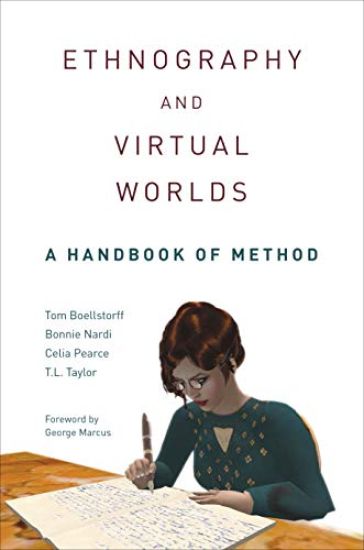
Ethnography and Virtual Worlds

Ethnography and Virtual Worlds

Tom Boellstorff; Bonnie Nardi; Celia Pearce; T. L. Taylor

PRINCETON UNIVERSITY PRESS
2024
pokkari
A practical guide to the ethnographic study of online cultures, and beyondEthnography and Virtual Worlds is the only book of its kind—a concise, comprehensive, and practical guide for students, teachers, designers, and scholars interested in using ethnographic methods to study online virtual worlds, including both game and nongame environments. Written by leading ethnographers of virtual worlds, and focusing on the key method of participant observation, the book provides invaluable advice, tips, guidelines, and principles to aid researchers through every stage of a project, from choosing an online fieldsite to writing and publishing the results.Provides practical and detailed techniques for ethnographic research customized to reflect the specific issues of online virtual worlds, both game and nongameDraws on research in a range of virtual worlds, including Everquest, Second Life, There.com, and World of WarcraftProvides suggestions for dealing with institutional review boards, human subjects protocols, and ethical issuesGuides the reader through the full trajectory of ethnographic research, from research design to data collection, data analysis, and writing up and publishing research resultsAddresses myths and misunderstandings about ethnographic research, and argues for the scientific value of ethnography
Coming of Age in Second Life

Coming of Age in Second Life

Tom Boellstorff

Princeton University Press
2015
pokkari
Millions of people around the world today spend portions of their lives in online virtual worlds. Second Life is one of the largest of these virtual worlds. The residents of Second Life create communities, buy property and build homes, go to concerts, meet in bars, attend weddings and religious services, buy and sell virtual goods and services, find friendship, fall in love--the possibilities are endless, and all encountered through a computer screen. At the time of its initial publication in 2008, Coming of Age in Second Life was the first book of anthropology to examine this thriving alternate universe. Tom Boellstorff conducted more than two years of fieldwork in Second Life, living among and observing its residents in exactly the same way anthropologists traditionally have done to learn about cultures and social groups in the so-called real world. He conducted his research as the avatar "Tom Bukowski," and applied the rigorous methods of anthropology to study many facets of this new frontier of human life, including issues of gender, race, sex, money, conflict and antisocial behavior, the construction of place and time, and the interplay of self and group. Coming of Age in Second Life shows how virtual worlds can change ideas about identity and society. Bringing anthropology into territory never before studied, this book demonstrates that in some ways humans have always been virtual, and that virtual worlds in all their rich complexity build upon a human capacity for culture that is as old as humanity itself. Now with a new preface in which the author places his book in light of the most recent transformations in online culture, Coming of Age in Second Life remains the classic ethnography of virtual worlds.
Data – Now Bigger and Better!

Data – Now Bigger and Better!

Genevieve Bell; Tom Boellstorff; Melissa Gregg; Bill Maurer; Nick Seaver

Prickly Paradigm Press, LLC
2015
nidottu
Data is too big to be left to the data analysts. Data: Now Bigger and Better! brings together researchers whose work is deeply informed by the conceptual frameworks of anthropology-frameworks that are comparative as well as field-based. From kinship to gifts, everything old becomes rich with new insight when the anthropological archive washes over "big data." Bringing together anthropology's classic debates and contemporary interventions, the book counters the future-oriented speculation so characteristic of discussions regarding big data. Drawing on long-standing experience in industry contexts, the contributors also provide analytical provocations that can help reframe some of the most important shifts in technology and society in the first half of the twenty-first century.
Communities of Play

Communities of Play

Celia Pearce; Tom Boellstorff; Bonnie A. Nardi

MIT Press
2011
pokkari
The odyssey of a group of "refugees" from a closed-down online game and an exploration of emergent fan cultures in virtual worlds.Play communities existed long before massively multiplayer online games; they have ranged from bridge clubs to sports leagues, from tabletop role-playing games to Civil War reenactments. With the emergence of digital networks, however, new varieties of adult play communities have appeared, most notably within online games and virtual worlds. Players in these networked worlds sometimes develop a sense of community that transcends the game itself. In Communities of Play, game researcher and designer Celia Pearce explores emergent fan cultures in networked digital worlds-actions by players that do not coincide with the intentions of the game's designers. Pearce looks in particular at the Uru Diaspora-a group of players whose game, Uru: Ages Beyond Myst, closed. These players (primarily baby boomers) immigrated into other worlds, self-identifying as "refugees"; relocated in There.com, they created a hybrid culture integrating aspects of their old world. Ostracized at first, they became community leaders. Pearce analyzes the properties of virtual worlds and looks at the ways design affects emergent behavior. She discusses the methodologies for studying online games, including a personal account of the sometimes messy process of ethnography. Pearce considers the "play turn" in culture and the advent of a participatory global playground enabled by networked digital games every bit as communal as the global village Marshall McLuhan saw united by television. Countering the ludological definition of play as unproductive and pointing to the long history of pre-digital play practices, Pearce argues that play can be a prelude to creativity.
A Coincidence of Desires

A Coincidence of Desires

Tom Boellstorff

Duke University Press
2007
pokkari
In A Coincidence of Desires, Tom Boellstorff considers how interdisciplinary collaboration between anthropology and queer studies might enrich both fields. For more than a decade he has visited Indonesia, both as an anthropologist exploring gender and sexuality and as an activist involved in HIV prevention work. Drawing on these experiences, he provides several in-depth case studies, primarily concerning the lives of Indonesian men who term themselves gay (an Indonesian-language word that overlaps with, but does not correspond exactly to, the English word “gay”). These case studies put interdisciplinary research approaches into practice. They are preceded and followed by theoretical meditations on the most productive forms that collaborations between queer studies and anthropology might take. Boellstorff uses theories of time to ask how a model of “coincidence” might open up new possibilities for cooperation between the two disciplines. He also juxtaposes his own work with other scholars’ studies of Indonesia, Thailand, the Philippines, Malaysia, and Singapore to compare queer sexualities across Southeast Asia. In doing so, he asks how comparison might be understood as a queer project and how queerness might be understood as comparative. The case studies contained in A Coincidence of Desires speak to questions about the relation of sexualities to nationalism, religion, and globalization. They include an examination of zines published by gay Indonesians; an analysis of bahasa gay-a slang spoken by gay Indonesians that is increasingly appropriated in Indonesian popular culture; and an exploration of the place of warias (roughly, “male-to-female transvestites”) within Indonesian society. Boellstorff also considers the tension between Islam and sexuality in gay Indonesians’ lives and a series of incidents in which groups of men, identified with Islamic fundamentalism, violently attacked gatherings of gay men. Collectively, these studies insist on the primacy of empirical investigation to any queer studies project that wishes to speak to the specificities of lived experience.
A Coincidence of Desires

A Coincidence of Desires

Tom Boellstorff

Duke University Press
2007
sidottu
In A Coincidence of Desires, Tom Boellstorff considers how interdisciplinary collaboration between anthropology and queer studies might enrich both fields. For more than a decade he has visited Indonesia, both as an anthropologist exploring gender and sexuality and as an activist involved in HIV prevention work. Drawing on these experiences, he provides several in-depth case studies, primarily concerning the lives of Indonesian men who term themselves gay (an Indonesian-language word that overlaps with, but does not correspond exactly to, the English word “gay”). These case studies put interdisciplinary research approaches into practice. They are preceded and followed by theoretical meditations on the most productive forms that collaborations between queer studies and anthropology might take. Boellstorff uses theories of time to ask how a model of “coincidence” might open up new possibilities for cooperation between the two disciplines. He also juxtaposes his own work with other scholars’ studies of Indonesia, Thailand, the Philippines, Malaysia, and Singapore to compare queer sexualities across Southeast Asia. In doing so, he asks how comparison might be understood as a queer project and how queerness might be understood as comparative. The case studies contained in A Coincidence of Desires speak to questions about the relation of sexualities to nationalism, religion, and globalization. They include an examination of zines published by gay Indonesians; an analysis of bahasa gay-a slang spoken by gay Indonesians that is increasingly appropriated in Indonesian popular culture; and an exploration of the place of warias (roughly, “male-to-female transvestites”) within Indonesian society. Boellstorff also considers the tension between Islam and sexuality in gay Indonesians’ lives and a series of incidents in which groups of men, identified with Islamic fundamentalism, violently attacked gatherings of gay men. Collectively, these studies insist on the primacy of empirical investigation to any queer studies project that wishes to speak to the specificities of lived experience.
The Gay Archipelago

The Gay Archipelago

Tom Boellstorff

Princeton University Press
2005
pokkari
The Gay Archipelago is the first book-length exploration of the lives of gay men in Indonesia, the world's fourth most populous nation and home to more Muslims than any other country. Based on a range of field methods, it explores how Indonesian gay and lesbian identities are shaped by nationalism and globalization. Yet the case of gay and lesbian Indonesians also compels us to ask more fundamental questions about how we decide when two things are "the same" or "different." The book thus examines the possibilities of an "archipelagic" perspective on sameness and difference. Tom Boellstorff examines the history of homosexuality in Indonesia, and then turns to how gay and lesbian identities are lived in everyday Indonesian life, from questions of love, desire, and romance to the places where gay men and lesbian women meet. He also explores the roles of mass media, the state, and marriage in gay and lesbian identities. The Gay Archipelago is unusual in taking the whole nation-state of Indonesia as its subject, rather than the ethnic groups usually studied by anthropologists. It is by looking at the nation in cultural terms, not just political terms, that identities like those of gay and lesbian Indonesians become visible and understandable. In doing so, this book addresses questions of sexuality, mass media, nationalism, and modernity with implications throughout Southeast Asia and beyond.