

Kirjailija
Tom R. Tyler
Kirjat ja teokset yhdessä paikassa: 9 kirjaa, julkaisuja vuosilta 1988-2022, suosituimpien joukossa Trust in the Law. Vertaile teosten hintoja ja tarkista saatavuus suomalaisista kirjakaupoista.
9 kirjaa
Kirjojen julkaisuhaarukka 1988-2022.


As with all social institutions, learning about law and how to relate to it is an important part of growing up. In Why Children Follow Rules, Tom R. Tyler and Rick Trinkner focus on legal socialization, the process by which children and adolescents form their orientation toward the law, and outline what is known about the process across three related, but distinct, contexts: family, school, and the juvenile justice system. They emphasize the degree to which individuals develop their orientations toward law upon values of responsibility and obligation, as opposed to fear of punishment. They further argue that when individuals experience authority that is fair, respectful, and aware of the limits of power, they are more likely to consent and voluntarily follow directives. Yet, strong pressures and popular support for the exercise of authority based on dominance and force persist. Given the low levels of public trust and confidence in the police, as well as the legal system in general, Why Children Follow Rules offers an invaluable tool for understanding how people come to understand their relationship with the law.

Legal socialization is the process by which children and adolescents acquire their law related values, attitudes, and reasoning capacities. Such values and attitudes, in particular legitimacy, underlie the ability and willingness to consent to laws and defer to legal authorities that make legitimacy based legal systems possible. By age eighteen a person's orientation toward law is largely established, yet legal scholarship has largely ignored this process in favor of studying adults and their relationship to the law. Why Children Follow Rules focuses upon legal socialization outlining what is known about the process across three related, but distinct, contexts: the family, the school, and the juvenile justice system. Throughout, Tom Tyler and Rick Trinkner emphasize the degree to which individuals develop their orientations toward law and legal authority upon values connected to responsibility and obligation as opposed to fear of punishment. They argue that authorities can act in ways that internalize legal values and promote supportive attitudes. In particular, consensual legal authority is linked to three issues: how authorities make decisions, how they treat people, and whether they recognize the boundaries of their authority. When individuals experience authority that is fair, respectful, and aware of the limits of power, they are more likely to consent and follow directives. Despite clear evidence showing the benefits of consensual authority, strong pressures and popular support for the exercise of authority based on dominance and force persist in America's families, schools, and within the juvenile justice system. As the currently low levels of public trust and confidence in the police, the courts, and the law undermine the effectiveness of our legal system, Tom Tyler and Rick Trinkner point to alternative way to foster the popular legitimacy of the law in an era of mistrust.
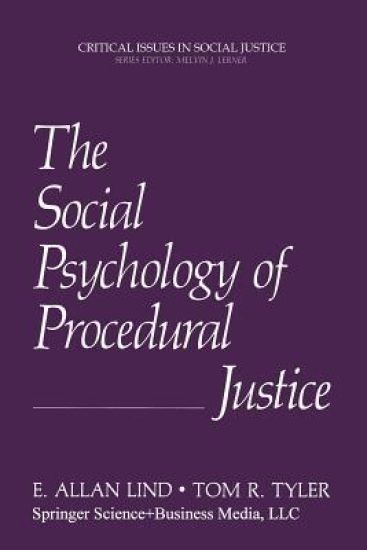
The Social Psychology of Procedural Justice
E.Allan Lind; Tom R. Tyler
Springer-Verlag New York Inc.
2013
nidottu
We dedicate this book to John Thibaut. He was mentor and personal friend to one of us, and his work had a profound intellectual influence on both of us. We were both strongly influenced by Thibaut's insightful articulation of the importance to psychology of the concept of pro cedural justice and by his empirical work with Laurens Walker in reactions to legal institu demonstrating the role of procedural justice tions. The great importance we accord the Thibaut and Walker work is evident throughout this volume. If anyone person can be said to have created an entire field of inquiry, John Thibaut created the psychological study of procedural justice. (To honor Thibaut thus in no sense reduces our recognition of the contributions of his co-worker, Laurens Walker, in the creation of the field. We are as certain that Walker would endorse our statement as we are that Thibaut, with characteristic modesty, would demur from it. ) Even to praise Thibaut in this fashion falls short of recognizing all of his contributions to procedural justice. Not only did he initiate the psy chological study of the topic, he also built much of the intellectual foun dation upon which the study of procedural justice rests. Thibaut's work with Harold Kelley (1959; Kelley & Thibaut, 1978) created a social psy chological theory of interdependence that, among many other applica tions, serves as the basis for one of the major models of the psychology of procedural justice.
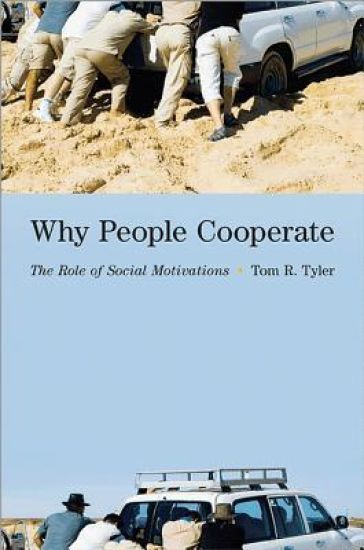
Any organization's success depends upon the voluntary cooperation of its members. But what motivates people to cooperate? In Why People Cooperate, Tom Tyler challenges the decades-old notion that individuals within groups are primarily motivated by their self-interest. Instead, he demonstrates that human behaviors are influenced by shared attitudes, values, and identities that reflect social connections rather than material interests. Tyler examines employee cooperation in work organizations, resident cooperation with legal authorities responsible for social order in neighborhoods, and citizen cooperation with governmental authorities in political communities. He demonstrates that the main factors for achieving cooperation are socially driven, rather than instrumentally based on incentives or sanctions. Because of this, social motivations are critical when authorities attempt to secure voluntary cooperation from group members. Tyler also explains that two related aspects of group practices--the use of fair procedures when exercising authority and the belief by group members that authorities are benevolent and sincere--are crucial to the development of the attitudes, values, and identities that underlie cooperation. With widespread implications for the management of organizations, community regulation, and governance, Why People Cooperate illustrates the vital role that voluntary cooperation plays in the long-standing viability of groups.
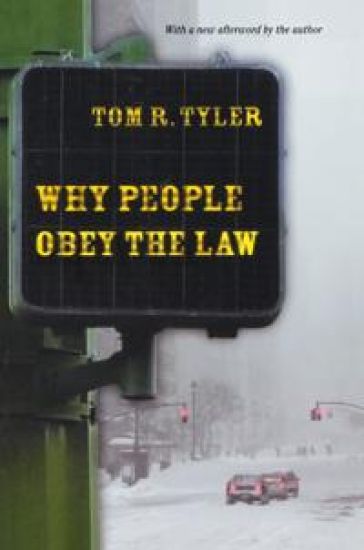
People obey the law if they believe it's legitimate, not because they fear punishment--this is the startling conclusion of Tom Tyler's classic study. Tyler suggests that lawmakers and law enforcers would do much better to make legal systems worthy of respect than to try to instill fear of punishment. He finds that people obey law primarily because they believe in respecting legitimate authority. In his fascinating new afterword, Tyler brings his book up to date by reporting on new research into the relative importance of legal legitimacy and deterrence, and reflects on changes in his own thinking since his book was first published.

The Social Psychology of Procedural Justice
E. Allan Lind; Tom R. Tyler
Kluwer Academic/Plenum Publishers
1988
sidottu
We dedicate this book to John Thibaut. He was mentor and personal friend to one of us, and his work had a profound intellectual influence on both of us. We were both strongly influenced by Thibaut's insightful articulation of the importance to psychology of the concept of pro cedural justice and by his empirical work with Laurens Walker in reactions to legal institu demonstrating the role of procedural justice tions. The great importance we accord the Thibaut and Walker work is evident throughout this volume. If anyone person can be said to have created an entire field of inquiry, John Thibaut created the psychological study of procedural justice. (To honor Thibaut thus in no sense reduces our recognition of the contributions of his co-worker, Laurens Walker, in the creation of the field. We are as certain that Walker would endorse our statement as we are that Thibaut, with characteristic modesty, would demur from it. ) Even to praise Thibaut in this fashion falls short of recognizing all of his contributions to procedural justice. Not only did he initiate the psy chological study of the topic, he also built much of the intellectual foun dation upon which the study of procedural justice rests. Thibaut's work with Harold Kelley (1959; Kelley & Thibaut, 1978) created a social psy chological theory of interdependence that, among many other applica tions, serves as the basis for one of the major models of the psychology of procedural justice.