Kirjojen hintavertailu. Mukana 12 657 676 kirjaa ja 12 kauppaa.
Kirjailija
Tomasz R. Bielecki
Kirjat ja teokset yhdessä paikassa: 7 kirjaa, julkaisuja vuosilta 2001-2020, suosituimpien joukossa Paris-Princeton Lectures on Mathematical Finance 2003. Vertaile teosten hintoja ja tarkista saatavuus suomalaisista kirjakaupoista.
The Paris-Princeton Lectures in Financial Mathematics, of which this is the second volume, will, on an annual basis, publish cutting-edge research in self-contained, expository articles from outstanding - established or upcoming! - specialists. The aim is to produce a series of articles that can serve as an introductory reference for research in the field. It arises as a result of frequent exchanges between the finance and financial mathematics groups in Paris and Princeton. This volume presents the following articles: "Hedging of Defaultable Claims" by T. Bielecki, M. Jeanblanc, and M. Rutkowski; "On the Geometry of Interest Rate Models" by T. Björk; "Heterogeneous Beliefs, Speculation and Trading in Financial Markets" by J.A. Scheinkman, and W. Xiong.
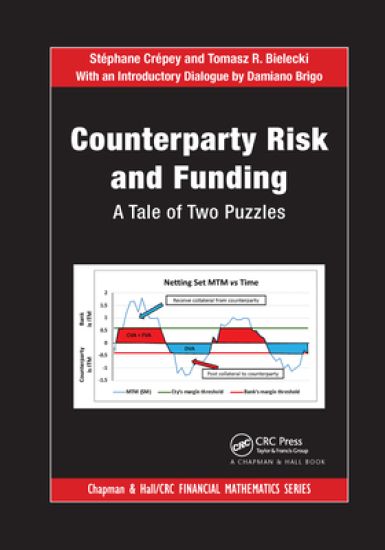
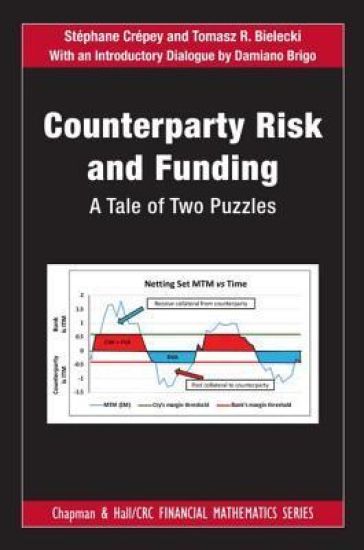
Solve the DVA/FVA Overlap Issue and Effectively Manage Portfolio Credit RiskCounterparty Risk and Funding: A Tale of Two Puzzles explains how to study risk embedded in financial transactions between the bank and its counterparty. The authors provide an analytical basis for the quantitative methodology of dynamic valuation, mitigation, and hedging of bilateral counterparty risk on over-the-counter (OTC) derivative contracts under funding constraints. They explore credit, debt, funding, liquidity, and rating valuation adjustment (CVA, DVA, FVA, LVA, and RVA) as well as replacement cost (RC), wrong-way risk, multiple funding curves, and collateral. The first part of the book assesses today’s financial landscape, including the current multi-curve reality of financial markets. In mathematical but model-free terms, the second part describes all the basic elements of the pricing and hedging framework. Taking a more practical slant, the third part introduces a reduced-form modeling approach in which the risk of default of the two parties only shows up through their default intensities. The fourth part addresses counterparty risk on credit derivatives through dynamic copula models. In the fifth part, the authors present a credit migrations model that allows you to account for rating-dependent credit support annex (CSA) clauses. They also touch on nonlinear FVA computations in credit portfolio models. The final part covers classical tools from stochastic analysis and gives a brief introduction to the theory of Markov copulas.The credit crisis and ongoing European sovereign debt crisis have shown the importance of the proper assessment and management of counterparty risk. This book focuses on the interaction and possible overlap between DVA and FVA terms. It also explores the particularly challenging issue of counterparty risk in portfolio credit modeling. Primarily for researchers and graduate students in financial mathematics, the book is also suitable for financial quants, managers in banks, CVA desks, and members of supervisory bodies.
The relatively young theory of structured dependence between stochastic processes has many real-life applications in areas including finance, insurance, seismology, neuroscience, and genetics. With this monograph, the first to be devoted to the modeling of structured dependence between random processes, the authors not only meet the demand for a solid theoretical account but also develop a stochastic processes counterpart of the classical copula theory that exists for finite-dimensional random variables. Presenting both the technical aspects and the applications of the theory, this is a valuable reference for researchers and practitioners in the field, as well as for graduate students in pure and applied mathematics programs. Numerous theoretical examples are included, alongside examples of both current and potential applications, aimed at helping those who need to model structured dependence between dynamic random phenomena.
Solve the DVA/FVA Overlap Issue and Effectively Manage Portfolio Credit RiskCounterparty Risk and Funding: A Tale of Two Puzzles explains how to study risk embedded in financial transactions between the bank and its counterparty. The authors provide an analytical basis for the quantitative methodology of dynamic valuation, mitigation, and hedging of bilateral counterparty risk on over-the-counter (OTC) derivative contracts under funding constraints. They explore credit, debt, funding, liquidity, and rating valuation adjustment (CVA, DVA, FVA, LVA, and RVA) as well as replacement cost (RC), wrong-way risk, multiple funding curves, and collateral. The first part of the book assesses today’s financial landscape, including the current multi-curve reality of financial markets. In mathematical but model-free terms, the second part describes all the basic elements of the pricing and hedging framework. Taking a more practical slant, the third part introduces a reduced-form modeling approach in which the risk of default of the two parties only shows up through their default intensities. The fourth part addresses counterparty risk on credit derivatives through dynamic copula models. In the fifth part, the authors present a credit migrations model that allows you to account for rating-dependent credit support annex (CSA) clauses. They also touch on nonlinear FVA computations in credit portfolio models. The final part covers classical tools from stochastic analysis and gives a brief introduction to the theory of Markov copulas.The credit crisis and ongoing European sovereign debt crisis have shown the importance of the proper assessment and management of counterparty risk. This book focuses on the interaction and possible overlap between DVA and FVA terms. It also explores the particularly challenging issue of counterparty risk in portfolio credit modeling. Primarily for researchers and graduate students in financial mathematics, the book is also suitable for financial quants, managers in banks, CVA desks, and members of supervisory bodies.
Mathematical finance and financial engineering have been rapidly expanding fields of science over the past three decades. The main reason behind this phenomenon has been the success of sophisticated quantitative methodolo gies in helping professionals manage financial risks. It is expected that the newly developed credit derivatives industry will also benefit from the use of advanced mathematics. This industry has grown around the need to handle credit risk, which is one of the fundamental factors of financial risk. In recent years, we have witnessed a tremendous acceleration in research efforts aimed at better comprehending, modeling and hedging this kind of risk. Although in the first chapter we provide a brief overview of issues related to credit risk, our goal was to introduce the basic concepts and related no tation, rather than to describe the financial and economical aspects of this important sector of financial market. The interested reader may consult, for instance, Francis et al. (1999) or Nelken (1999) for a much more exhaustive description of the credit derivatives industry.
This volume includes the five lecture courses given at the CIME-EMS School on "Stochastic Methods in Finance" held in Bressanone/Brixen, Italy 2003. It deals with innovative methods, mainly from stochastic analysis, that play a fundamental role in the mathematical modelling of finance and insurance: the theory of stochastic processes, optimal and stochastic control, stochastic differential equations, convex analysis and duality theory. Five topics are treated in detail: Utility maximization in incomplete markets; the theory of nonlinear expectations and its relationship with the theory of risk measures in a dynamic setting; credit risk modelling; the interplay between finance and insurance; incomplete information in the context of economic equilibrium and insider trading.
Mathematical finance and financial engineering have been rapidly expanding fields of science over the past three decades. The main reason behind this phenomenon has been the success of sophisticated quantitative methodolo gies in helping professionals manage financial risks. It is expected that the newly developed credit derivatives industry will also benefit from the use of advanced mathematics. This industry has grown around the need to handle credit risk, which is one of the fundamental factors of financial risk. In recent years, we have witnessed a tremendous acceleration in research efforts aimed at better comprehending, modeling and hedging this kind of risk. Although in the first chapter we provide a brief overview of issues related to credit risk, our goal was to introduce the basic concepts and related no tation, rather than to describe the financial and economical aspects of this important sector of financial market. The interested reader may consult, for instance, Francis et al. (1999) or Nelken (1999) for a much more exhaustive description of the credit derivatives industry.