Kirjojen hintavertailu. Mukana 12 595 353 kirjaa ja 12 kauppaa.

Kirjailija

Tony Jefferson

Kirjat ja teokset yhdessä paikassa: 17 kirjaa, julkaisuja vuosilta 2007-2026, suosituimpien joukossa Policing the Crisis. Vertaile teosten hintoja ja tarkista saatavuus suomalaisista kirjakaupoista.

17 kirjaa

Kirjojen julkaisuhaarukka 2007-2026.

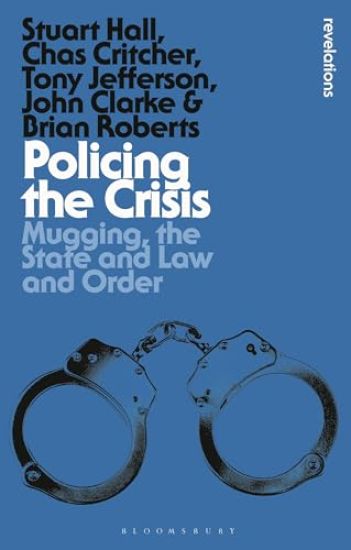
Policing the Crisis

Policing the Crisis

Stuart Hall; Chas Critcher; Tony Jefferson; John Clarke; Brian Roberts

BLOOMSBURY PUBLISHING PLC
2026
sidottu
As relevant as it was at the time of publication, this landmark work remains timely and urgent in demonstrating how to examine questions of race, politics and crime in contemporary society. A formative text in cultural studies and criminology, it shows the relevance of conjunctural analysis to the current emergence of forms of authoritarian populist politics. Examining the crisis of the British state in the 1970s, the book explores how interacting economic, social and political conflicts and crises were displaced onto the problem of crime. Now in the Bloomsbury Revelations series, this re-issue of the 35th Anniversary Edition includes a personal note from the authors about their co-author, the late Stuart Hall, and a brand new foreword by Michael Denning.
Policing the Crisis

Policing the Crisis

Stuart Hall; Chas Critcher; Tony Jefferson; John Clarke; Brian Roberts

Red Globe Press
2013
sidottu
This special 35th anniversary edition contains the original, unchanged text that inspired a generation, alongside two new chapters that explore the book's continued significance for today's readers. The Preface provides a brief retrospective account of the book's original structure, the rich ethnographic, intellectual and theoretical work that informed it, and the historical context in which it appeared. In the new Afterword, each of the authors takes up a specific theme from the original book and interrogates it in the light of current crises, perspectives and contexts.
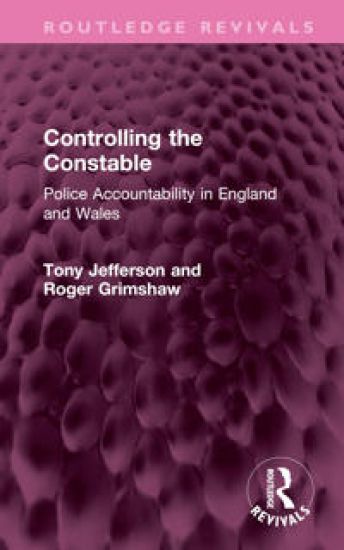
Controlling the Constable

Controlling the Constable

Tony Jefferson; Roger Grimshaw

TAYLOR FRANCIS LTD
2025
nidottu
In the early 1980s, the question of how far the police should be accountable for their actions had become extremely vexed. The impending new Police Bill, the Scarman report and the pressure from many sides for an independent complaints machinery hinged on this issue, and a careful review of the problem was badly needed.The Cobden Trust commissioned Tony Jefferson and Roger Grimshaw to research into the matter, and Controlling the Constable, originally published in 1984, is the result of their findings. The authors examine closely the concept of constabulary independence at the time. They look at the relevant legal history and at how this independence was used by chief constables from day to day. On this basis, they then re-assess two of the most controversial policing operations of modern times – Brixton prior to the 1981 Riots and Southall on 23 April 1979, a day which resulted in hundreds of arrests and the death of Blair Peach.They conclude that the concept embodies a fundamental incoherence: the reliance on the law to guide the chief constable, and the failure of the law to do so. They show that all the current proposals for reform, which entailed greater emphasis on the democratic system as a guide, could result in similar incoherence. A new approach to the conflict between legal authority and democratic authority was urgently needed. Controlling the Constable points the way to the only satisfactory resolution – and this included a concept of justice which was coherent and which could serve as a real guide for the chief constable in using his discretion. The book was controversial, but quite clear on one point: however independent any new complaints procedure may become, and however much committees were ‘consulted’ by chief constables via ‘Scarman-type’ liaison committees, until the problem was tackled on this fundamental level, there could be no significant change in police behaviour.
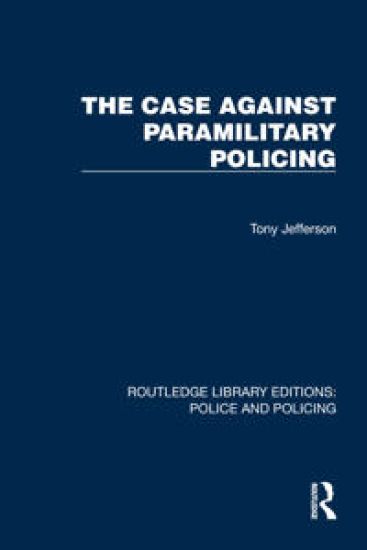
The Case Against Paramilitary Policing

The Case Against Paramilitary Policing

Tony Jefferson

TAYLOR FRANCIS LTD
2025
nidottu
In the late 1980s, the conventional wisdom informing the policing of public order events was that of paramilitarism: militarily trained and equipped units with a special responsibility to deal quickly and effectively with outbreaks of disorder. The philosophy behind the paramilitary response suggested that the training, discipline and specialization entailed ensured that the response was maximally effective and most in line with the tradition of ‘impartial policing by consent’. The argument of this book, originally published in 1990, demonstrates the reverse: not only that police impartiality was chimerical and policing by consent was a viewpoint that did not include the consent of the routinely policed: but that paramilitarism, far from being maximally effective, substantially contributed to the very problem it claimed to minimize. The evidence for this argument is drawn from: concrete analyses of a range of public disorder events – political, industrial and social; a comparative look at similar work in USA and Australia; and substantial fieldwork observations and interviews undertaken with a police special patrol group and its supervising officers.Jefferson argues further that solutions need to be sought for public order policing in making the police politically accountable, ensuring that such accountability is also just (in accordance with the viewpoint of the routinely policed) and in reversing the drift toward paramilitarism.
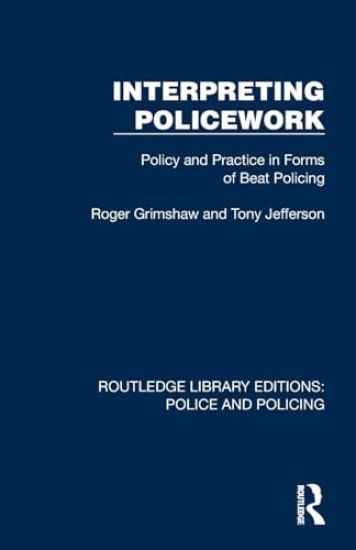
Interpreting Policework

Interpreting Policework

Roger Grimshaw; Tony Jefferson

TAYLOR FRANCIS LTD
2025
nidottu
In the 1980s there existed wide and often acrimonious disagreement over the purposes and objectives of police organizations, the ways in which their activities were structured, and their relations with the wider society. Interpreting policework requires a rounded conception of policing, based on both a thorough critique of the main theoretical trends in police sociology, and close familiarity with actual patterns of policing, on the streets, in the stations, and inside the police headquarters where key policies are formulated.Originally published in 1987, the achievement of this book is that it combines rigorous theoretical analysis with a wealth of descriptive material drawn from first-hand observation of policing and decision making at all levels, and thus relates sociological theory to practice and political debate at the time. The introduction provides a careful analysis of central theoretical and political strands in police sociology, and proposes a new general conception of policework. The authors go on to provide vivid illustrations of this conception from the worlds of uniformed unit beat patrols and resident beat officers, and from the fora in which policy for operational practice is considered. A final section draws the wider lessons of these concrete analyses for sociological theory and for our understanding of past policy shifts from one form of beatwork to another, and spells out the radical implications of the study for the political debate on the future of policing.Interpreting Policework thus had relevance to students and researchers in police studies, sociology, public policy and the law at the time and will still be of historical interest today. The authors are experienced researchers, practised in investigating a wide range of criminological and social control issues.
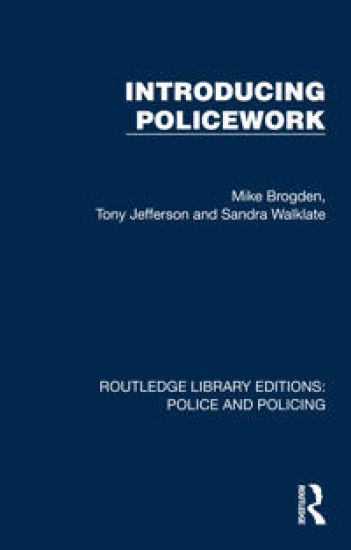
Introducing Policework

Introducing Policework

Mike Brogden; Tony Jefferson; Sandra Walklate

TAYLOR FRANCIS LTD
2025
nidottu
Originally published in1988, Introducing Policework offered a new and concise overview of the controversial subject of policework at the time. The authors provide critical evaluations of the contributions made by psychologists, social psychologists, historians, sociologists, and political scientists, and an assessment of how these fit within an overall understanding of policework.Among the issues considered are: the process of socialization that lead to a ‘cop culture’; the historical evolution of police working practices and their current impact upon the social divisions of age, gender, race and class; problems with the present system of accountability; the prospects for success of recent (post-Scarman) initiatives, such as community consultation.The achievement of this book is that it provides lively and consistent discussion of key issues in the consideration of policework: race and crime, the question of gender, victimization and the ‘new realism’, police monitoring, Neighbourhood Watch, and police training initiatives. Today it will provide an interesting look back at a critical evaluation of policework in the 1980s.
Controlling the Constable

Controlling the Constable

Tony Jefferson; Roger Grimshaw

TAYLOR FRANCIS LTD
2023
sidottu
In the early 1980s, the question of how far the police should be accountable for their actions had become extremely vexed. The impending new Police Bill, the Scarman report and the pressure from many sides for an independent complaints machinery hinged on this issue, and a careful review of the problem was badly needed.The Cobden Trust commissioned Tony Jefferson and Roger Grimshaw to research into the matter, and Controlling the Constable, originally published in 1984, is the result of their findings. The authors examine closely the concept of constabulary independence at the time. They look at the relevant legal history and at how this independence was used by chief constables from day to day. On this basis, they then re-assess two of the most controversial policing operations of modern times – Brixton prior to the 1981 Riots and Southall on 23 April 1979, a day which resulted in hundreds of arrests and the death of Blair Peach.They conclude that the concept embodies a fundamental incoherence: the reliance on the law to guide the chief constable, and the failure of the law to do so. They show that all the current proposals for reform, which entailed greater emphasis on the democratic system as a guide, could result in similar incoherence. A new approach to the conflict between legal authority and democratic authority was urgently needed. Controlling the Constable points the way to the only satisfactory resolution – and this included a concept of justice which was coherent and which could serve as a real guide for the chief constable in using his discretion. The book was controversial, but quite clear on one point: however independent any new complaints procedure may become, and however much committees were ‘consulted’ by chief constables via ‘Scarman-type’ liaison committees, until the problem was tackled on this fundamental level, there could be no significant change in police behaviour.
The Case Against Paramilitary Policing

The Case Against Paramilitary Policing

Tony Jefferson

TAYLOR FRANCIS LTD
2023
sidottu
In the late 1980s, the conventional wisdom informing the policing of public order events was that of paramilitarism: militarily trained and equipped units with a special responsibility to deal quickly and effectively with outbreaks of disorder. The philosophy behind the paramilitary response suggested that the training, discipline and specialization entailed ensured that the response was maximally effective and most in line with the tradition of ‘impartial policing by consent’. The argument of this book, originally published in 1990, demonstrates the reverse: not only that police impartiality was chimerical and policing by consent was a viewpoint that did not include the consent of the routinely policed: but that paramilitarism, far from being maximally effective, substantially contributed to the very problem it claimed to minimize. The evidence for this argument is drawn from: concrete analyses of a range of public disorder events – political, industrial and social; a comparative look at similar work in USA and Australia; and substantial fieldwork observations and interviews undertaken with a police special patrol group and its supervising officers.Jefferson argues further that solutions need to be sought for public order policing in making the police politically accountable, ensuring that such accountability is also just (in accordance with the viewpoint of the routinely policed) and in reversing the drift toward paramilitarism.
Interpreting Policework

Interpreting Policework

Roger Grimshaw; Tony Jefferson

TAYLOR FRANCIS LTD
2023
sidottu
In the 1980s there existed wide and often acrimonious disagreement over the purposes and objectives of police organizations, the ways in which their activities were structured, and their relations with the wider society. Interpreting policework requires a rounded conception of policing, based on both a thorough critique of the main theoretical trends in police sociology, and close familiarity with actual patterns of policing, on the streets, in the stations, and inside the police headquarters where key policies are formulated.Originally published in 1987, the achievement of this book is that it combines rigorous theoretical analysis with a wealth of descriptive material drawn from first-hand observation of policing and decision making at all levels, and thus relates sociological theory to practice and political debate at the time. The introduction provides a careful analysis of central theoretical and political strands in police sociology, and proposes a new general conception of policework. The authors go on to provide vivid illustrations of this conception from the worlds of uniformed unit beat patrols and resident beat officers, and from the fora in which policy for operational practice is considered. A final section draws the wider lessons of these concrete analyses for sociological theory and for our understanding of past policy shifts from one form of beatwork to another, and spells out the radical implications of the study for the political debate on the future of policing.Interpreting Policework thus had relevance to students and researchers in police studies, sociology, public policy and the law at the time and will still be of historical interest today. The authors are experienced researchers, practised in investigating a wide range of criminological and social control issues.
Introducing Policework

Introducing Policework

Mike Brogden; Tony Jefferson; Sandra Walklate

TAYLOR FRANCIS LTD
2023
sidottu
Originally published in1988, Introducing Policework offered a new and concise overview of the controversial subject of policework at the time. The authors provide critical evaluations of the contributions made by psychologists, social psychologists, historians, sociologists, and political scientists, and an assessment of how these fit within an overall understanding of policework.Among the issues considered are: the process of socialization that lead to a ‘cop culture’; the historical evolution of police working practices and their current impact upon the social divisions of age, gender, race and class; problems with the present system of accountability; the prospects for success of recent (post-Scarman) initiatives, such as community consultation.The achievement of this book is that it provides lively and consistent discussion of key issues in the consideration of policework: race and crime, the question of gender, victimization and the ‘new realism’, police monitoring, Neighbourhood Watch, and police training initiatives. Today it will provide an interesting look back at a critical evaluation of policework in the 1980s.
Stuart Hall, Conjunctural Analysis and Cultural Criminology

Stuart Hall, Conjunctural Analysis and Cultural Criminology

Tony Jefferson

Springer Nature Switzerland AG
2021
sidottu
This book discusses Stuart Hall's unique contribution to criminology. It suggests that this is captured best in Hall’s commitment to understanding a given historical moment, or conjuncture, in its full complexity, and his continuous deployment of an appropriate methodology, conjunctural analysis, to do so. This provides a running thread linking Hall’s early work on youth subcultures, the media, the state and hegemony to his later work on racial identities, racism and the politics of difference. This is contrasted with more theoretically-driven work in cultural criminology. Its failure to adopt a conjunctural approach constitutes, for the author, something of a missed moment. To demonstrate the continuing relevance of this form of analysis, the book provides a conjunctural analysis of Brexit, including its psychosocial dimension and concludes with a brief analysis of Trump’s failure to get re-elected. The book is intended for students of criminology and cultural studies.
Policing the Crisis

Policing the Crisis

Stuart Hall; Chas Critcher; Tony Jefferson; John Clarke; Brian Roberts

Red Globe Press
2013
nidottu
This special 35th anniversary edition contains the original, unchanged text that inspired a generation, alongside two new chapters that explore the book's continued significance for today's readers. The Preface provides a brief retrospective account of the book's original structure, the rich ethnographic, intellectual and theoretical work that informed it, and the historical context in which it appeared. In the new Afterword, each of the authors takes up a specific theme from the original book and interrogates it in the light of current crises, perspectives and contexts.
Doing Qualitative Research Differently

Doing Qualitative Research Differently

Wendy Hollway; Tony Jefferson

SAGE Publications Ltd
2012
nidottu
Hollway and Jefferson have updated their ground-breaking book for students and researchers looking to do qualitative research differently. The new edition critically reviews many of the assumptions, claims and methods of qualitative research and also acts as a `how to' guide to the method the authors call the Free Association Narrative Interview. In the new edition, the authors situate their arguments firmly within a tradition of psychosocial research and show how their method has developed over the last decade. The book follows this approach through the phases of empirical research practice. At each stage they use examples from their own research and end with an extended case study which demonstrates the value of their method in producing a psychosocial research subject; that is, one with socially-imbued depth, complexity and biographical uniqueness.
Doing Qualitative Research Differently

Doing Qualitative Research Differently

Wendy Hollway; Tony Jefferson

SAGE Publications Ltd
2012
sidottu
Hollway and Jefferson have updated their ground-breaking book for students and researchers looking to do qualitative research differently. The new edition critically reviews many of the assumptions, claims and methods of qualitative research and also acts as a `how to' guide to the method the authors call the Free Association Narrative Interview. In the new edition, the authors situate their arguments firmly within a tradition of psychosocial research and show how their method has developed over the last decade. The book follows this approach through the phases of empirical research practice. At each stage they use examples from their own research and end with an extended case study which demonstrates the value of their method in producing a psychosocial research subject; that is, one with socially-imbued depth, complexity and biographical uniqueness.
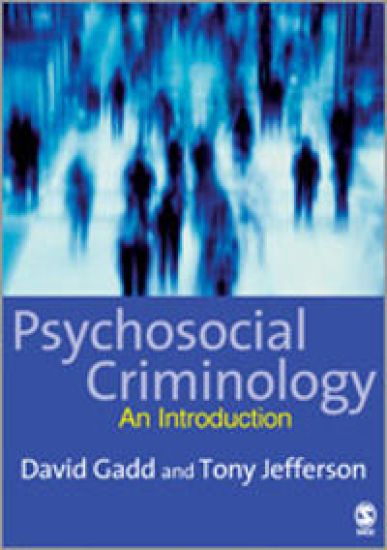
Psychosocial Criminology

Psychosocial Criminology

David Gadd; Tony Jefferson

SAGE Publications Inc
2007
sidottu
'This is a well written, thought provoking, and highly challenging book for anyone who claims to be a criminologist or for whom crime is of central concern. It should be required reading on all undergraduate and post-graduate criminology courses. A truly innovative take on some well established criminological dilemmas.' - Sandra Walklate, Eleanor Rathbone Chair of Sociology, University of Liverpool What makes people commit crime? Psychosocial Criminology demonstrates how a psychosocial approach can illuminate the causes of particular crimes, challenging readers to re-think the similarities and differences between themselves and those involved in crime. The book critiques existing psychological and sociological theories before outlining a more adequate understanding of the criminal offender. It sheds new light on a series of crimes - rape, serial murder, racial harassment , 'jack-rolling' (mugging of drunks), domestic violence - and contemporary criminological issues such as fear of crime, cognitive-behavioural interventions and restorative justice. Gadd and Jefferson bring together theories about identity, subjectivity and gender to provide the first comprehensive account of their psychoanalytically inspired approach. For each topic, the theoretical perspective is supported by individual case studies, which are designed to facilitate the understanding of theory and to demonstrate its application to a variety of criminological topics. This important and lucid book is written primarily for upper level undergraduates, postgraduates and teachers of criminology. It is particularly useful for students undertaking a joint degree in criminology and psychology. It will also appeal to critical psychologists, psychoanalysts, students of biographical methods and those pursuing social work training. David Gadd is Senior Lecturer in Criminology at Keele University. Tony Jefferson is Professor of Criminology at Keele University.
Psychosocial Criminology

Psychosocial Criminology

David Gadd; Tony Jefferson

SAGE Publications Inc
2007
nidottu
'This is a well written, thought provoking, and highly challenging book for anyone who claims to be a criminologist or for whom crime is of central concern. It should be required reading on all undergraduate and post-graduate criminology courses. A truly innovative take on some well established criminological dilemmas.' - Sandra Walklate, Eleanor Rathbone Chair of Sociology, University of Liverpool What makes people commit crime? Psychosocial Criminology demonstrates how a psychosocial approach can illuminate the causes of particular crimes, challenging readers to re-think the similarities and differences between themselves and those involved in crime. The book critiques existing psychological and sociological theories before outlining a more adequate understanding of the criminal offender. It sheds new light on a series of crimes - rape, serial murder, racial harassment , 'jack-rolling' (mugging of drunks), domestic violence - and contemporary criminological issues such as fear of crime, cognitive-behavioural interventions and restorative justice. Gadd and Jefferson bring together theories about identity, subjectivity and gender to provide the first comprehensive account of their psychoanalytically inspired approach. For each topic, the theoretical perspective is supported by individual case studies, which are designed to facilitate the understanding of theory and to demonstrate its application to a variety of criminological topics. This important and lucid book is written primarily for upper level undergraduates, postgraduates and teachers of criminology. It is particularly useful for students undertaking a joint degree in criminology and psychology. It will also appeal to critical psychologists, psychoanalysts, students of biographical methods and those pursuing social work training. David Gadd is Senior Lecturer in Criminology at Keele University. Tony Jefferson is Professor of Criminology at Keele University.