Kirjojen hintavertailu. Mukana 12 595 353 kirjaa ja 12 kauppaa.

Kirjailija

Tony Thacker

Kirjat ja teokset yhdessä paikassa: 5 kirjaa, julkaisuja vuosilta 2010-2025, suosituimpien joukossa Ford Flathead Engines. Vertaile teosten hintoja ja tarkista saatavuus suomalaisista kirjakaupoista.

5 kirjaa

Kirjojen julkaisuhaarukka 2010-2025.

HOT ROD Mavericks

HOT ROD Mavericks

Tony Thacker

Quarto Publishing Group USA Inc
2025
sidottu
Produced in cooperation with HOT ROD magazine, HOT ROD Mavericks takes you on a rollicking look back on more than a century of trailblazers, risk-takers, hell-raisers, and forward-thinkers.No aspect of automobile culture embodies the DIY spirit like hot rodding. From prewar pressed steel and milled four-bangers to modern machined billet and 800-hp behemoths, the story of hot rodding has been the story of can-do iconoclasts who did for themselves what Detroit wouldn’t do for them. Longtime hot rod and custom car historian Tony Thacker crafts an illustrated history that leaves no camshaft unturned.Just some of the 50-plus movers and shakers profiled are:Pioneers of the speed equipment industry like Barney Navarro, Ed “Isky” Iskendarian, and Vic EdelbrockPostwar racers and builders Alex Xydias, Mickey Thompson, and Ak MillerQuarter-mile dragstrip heroes such as “TV” Tommy Ivo, “Big Daddy” Don Garlits, and Shirley “Cha-Cha” MuldowneyKustom kulture icons Dean Jeffries, Ed “Big Daddy” Roth, Von Dutch, Sam and George Barris, and Gene WinfieldThacker also includes latter-day innovators who kept hot rodding a going concern, like Pete & Jake, Boyd Coddington, and Chip Foose. HOT ROD Mavericks is accompanied by exceptional images sourced from Motor Trend Group’s archives at The Petersen Automotive Museum. Celebrate the rebels who revolutionized hot rodding with this authoritative and visually engaging history.
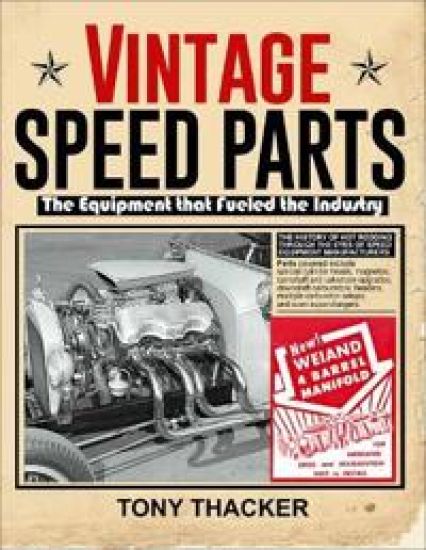
Vintage Speed Parts

Vintage Speed Parts

Tony Thacker

Cartech Inc
2022
nidottu
Follow the history of hot rodding through this nostalgic look at vintage speed equipment. When most people think of speed parts, they rewind a few decades and think back to the Ford flatheads that were so prevalent in the 1940s and 1950s. However, did you know that the speed parts industry began way back in the Model T era? It's true. As soon as vehicles were mass produced, manufacturers were looking for ways to make them faster. Manufacturers, such as Roof, Rajo, Winfield, Miller, Frontenac, and Holley, made speed parts for 4-cylinder Model T engines and accomplished speeds of up to 100 mph In Vintage Speed Parts: The Equipment That Fueled the Industry, veteran hot rod historian Tony Thacker looks at the history of hot rodding through the eyes of speed equipment manufacturers. Covered chronologically, the book begins with the early 4-cylinder engines. In 1932, Henry Ford introduced the flathead V-8, which was slow to be adopted as the engine of choice in racing until the parts industry caught up. Once it did, the flathead, although interrupted by the war, was the engine to run until the automobile manufacturers introduced overhead-valve V-8 engines in the late 1940s. Chrysler's early-1950s Hemi and Chevrolet's small-block V-8 in 1955 spelled the end for the flattie. Both mills dominated well into the 1970s, and the speed industry was there to support all platforms in spades. During that period, every auto manufacturer made a V-8 worthy of modification, and the speed industry boomed. Eventually, the speed equipment manufacturers grew to the point of becoming corporate entities, as mergers and acquisitions became the much less interesting story. Parts covered include special cylinder heads, magnetos, camshaft and valvetrain upgrades, downdraft carburetors, headers, multiple-carburetor setups, and even superchargers. Everyone figured out how to make engines more powerful, upgrading with the type of parts that were being produced decades later, even to today. Join in the fun of reviewing the history of speed through this fascinating tale of vintage speed parts.
How to Build Affordable Hot Rods

How to Build Affordable Hot Rods

Tony Thacker; Billy Gibbons

CarTech Inc
2020
nidottu
Learn how to build an affordable hot rod following the advice of the masters In How to Build Affordable Hot Rods, author and lifelong hot rod aficionado Tony Thacker takes you through the process of building a hot rod on a budget. Drawing on his own extensive experience of both buying and building rods, Thacker explores the good, the bad and the ugly. The good was setting a land speed record at Bonneville, the bad was buying a rod from which the previous owner had "swapped out" the good engine, and the ugly--well, let's just not go there. How to Build Affordable Hot Rods includes extensive how-to sections that cover step-by-step chassis builds for Model A, 1932, and 1936 Fords, including front- and rear-end setups. The in-depth chassis builds are complimented with sections on powertrain choices, bodywork and roof chops, wheels and tires, and wiring and paint. Also included are chapters on interiors and the all-important details that individualize any project to ensure that it stands out from the rest.When Henry Ford introduced his beloved Model T, he unwittingly gave the average person the means to go racing. Prior to the T, racing was mostly a sport of the rich, but that changed with the Model T. Stripped of fenders and hopped up with speed parts, T speedsters ruled, and it wasn't long before enthusiasm on the track translated to the street and the term hot rod entered the vernacular.Of course, it didn't need to be a Ford (and still doesn't), but the easiest and therefore cheapest route to Hot Rod Boulevard is down the Ford road. The journey accelerated after World War II, as hot rodding boomed with the growth of speed shops, car shows, drag racing, talented and trained GIs returning home, and the launch of Hot Rod magazine to spread the gospel far and wide. More than 100 years after the original Model T, hot rodding remains alive and well in the Australasia, Europe, and (of course) its birthplace the US.Learn from the best and get started building your affordable hot rod today
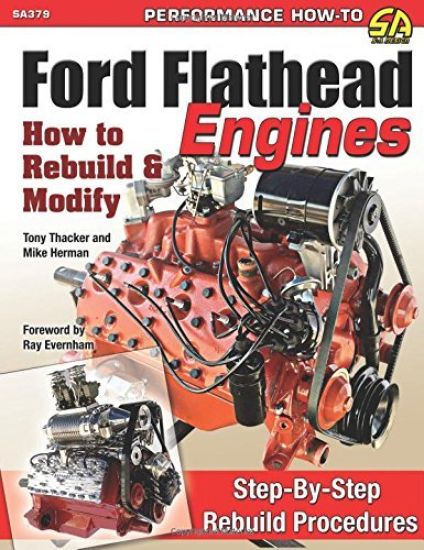
Ford Flathead Engines

Ford Flathead Engines

Michael Hermann; Tony Thacker

CarTech Inc
2016
nidottu
Although not the first V-8 engine ever produced, Henry Ford's side-valve V-8, launched in 1932, certainly qualified as the first mass-produced V-8 sold to the public. Because of Henry Ford's stubbornness, the first versions were less than ideal. The technology was in its infancy and cost-cutting measures limited the output and reliability of the early models. Over time, however, the "Flattie" became the go-to powerplant for a whole generation of new hobbyists who were called "hot rodders." The engine maintained its position in the hobby well into the 1950s, even when more modern overhead-valve designs started coming out of Detroit. It's hard to overstate the impact that this simple little engine had on a whole generation of enthusiasts. Even today, people choose a flathead for period-correct builds over far more powerful options. The style and sound of a modified flathead is an iconic part of American history.In "Ford Flathead Engines: How to Rebuild & Modify," veteran author Tony Thacker and flathead guru of H&H Flatheads, Mike Herman, take you step-by-step through rebuilding a vintage flathead. One of the most important steps is to actually find a good, usable core; many have been sitting for a very long time and the engine design is prone to cracking. Running changes are also an important consideration when selecting a core, and include cooling system, ignition, and transmission mount. After you have selected a core, Thacker and Herman take you through the entire process of a rebuild, including teardown, parts inspection, machine shop processes, replacement part selection, re-assembly, start up, and break-in. Also covered is a unique performance build completed at the H&H shop for legendary race car team manager and all-around enthusiast Ray Evernham. It all adds up to more than 500 color photos and insider tips on building what could be called the most iconic engine ever built, the Ford flathead V-8.