Kirjojen hintavertailu. Mukana 12 657 676 kirjaa ja 12 kauppaa.

Kirjailija

Tor A. Fjeldly

Kirjat ja teokset yhdessä paikassa: 4 kirjaa, julkaisuja vuosilta 1997-2003, suosituimpien joukossa Device Modeling for Analog and RF CMOS Circuit Design. Vertaile teosten hintoja ja tarkista saatavuus suomalaisista kirjakaupoista.

Mukana myös kirjoitusasut: Tor A Fjeldly

4 kirjaa

Kirjojen julkaisuhaarukka 1997-2003.

Device Modeling for Analog and RF CMOS Circuit Design

Device Modeling for Analog and RF CMOS Circuit Design

Trond Ytterdal; Yuhua Cheng; Tor A. Fjeldly

John Wiley Sons Inc
2003
sidottu
In order to keep up with global demand, microelectronics engineers are continually challenged to produce increasingly complex, high performance integrated circuits. The steady downscaling of MOSFET/CMOS technology has highlighted the need for a thorough understanding of the properties, potentials and limitations of the latest device models and technology. Presenting state-of-the-art MOSFET models, this book will prove a valuable reference and text for engineers striving to achieve first-time-right, reduced time-to-market silicon products. Featuring: *A complete survey of the CMOS device models used in modern analog and RF integrated circuit design. *A thorough treatment of the device modeling challenges faced by designers today. *An examination of the most commonly used MOSFET models, including BSIM4 and EKV. *A discussion of the modeling of process variations and device mismatch effects, along with device model quality assurance. *Two accompanying software packages, AIM-Spice and MOSCalc, available via the Internet. Bridging the gap between modeling and analog circuit design Device Modeling for Analog & RF CMOS Circuit Design will appeal to practicing microelectronics engineers and senior and graduate level students following courses in analog integrated circuit design.
Introduction to Device Modeling and Circuit Simulation

Introduction to Device Modeling and Circuit Simulation

Tor A. Fjeldly; Trond Ytterdal; Michael S. Shur

John Wiley Sons Inc
1997
sidottu
A detailed guide to SPICE-oriented design and testing of electronic devices SPICE allows engineers to simulate individual semiconductor devices and electronic circuits and to perform the large number of different analyses needed for tasks such as verification of circuit designs and prediction of circuit performance. However, these simulations are only as good as the device models and parameters used in the simulations. Wrong models yield unreliable results. Introduction to Device Modeling and Circuit Simulation links electronic device modeling to simulation of these devices using the SPICE program. Ideal as a reference for professional engineers or as a text for courses in semiconductor device modeling, it presents*A combination of background device physics and technology*A review of existing device models*A set of new and improved models compatible with the most advanced technology*Descriptions of device models and examples of circuit simulationsFollowing an introduction to SPICE, this book covers charge transport in semiconductors, two-terminal devices, bipolar junction transistors, field effect transistors, and advanced FET modeling. With its concentration on modeling and simulation, Introduction to Device Modeling and Circuit Simulation is the core book on SPICE-oriented semiconductor device modeling.
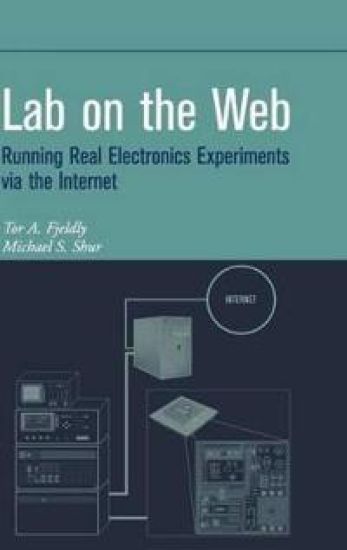
Lab on the Web

Lab on the Web

Tor A. Fjeldly; Michael S. Shur

John Wiley Sons Inc
2003
sidottu
A groundbreaking resource for remote study of interactive electronics applications The widespread use of the Internet as a communication medium has opened up a broad range of possibilities for extending its use into new areas. One such area is remote education, a rapidly growing part of today’s university curricula. Using the Internet and Web technology, courses can be offered to students anywhere in the world with no more technical requirements than a personal computer and an Internet connection. Until recently however, lab courses have been considered impractical for remote access. But thanks to technical advances of the past decade, even these courses with their often complex interactive techniques have been made accessible to remote students. Lab on the Web: Running Real Electronics Experiments via the Internet is the first text to present, in detail, experiments that can be run over the Web, specifically in the area of electronics. The authors present detailed descriptions of approximately 100 experiments in solid state electronics that can be used by engineering and science students at all levels, anywhere in the world, as well as by researchers working on semiconductor devices. Topics covered include: *Electronics laboratory experiments accessible through the Internet *MIT Microelectronics WebLab *Instrumentation on the Web *Next Generation Laboratory: a solution for remote characterization of analog integrated circuits *A Remote Lab for electrical experiments *The Remote Lab as it can be applied to semiconductor devices The book has achieved widespread collaboration that will enable universities around the world to participate in these remote access experiments. Enhanced by interactive Web sites which will accommodate a growing array of experimental modules from participating institutions, the text opens up a virtual Pandora’s box of possibilities for students to access a wide variety of real experiments, and for institutions, jointly or individually, to establish their own remote laboratory sites.
Silicon And Beyond: Advanced Device Models And Circuit Simulators

Silicon And Beyond: Advanced Device Models And Circuit Simulators

Tor A Fjeldly; Michael S Shur

World Scientific Publishing Co Pte Ltd
2000
sidottu
The steady downscaling of device-feature size combined with a rapid increase in circuit complexity as well as the introduction of new device concepts based on non-silicon-material systems poses great challenges for device and circuit designers. One of the major tasks is the development of new and improved device models needed for accurate device and circuit design. Another task is the development of new circuit-simulation tools to handle very large and complex circuits. This book addresses both these issues with up-to-date reviews written by leading experts in the field.The first three chapters of the book discuss advanced device models both for existing technologies and for new, emerging technologies. Among the topics covered are models for MOSFETs, thin-film transitors (TFTs), and compound semiconductor devices, including GaAs HEMTs and HFETs, heterodimensional devices, quantum-tunneling devices, as well as wide-bandgap devices. Chapters 4 and 5 discuss advanced circuit simulators that hold promise for handling circuits of much higher complexity than what is possible for typical state-of-the-art circuit simulators today.