Kirjailija
Torben Juul Andersen
Kirjat ja teokset yhdessä paikassa: 14 kirjaa, julkaisuja vuosilta 2010-2023, suosituimpien joukossa The Responsive Global Organization. Vertaile teosten hintoja ja tarkista saatavuus suomalaisista kirjakaupoista.
14 kirjaa
Kirjojen julkaisuhaarukka 2010-2023.
Organizations face challenges in adapting their current business and operational activities to dynamic contexts. Successful companies share a common characteristic of dealing with the emergent risks and threats in responses that generate viable solutions.Strategic risk management (SRM) is a multidisciplinary and rather fractured field of study, which creates significant challenges for research. This short-form book provides an expert overview of the topic, providing insight into the theory and practice. Essential reading for strategic management researchers, the authors frame the fundamental principles, emerging challenges and responses for the future, which will also provide valuable insights for adjacent business disciplines and beyond.
This casebook extends Strategic Risk Leadership: Engaging a World of Risk, Uncertainty and the Unknown, bringing theory and practice grounded in the first book to life with an array of applicable, real-world examples. The book enables critical thinking about the current state of risk management and ERM, demonstrating contemporary shortcomings and challenges from real-life cases drawn from a global selection of well-known organizations. It confronts modern risk management practices and discusses what leaders should do to deal with unpredictable environments. Providing a basis for developing more effective risk management approaches, the book identifies shortcomings of contemporary approaches to risk management and specifies how to deal with the major risks we face today, illuminated by a variety of comprehensive global examples. It also provides valuable insights on these approaches for managers and leaders in general—including risk executives and chief risk officers—as well as advanced risk management students. End-of-chapter cases illustrate both good and bad risk management approaches as useful inspiration for reflective risk leaders.This book will be a hugely valuable resource for those studying or teaching risk management.
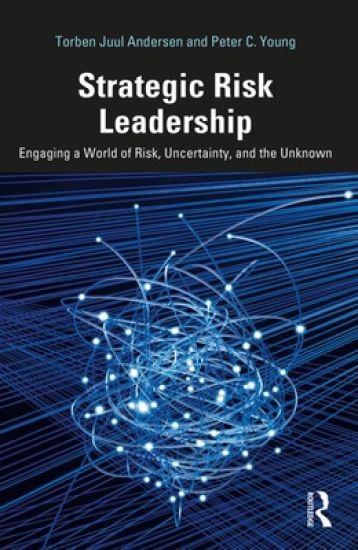
Modern risk management as practiced today faces significant obstacles—we argue—primarily due to the fundamental premise of the concept itself. It asserts that we are mainly dealing with measurable, quantifiable risks and that we can manage the uncontrollable by relying on formal control-based systems, which has produced a general view that (enterprise) risk management is a technical-scientific discipline. Strategic Risk Leadership offers a critique of the status quo, and encourages leaders, executives, and chief risk officers to find fresh approaches that can help them deal more proactively with what the future may hold. The book provides an overview of the history of risk management and current risk governance approaches as prescribed by leading risk management standards, such as COSO and ISO31000. This enables practitioners to challenge the frameworks and improve their adoption in practice introducing sustainable resilience as a (more) meaningful response to uncertain and unknowable conditions. The book shows how traditional thinking downplays the significance of human behavior and judgmental biases as key elements of major organizational exposures illustrated and explained through numerous case examples and studies. This book is essential reading for strategic risk managers to understand the requirements for effective risk governance practices in the contemporary and rapidly changing global risk landscape. Indeed, it is a valuable resource for all risk executives, leaders, and chief risk officers, as well as advanced students of risk management.
Organizations face challenges in adapting their current business and operational activities to dynamic contexts. Successful companies share a common characteristic of dealing with the emergent risks and threats in responses that generate viable solutions.Strategic risk management (SRM) is a multidisciplinary and rather fractured field of study, which creates significant challenges for research. This short-form book provides an expert overview of the topic, providing insight into the theory and practice. Essential reading for strategic management researchers, the authors frame the fundamental principles, emerging challenges and responses for the future, which will also provide valuable insights for adjacent business disciplines and beyond.

Et netværk af hjerner
Torben Juul Andersen; Carina Antonia Hallin; Kjeld Fredens
Gyldendal Trade 150
2018
nidottu
En hjerneforsker og to økonomer diskuterer, hvordan vi kan bruge organisationens samlede netværk af hjerner til at nå vores mål. I disse år forandrer den teknologiske udvikling grundlaget for vores forretning, og vi kan ikke længere være sikre på at nå de mål, vi har sat os. Præcis planlægning hører fortiden til. Men hvis vi tænder for det netværk af hjerner, som organisationen råder over, kan vi sætte en kurs og justere den, mens vi bevæger os fremad. Vi skal skabe intelligente organisationer, der er mere omstillingsparate end traditionelle top-downorganisationer. Vi skal trække på organisationens netværk af hjerner, når vi indsamler viden og erfaringer, og når vi træffer beslutninger. Og vi skal skabe kloge organisationer, der kan overleve fremtidens skiftende krav. Bogen er en inspirationsbog, der sætter gang i diskussionen om, hvordan fremtidens organisationer ser ud, og hvordan de skal ledes.
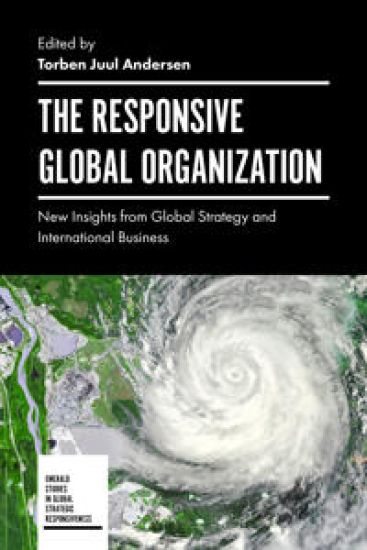
The responsive global organization can adapt business operations across multinational markets in response to unpredictable changes in the turbulent global marketplace. This book deals with different aspects of the effective multinational corporation (MNC) pointing to new ways in which the MNC can enhance responsiveness faced with increasing market turbulence. Drawing on contemporary research in strategy and international business, the book considers relevant aspects including subsidiary autonomy, individual and team engagement, local knowledge, knowledge-based innovation, dynamic integrative processes, cross-cultural management, crisis handling, and the impact of abrupt events.The diversity of multinational business provides many opportunities, but also distinct challenges that must be managed effectively. Here an interactive dynamic between headquarters and local business units is driving responsiveness and adaptive behaviors. Corporate headquarters must structure a multinational organization so adaptive initiatives exploit local market insights where opportunities evolve from autonomous responses around the world. This can entail crisis responses involving both local and corporate efforts as a robust way to handle unexpected incidents. Such interactive approaches constitute a combination of central integration and decentralized local responses as the basis for a dynamic adaptive system. To make this work in a multinational context, we must consider the intricate interplay between corporate values and local cultures, and understand how leadership philosophies influence how diverse employees act as team players and global corporate citizens. The book provides relevant insights on all these important issues.
Global firms must operate in turbulent conditions, facing relentless pressure to be efficient, whilst also accommodating local factors and ways of thinking. This book offers an insight into how an adaptive multinational enterprise can achieve a sustainable competitive advantage in an uncertain environment.Drawing on ground-breaking research into adaptive strategy, this book introduces compelling tools to help design responsive strategic organizations by cultivating global strategic democracy. Written by two leading scholars, this book provides models to inform strategic decisions through the aggregation of frontline information.With a wealth of illustrative case examples supplementing unique research, this text is essential reading for students of strategic management and provides illuminating insights for the reflective practitioner.
Managing Risk and Opportunity
Torben Juul Andersen; Maxine Garvey; Oliviero Roggi
Oxford University Press
2014
sidottu
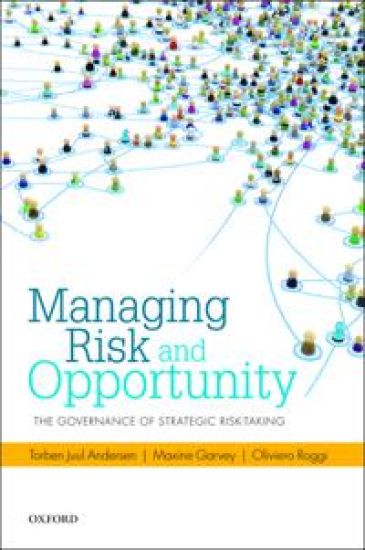
This book promotes good risk governance and risk management practices to corporate managers, executives, and directors wherever they operate around the world. The major corporate scandals have their roots in governance failure pointing to the link between risk governance and good performance outcomes. This topic is timely and of interest both to the academic community as well as to practicing managers, executives, and directors. The volume focuses on contemporary risk leadership issues based on recent research insights but avoids excessive technical language and mathematical formulas. The book is framed around the challenges imposed on executives and directors in dealing with an increasingly complex and unpredictable world. This requires a new risk leadership focus that not only avoids the downside risks but also considers ways to exploit the upside potential offered by a dynamic environment. The underlying logic is built on the principles of financial economics where benefits derive from reducing bankruptcy costs and increasing future cash inflows. This provides a stringent framework for analyzing the effect of different risk management actions and behaviors in effective risk-taking organizations. Hence, the book addresses the potential for upside gains as much as the threats of downside losses that represent the conventional risk perspectives. It states the simple fact that you must be willing to take risk to increase strategic responsiveness and corporate manoeuverability. The text builds the arguments in logical steps explicating relevant techniques and practices along the way that invite to immediate applications and practical thinking
Short Introduction to Strategic Management
Torben Juul Andersen
Cambridge University Press
2013
sidottu
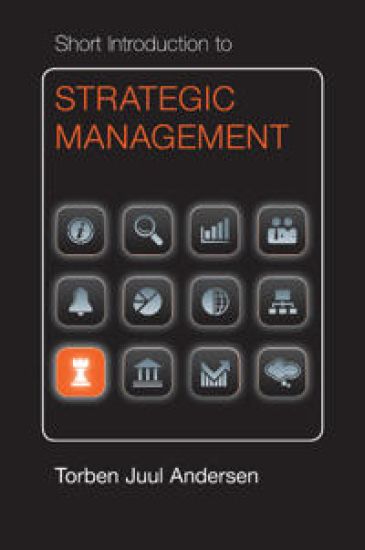
The Short Introduction to Strategic Management provides an authoritative yet accessible account of strategic management and its contemporary challenges. It explains the roots and key rationales of the strategy field, discussing common models, tools and practices, to provide a complete overview of conventional analytical techniques in strategic management. Andersen extends the discussion to consider dynamic strategy making and how it can enable organizations to respond effectively to turbulent and unpredictable global business environments. There is a specific focus on multinational corporate strategy issues relevant to organizations operating across multiple international markets. Written in a clear and direct style, it will appeal to students and practising managers and executives alike.
Short Introduction to Strategic Management
Torben Juul Andersen
Cambridge University Press
2013
pokkari
The Short Introduction to Strategic Management provides an authoritative yet accessible account of strategic management and its contemporary challenges. It explains the roots and key rationales of the strategy field, discussing common models, tools and practices, to provide a complete overview of conventional analytical techniques in strategic management. Andersen extends the discussion to consider dynamic strategy making and how it can enable organizations to respond effectively to turbulent and unpredictable global business environments. There is a specific focus on multinational corporate strategy issues relevant to organizations operating across multiple international markets. Written in a clear and direct style, it will appeal to students and practising managers and executives alike.
Strategic Risk Management Practice
Torben Juul Andersen; Peter Winther Schrøder
Cambridge University Press
2010
sidottu
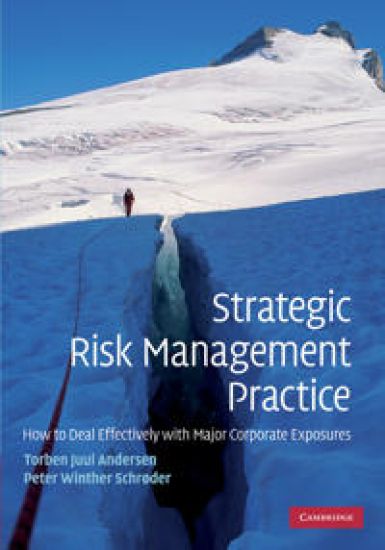
At a time when corporate scandals and major financial failures dominate newspaper headlines, the importance of good risk management practices has never been more obvious. The absence or mismanagement of such practices can have devastating effects on exposed organizations and the wider economy (Barings Bank, Enron, Lehmann Brothers, Northern Rock, to name but a few). Today's organizations and corporate leaders must learn the lessons of such failures by developing practices to deal effectively with risk. This book is an important step towards this end. Written from a European perspective, it brings together ideas, concepts and practices developed in various risk markets and academic fields to provide a much-needed overview of different approaches to risk management. It critiques prevailing enterprise risk management frameworks (ERMs) and proposes a suitable alternative. Combining academic rigour and practical experience, this is an important resource for graduate students and professionals concerned with strategic risk management.
Strategic Risk Management Practice
Torben Juul Andersen; Peter Winther Schrøder
Cambridge University Press
2010
pokkari
At a time when corporate scandals and major financial failures dominate newspaper headlines, the importance of good risk management practices has never been more obvious. The absence or mismanagement of such practices can have devastating effects on exposed organizations and the wider economy (Barings Bank, Enron, Lehmann Brothers, Northern Rock, to name but a few). Today's organizations and corporate leaders must learn the lessons of such failures by developing practices to deal effectively with risk. This book is an important step towards this end. Written from a European perspective, it brings together ideas, concepts and practices developed in various risk markets and academic fields to provide a much-needed overview of different approaches to risk management. It critiques prevailing enterprise risk management frameworks (ERMs) and proposes a suitable alternative. Combining academic rigour and practical experience, this is an important resource for graduate students and professionals concerned with strategic risk management.