Kirjojen hintavertailu. Mukana 12 595 353 kirjaa ja 12 kauppaa.

Kirjailija

Toshi Yoshihara

Kirjat ja teokset yhdessä paikassa: 12 kirjaa, julkaisuja vuosilta 2004-2026, suosituimpien joukossa Indian Naval Strategy in the Twenty-first Century. Vertaile teosten hintoja ja tarkista saatavuus suomalaisista kirjakaupoista.

12 kirjaa

Kirjojen julkaisuhaarukka 2004-2026.

Indian Naval Strategy in the Twenty-first Century

Indian Naval Strategy in the Twenty-first Century

James R. Holmes; Andrew C. Winner; Toshi Yoshihara

Routledge
2010
nidottu
This is the first academic study of India's emerging maritime strategy, and offers a systematic analysis of the interplay between Western military thought and Indian maritime traditions.By a quirk of historical fate, Europe embarked on its Age of Discovery just as the main Asian powers were renouncing the sea, ushering in centuries of Western dominance. In the 21st century, however, Asian states are once again resuming a naval focus, with both China and India dedicating some of their new-found wealth to building powerful navies and coast guards, and drawing up maritime strategies to govern the use of these forces. The United States, like the British Empire before it, is attempting to manage these rising sea powers while preserving its maritime primacy.This book probes how India looks at the sea, what kind of strategy and seagoing forces New Delhi may craft in the coming years, and how Indian leaders may use these forces. It examines the material dimension, but its major premise is that navies represent a physical expression of a society's history, philosophical traditions, and culture. This book, then, ventures a comprehensive appraisal of Indian maritime strategy.This book will be of interest to students of sea power, strategic studies, Indian politics and Asian Studies in general.James R. Holmes is an Associate Professor of Strategy at the U.S. Naval War College and a former U.S. Navy surface warfare officer. Toshi Yoshihara is an Associate Professor in the Strategy and Policy Department at the Naval War College. Andrew C. Winner is Professor in the Strategic Research Department at the U.S. Naval War College.
Indian Naval Strategy in the Twenty-first Century

Indian Naval Strategy in the Twenty-first Century

James R. Holmes; Andrew C. Winner; Toshi Yoshihara

Routledge
2009
sidottu
This is the first academic study of India's emerging maritime strategy, and offers a systematic analysis of the interplay between Western military thought and Indian maritime traditions.By a quirk of historical fate, Europe embarked on its Age of Discovery just as the main Asian powers were renouncing the sea, ushering in centuries of Western dominance. In the 21st century, however, Asian states are once again resuming a naval focus, with both China and India dedicating some of their new-found wealth to building powerful navies and coast guards, and drawing up maritime strategies to govern the use of these forces. The United States, like the British Empire before it, is attempting to manage these rising sea powers while preserving its maritime primacy.This book probes how India looks at the sea, what kind of strategy and seagoing forces New Delhi may craft in the coming years, and how Indian leaders may use these forces. It examines the material dimension, but its major premise is that navies represent a physical expression of a society's history, philosophical traditions, and culture. This book, then, ventures a comprehensive appraisal of Indian maritime strategy.This book will be of interest to students of sea power, strategic studies, Indian politics and Asian Studies in general.James R. Holmes is an Associate Professor of Strategy at the U.S. Naval War College and a former U.S. Navy surface warfare officer. Toshi Yoshihara is an Associate Professor in the Strategy and Policy Department at the Naval War College. Andrew C. Winner is Professor in the Strategic Research Department at the U.S. Naval War College.
Red Star Over the Pacific, Third Edition

Red Star Over the Pacific, Third Edition

Toshi Yoshihara; James R. Holmes

Naval Institute Press
2026
pokkari
The latest edition of Red Star over the Pacific explores how China’s growing sea power—shaped by both Western and Chinese strategic thought—threatens U.S. maritime dominance in Asia and demands urgent adaptation by American sea services. In this third edition of Red Star over the Pacific, authors Toshi Yoshihara and James R. Holmes assess how the rise of Chinese sea power challenges American primacy in maritime Asia. Drawing on Alfred Thayer Mahan’s sea-power theories, now popular with Chinese practitioners and thinkers, along with Chinese theorists such as Sun Tzu and Mao Zedong, they consider how strategic thought about the sea shapes Beijing’s deliberations and examine how the Chinese navy has translated strategic ideas into operational concepts, tactics, and capabilities. It pays great attention to the missile threat while acknowledging the disruptive potential of emerging technologies like drones, AI, and orbital capabilities. The authors conclude that an age of strategic competition is upon Asia and that America must adapt quickly to prevail. The third edition updates the narrative, adds substantial new material, and shows just how much the world has changed around the American sea services in a such a short time.
Red Star over the Pacific, Second Edition

Red Star over the Pacific, Second Edition

Toshi Yoshihara; James Holmes

Naval Institute Press
2024
pokkari
Combining a close knowledge of Asia and an ability to tap Chinese-language sources with naval combat experience and expertise in sea-power theory, the authors assess how the rise of Chinese sea power will affect U.S. maritime strategy in Asia. They argue that China has laid the groundwork for a sustained challenge to American primacy in maritime Asia, and to defend this hypothesis they look back to Alfred Thayer Mahan's sea-power theories, now popular with the Chinese. The book considers how strategic thought about the sea shapes Beijing's deliberations and compares China's geostrategic predicament to that of the Kaiser's Germany a century ago. It examines the Chinese Navy's operational concepts, tactics, and capabilities and appraises China's missile force. The authors conclude that China now presents a challenge to America's strategic position of such magnitude that Washington must compete in earnest.
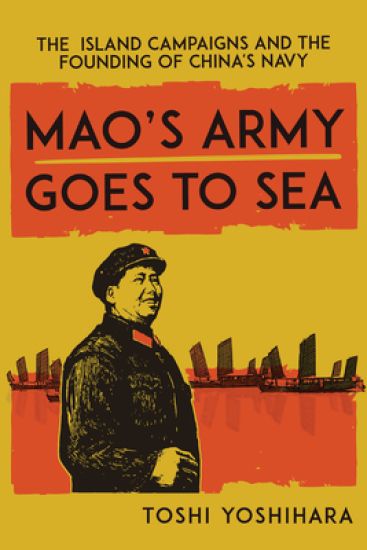
Mao's Army Goes to Sea

Mao's Army Goes to Sea

Toshi Yoshihara

GEORGETOWN UNIVERSITY PRESS
2023
pokkari
New details about the founding of China’s Navy reveals critical historical context and insight into future strategyFrom 1949 to 1950, the People’s Liberation Army (PLA) made crucial decisions to establish a navy and secure China’s periphery. The civil war had been fought with a peasant army, yet in order to capture key offshore islands from the Nationalist rival, Mao Zedong needed to develop maritime capabilities. Mao’s Army Goes to Sea is a ground-breaking history of the founding of the Chinese navy and Communist China’s earliest island-seizing campaigns. In this definitive account of a little-known yet critical moment in China’s naval history, Toshi Yoshihara shows that Chinese leaders refashioned the stratagems and tactics honed over decades of revolutionary struggle on land for nautical purposes. Despite significant challenges, the PLA ultimately scored important victories over its Nationalist foes as it captured offshore islands to secure its position. Drawing extensively from newly available Chinese-language sources, this book reveals how the navy-building process, sea battles, and contested offshore landings had a lasting influence on the PLA. Even today, the institution’s identity, strategy, doctrine, and structure are conditioned by these early experiences and myths. Mao’s Army Goes to Sea will help US policymakers and scholars place China’s recent maritime achievements in proper historical context—and provide insight into how its navy may act in the future.
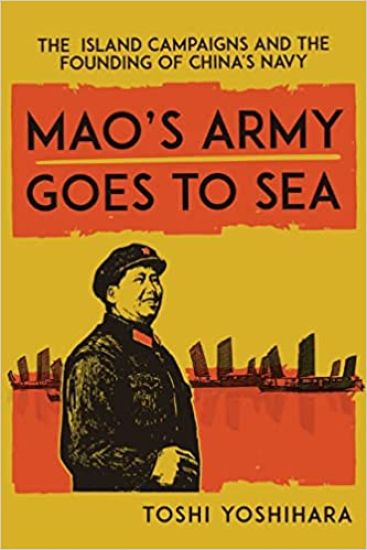
Mao's Army Goes to Sea

Mao's Army Goes to Sea

Toshi Yoshihara

GEORGETOWN UNIVERSITY PRESS
2023
sidottu
New details about the founding of China’s Navy reveals critical historical context and insight into future strategyFrom 1949 to 1950, the People’s Liberation Army (PLA) made crucial decisions to establish a navy and secure China’s periphery. The civil war had been fought with a peasant army, yet in order to capture key offshore islands from the Nationalist rival, Mao Zedong needed to develop maritime capabilities. Mao’s Army Goes to Sea is a ground-breaking history of the founding of the Chinese navy and Communist China’s earliest island-seizing campaigns. In this definitive account of a little-known yet critical moment in China’s naval history, Toshi Yoshihara shows that Chinese leaders refashioned the stratagems and tactics honed over decades of revolutionary struggle on land for nautical purposes. Despite significant challenges, the PLA ultimately scored important victories over its Nationalist foes as it captured offshore islands to secure its position. Drawing extensively from newly available Chinese-language sources, this book reveals how the navy-building process, sea battles, and contested offshore landings had a lasting influence on the PLA. Even today, the institution’s identity, strategy, doctrine, and structure are conditioned by these early experiences and myths. Mao’s Army Goes to Sea will help US policymakers and scholars place China’s recent maritime achievements in proper historical context—and provide insight into how its navy may act in the future.
Chinese Information Warfare: A Phantom Menace or Emerging Threat?

Chinese Information Warfare: A Phantom Menace or Emerging Threat?

Toshi Yoshihara; Strategic Studies Institute

Lulu.com
2014
nidottu
Mao Tse-tung counseled, "To achieve victory we must as far as possible make the enemy blind and deaf by sealing his eyes and ears, and drive his commanders to distraction by creating confusion in their minds." Few concepts mesh so contextually with Mao than the Chinese approach to Information Warfare (IW). As the People's Republic of China struggles with its national military strategy, IW offers opportunities to win wars without the traditional clash of arms. In this monograph, Mr. Toshi Yoshihara explores what he perceives to be China's pursuit of IW as a method of fighting asymmetric warfare against the United States. Largely imitative of U.S. thoughts, literature, and practices on IW, he believes the Chinese are seeking ways to adapt it to their own style of warfare. Paradoxically, he observes that the Chinese have not gleaned their intelligence through espionage, but through careful scrutiny of U.S. IW in practice. The Persian Gulf War and Kosovo conflict have provided ample largess to the Chinese ...
Chinese Naval Strategy in the 21st Century

Chinese Naval Strategy in the 21st Century

James R. Holmes; Toshi Yoshihara

Routledge
2009
nidottu
Alfred Thayer Mahan has been called America’s nineteenth-century ‘evangelist of sea power’ and the intellectual father of the modern US Navy. His theories have a timeless appeal, and Chinese analysts now routinely invoke Mahan’s writings, exhorting their nation to build a powerful navy. Economics is the prime motivation for maritime reorientation, and securing the sea lanes that convey foreign energy supplies and other commodities now ranks near or at the top of China’s list of military priorities. This book is the first systematic effort to test the interplay between Western military thought and Chinese strategic traditions vis-à-vis the nautical arena. It uncovers some universal axioms about how theories of sea power influence the behaviour of great powers and examines how Mahanian thought could shape China’s encounters on the high seas. Empirical analysis adds a new dimension to the current debate over China’s ‘rise’ and its importance for international relations. The findings also clarify the possible implications of China’s maritime rise for the United States, and illuminate how the two powers can manage their bilateral interactions on the high seas.Chinese Naval Strategy in the 21st Century will be of much interest to students of naval history, Chinese politics and security studies.
Chinese Naval Strategy in the 21st Century

Chinese Naval Strategy in the 21st Century

James R. Holmes; Toshi Yoshihara

Routledge
2007
sidottu
Alfred Thayer Mahan has been called America’s nineteenth-century ‘evangelist of sea power’ and the intellectual father of the modern US Navy. His theories have a timeless appeal, and Chinese analysts now routinely invoke Mahan’s writings, exhorting their nation to build a powerful navy. Economics is the prime motivation for maritime reorientation, and securing the sea lanes that convey foreign energy supplies and other commodities now ranks near or at the top of China’s list of military priorities. This book is the first systematic effort to test the interplay between Western military thought and Chinese strategic traditions vis-à-vis the nautical arena. It uncovers some universal axioms about how theories of sea power influence the behaviour of great powers and examines how Mahanian thought could shape China’s encounters on the high seas. Empirical analysis adds a new dimension to the current debate over China’s ‘rise’ and its importance for international relations. The findings also clarify the possible implications of China’s maritime rise for the United States, and illuminate how the two powers can manage their bilateral interactions on the high seas.Chinese Naval Strategy in the 21st Century will be of much interest to students of naval history, Chinese politics and security studies.