Kirjojen hintavertailu. Mukana 12 390 323 kirjaa ja 12 kauppaa.

Kirjailija

Tracy J. Trothen

Kirjat ja teokset yhdessä paikassa: 10 kirjaa, julkaisuja vuosilta 2003-2025, suosituimpien joukossa Winning the Race?. Vertaile teosten hintoja ja tarkista saatavuus suomalaisista kirjakaupoista.

Mukana myös kirjoitusasut: Tracy J Trothen

10 kirjaa

Kirjojen julkaisuhaarukka 2003-2025.

Understanding Religion and Artificial Intelligence

Understanding Religion and Artificial Intelligence

Randall Reed; Tracy J. Trothen

TAYLOR FRANCIS LTD
2025
nidottu
Is Artificial Intelligence just another tool, or is it something more… Special? In Understanding Religion and Artificial Intelligence: Meaning-Making in the Digital Age, Randall Reed and Tracy J. Trothen delve into this provocative question, revealing how our perceptions of AI are deeply intertwined with age-old human impulses to define the extraordinary.Introducing their innovative “Model of the Special,” Reed and Trothen illuminate how individuals, groups, and cultures dynamically shape AI’s meaning, ranging from the mundane to the Sacred and Demonic. Through compelling case studies – from AI chatbots, sport, and art to self-driving cars and “Deadbots” – the authors explore how narratives of awe, fear, and even transcendence position AI as a truly “Special thing” in our modern world.Drawing on insights from religious studies, ethics, and sociology, this interdisciplinary exploration provides a crucial framework for understanding the profound societal, ethical, and spiritual implications of AI. Understanding Religion and Artificial Intelligence invites readers to engage in vital conversations about AI’s impact on meaning, values, and the very fabric of human experience in this rapidly evolving digital age. Prepare to see AI—and ourselves—in a whole new light.
Understanding Religion and Artificial Intelligence

Understanding Religion and Artificial Intelligence

Randall Reed; Tracy J. Trothen

TAYLOR FRANCIS LTD
2025
sidottu
Is Artificial Intelligence just another tool, or is it something more… Special? In Understanding Religion and Artificial Intelligence: Meaning-Making in the Digital Age, Randall Reed and Tracy J. Trothen delve into this provocative question, revealing how our perceptions of AI are deeply intertwined with age-old human impulses to define the extraordinary.Introducing their innovative “Model of the Special,” Reed and Trothen illuminate how individuals, groups, and cultures dynamically shape AI’s meaning, ranging from the mundane to the Sacred and Demonic. Through compelling case studies – from AI chatbots, sport, and art to self-driving cars and “Deadbots” – the authors explore how narratives of awe, fear, and even transcendence position AI as a truly “Special thing” in our modern world.Drawing on insights from religious studies, ethics, and sociology, this interdisciplinary exploration provides a crucial framework for understanding the profound societal, ethical, and spiritual implications of AI. Understanding Religion and Artificial Intelligence invites readers to engage in vital conversations about AI’s impact on meaning, values, and the very fabric of human experience in this rapidly evolving digital age. Prepare to see AI—and ourselves—in a whole new light.
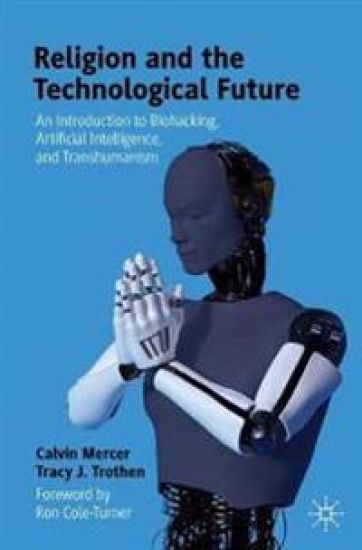
Religion and the Technological Future

Religion and the Technological Future

Calvin Mercer; Tracy J. Trothen

Springer Nature Switzerland AG
2021
nidottu
We live in an age of rapid technological advancement. Never before has humankind wielded so much power over our own biology. Biohacking, the attempt at human enhancement of physical, cognitive, affective, moral, and spiritual traits, has become a global phenomenon. This textbook introduces religious and ethical implications of biohacking, artificial intelligence, and other technological changes, offering perspectives from monotheistic and karmic religions and applied ethics. These technological breakthroughs are transforming our societies and ourselves fundamentally via genetic modification, tissue engineering, artificial intelligence, robotics, the merging of computer technology with human biology, extended reality, brain stimulation, and nanotechnology. The book also considers the extreme possibilities of mind uploading, cryonics, and superintelligence. Chapters explore some of the political, economic, sociological, and psychological dimensions of these advances, withbibliographies for further study and questions for discussion. The technological future is here – and it is up to us to decide its moral and religious shape.
A Faithful Public-Prophetic Witness

A Faithful Public-Prophetic Witness

Barry K Morris; Tracy J Trothen

Wipf Stock Publishers
2020
sidottu
This book hails from decades of challenging trial-and-error work, abundant reading, and an enduring obligation to ministers, activists, and unsung lay heroes whose legacies matter. As there is little that actually addresses the elusive meanings, if not the dangers inherent in pursuing alleged spoils of ""success,"" it is kairos time. Seemingly scarce resources and competition to make and maintain ministries in the city challenge those of us in the field, or on the sidelines, to speak, write, and communicate clearly, and convincingly--not only for ourselves and our ""people,"" past and present, but for those who come along soon to receive the baton or wear the mantle. Concretely narrated, with unique case studies, a cast of dozens contribute their earthy, earnest testimonies and are, at long last, energetically affirmed. Specifically, this work proffers constructive attention to the critical cautions concerning subtle temptations to ""succeed,"" including: commodification, cooptation, communalism, clientelism, and cowardice--and, not bailing on fierce charity-justice tensions (with benevolence protectively dominant). Narrative analysis and biography-as-theology, social ethics, biblical theology, and recent church history give apt attention to how a compelling case is possible for success, if justice is practiced, given a hopeful realism and perspective of prophetic eschatology.
Spiritualities, ethics, and implications of human enhancement and artificial intelligence
By taking a religiously and spiritually literature approach, this volume gets the heart of several emerging ethical issues crucial to both human identity and personhood beyond the human as technology advances in the areas of human enhancement and artificial intelligence (AI). Several significant questions are addressed by the contributors, such as: How far should we go in improving our biological selves? How long should we aspire to live? What are fair and just human enhancements? When will AIs become people? What does AI spirituality consist of? Can AIs do more than project humour and emotions? What are the religious undertones of these high technology quests for better AI and improved human existence? Established and emerging voices explore these questions, and more, in Spiritualities, ethics, and implications of human enhancement and artificial intelligence. This volume will be of interest to university students and researchers absorbed by issues surrounding spiritualities, human enhancement, and artificial intelligence; while also providing points for reflection for the wider public as these topics become increasingly important to our common future.
Spirituality, Sport, and Doping: More than Just a Game

Spirituality, Sport, and Doping: More than Just a Game

Tracy J. Trothen

Springer Nature Switzerland AG
2018
nidottu
This book explores the deeper meaning of sports. Drawing on contemporary research, the author makes a strong case for why we should see sport not only in terms of religion but--more importantly-as a possible location for spiritual meaning. Taking this a step farther, she considers how gene editing, robotics, and other biomedical technological enhancements affect not only sports performances but experiences of sport as sacred. In addition, the author explores what difference it might make to the enhancement debate if sports’ spirituality is taken seriously. The author is not afraid to explore the issue in all its complexity. Yet, the argument she presents is both meaningful and accessible. This investigation applies insights from Christian theology, applied ethics, psychology, and sports studies. From lightweight tennis racquets to anabolic steroids, athletes have long used technology and science to improve their performances. But, until now, no one has askedhow biomedical technological enhancements might affect the undervalued spiritual dimension of sport. This book presents rich insights into the connection between sports, spirituality, and human enhancement technologies. It will appeal to researchers, athletes and sports followers, and undergraduate and graduate students in ethics, sport, religion or theology.
Winning the Race?

Winning the Race?

Tracy J. Trothen

Mercer University Press
2015
nidottu
Examining hope as a spiritual dimension of sport—how hope is morally relevant to the sport enhancement debate should high-tech prosthetic limbs be permissible in elite sports competitions? Why are caffeine and engineer new enhancing options such as genetic modification technologies that increase muscle strength, or individualized nutritional genomic programs for elite athletes? The ethics debate about the use of enhancements in elite sport is becoming increasingly complex. Yet we are not asking what relevance sports’ religious dimension has to this debate. Through an examination of literature on the relationship between sport, religion and spirituality, hope emerges as a compelling feature of sport and a significant part of what makes sport meaningful. Trothen explores four main locations of hope in sport: winning, losing, and anticipation; star athletes; perfect moments; and relational embodiment, and examines how these locations intersect with the enhancement debate. Using Christian theological reflection to problematize the four main approaches to the ethical question of enhancement use in elite sport, and the underlying values informing these approaches, Trothen asks: How will hope in sport potentially be affected by techno-science? And how might a valuing of sports’ spiritual dimension—and particularly hope—reshape the sport enhancement debate? The clear conclusion is that sports’ spiritual dimension includes hope, and the locations of hope in sport are morally relevant to the sport enhancement discussion.
Shattering the Illusion

Shattering the Illusion

Tracy J. Trothen

Wilfrid Laurier University Press
2012
nidottu
Shattering the Illusion is the first book to gather and comparatively analyze policies addressing child sexual abuse complaints in a selection of religious institutions in Canada. Although there is a substantial body of literature regarding Christianity and sexual abuse, very little of it focuses on religious institutions in Canada and their respective policies. In the foreword, Tracey J. Trothen summarizes the Cornwall Inquiry, out of which this book arose. She then examines the Roman Catholic Church, The United Church of Canada, the Anglican Church, the Mennonite Church, Islam, and the Canadian Unitarian Council/Unitarian Universalist Association, describing in detail the evolution and particular content of policies and procedures that address child sexual abuse complaints directed at paid and volunteer faith community representatives and/ or leaders. She identifies differences and common themes among the approaches taken by the institutions and provides a summary table for an accessible comparative overview. Child sexual abuse is not new, but the emergence of policies to address abuse complaints within religious institutions is. This book identifies significant and shared causal factors behind the emergence of policy and reviews their content carefully. This review will serve as a significant tool for furthering the development of such policies.
Linking Sexuality and Gender

Linking Sexuality and Gender

Tracy J. Trothen

Wilfrid Laurier University Press
2003
nidottu
Why did it take so long for the United Church of Canada to respond to violence against women? Tracy J. Trothen looks at the United Church as a uniquely Canadian institution, and explores how it has approached gender and sexuality issues. She argues that how the Church deals with these issues influences its ability to name violence against women. In examining the Church's early approaches to gender and sexuality, Tracy J. Trothen discovered that the United Church had tended to see certain structures or roles as sacred and others as demonic. For example, while sex outside marriage was bad or improper, sexual expression within marriage was largely deemed as proper or good, no matter what manifestation it took. This assumption allowed much violence within families and marriages to go unchallenged. Trothen uncovers significant shifts in this approach through the examination of such issues as redemptive homes, marriage, pornography, abortion, the ordination of women, and family. Then, analyzing three recent case studies, she demonstrates the value of women's voices in challenging dominant world views. Finally, she suggests how the Church's approach to human sexuality and gender has facilitated or obstructed the move to address violence against women. The findings in Linking Sexuality and Gender can be applied to faiths outside the United Church and will be important to anyone interested in church and society, sexuality, gender, or the causal dynamics behind one Canadian institution's response to violence against women. Tracy J. Trothen is an assistant professor of systematic theology and ethics, and director of field education at Queen's Theological College, Queen's University, Canada. She was ordained in the United Church of Canada. Why did it take so long for the United Church of Canada to respond to violence against women?