Kirjojen hintavertailu. Mukana 12 390 323 kirjaa ja 12 kauppaa.

Kirjailija

Tsutomu Sasao

Kirjat ja teokset yhdessä paikassa: 9 kirjaa, julkaisuja vuosilta 1999-2024, suosituimpien joukossa Index Generation Functions. Vertaile teosten hintoja ja tarkista saatavuus suomalaisista kirjakaupoista.

9 kirjaa

Kirjojen julkaisuhaarukka 1999-2024.

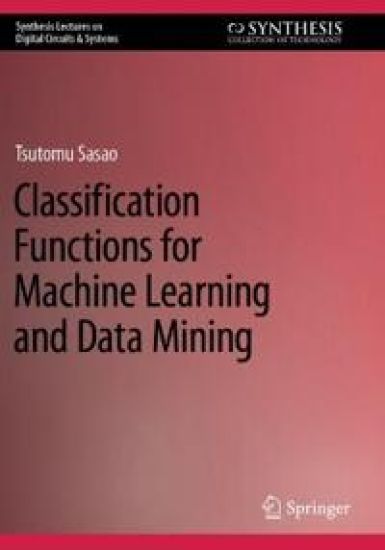
Classification Functions for Machine Learning and Data Mining

Classification Functions for Machine Learning and Data Mining

Tsutomu Sasao

Springer International Publishing AG
2024
nidottu
This book introduces a novel perspective on machine learning, offering distinct advantages over neural network-based techniques. This approach boasts a reduced hardware requirement, lower power consumption, and enhanced interpretability. The applications of this approach encompass high-speed classifications, including packet classification, network intrusion detection, and exotic particle detection in high-energy physics. Moreover, it finds utility in medical diagnosis scenarios characterized by small training sets and imbalanced data. The resulting rule generated by this method can be implemented either in software or hardware. In the case of hardware implementation, circuit design can employ look-up tables (memory), rather than threshold gates.The methodology described in this book involves extracting a set of rules from a training set, composed of categorical variable vectors and their corresponding classes. Unnecessary variables are eliminated, and the rules are simplified before being transformed into a sum-of-products (SOP) form. The resulting SOP exhibits the ability to generalize and predict outputs for new inputs. The effectiveness of this approach is demonstrated through numerous examples and experimental results using the University of California-Irvine (UCI) dataset.This book is primarily intended for graduate students and researchers in the fields of logic synthesis, machine learning, and data mining. It assumes a foundational understanding of logic synthesis, while familiarity with linear algebra and statistics would be beneficial for readers.
Classification Functions for Machine Learning and Data Mining

Classification Functions for Machine Learning and Data Mining

Tsutomu Sasao

Springer International Publishing AG
2023
sidottu
This book introduces a novel perspective on machine learning, offering distinct advantages over neural network-based techniques. This approach boasts a reduced hardware requirement, lower power consumption, and enhanced interpretability. The applications of this approach encompass high-speed classifications, including packet classification, network intrusion detection, and exotic particle detection in high-energy physics. Moreover, it finds utility in medical diagnosis scenarios characterized by small training sets and imbalanced data. The resulting rule generated by this method can be implemented either in software or hardware. In the case of hardware implementation, circuit design can employ look-up tables (memory), rather than threshold gates.The methodology described in this book involves extracting a set of rules from a training set, composed of categorical variable vectors and their corresponding classes. Unnecessary variables are eliminated, and the rules are simplified before being transformed into a sum-of-products (SOP) form. The resulting SOP exhibits the ability to generalize and predict outputs for new inputs. The effectiveness of this approach is demonstrated through numerous examples and experimental results using the University of California-Irvine (UCI) dataset.This book is primarily intended for graduate students and researchers in the fields of logic synthesis, machine learning, and data mining. It assumes a foundational understanding of logic synthesis, while familiarity with linear algebra and statistics would be beneficial for readers.
Index Generation Functions

Index Generation Functions

Tsutomu Sasao

Springer International Publishing AG
2019
nidottu
Index generation functions are binary-input integer valued functions. They represent functions of content addressable memories (CAMs). Applications include: IP address tables; terminal controllers; URL lists; computer virus scanning circuits; memory patch circuits; list of English words; code converters; and pattern matching circuits. This book shows memory-based realization of index generation functions. It shows: 1. methods to implement index generation functions by look-up table (LUT) cascades and index generation units (IGU), 2. methods to reduce the number of variables using linear transformations, and 3. methods to estimate the sizes of memories, with many illustrations, tables, examples, exercises, and their solutions.
Applications of Zero-Suppressed Decision Diagrams

Applications of Zero-Suppressed Decision Diagrams

Jon T. Butler; Tsutomu Sasao

Springer International Publishing AG
2014
nidottu
A zero-suppressed decision diagram (ZDD) is a data structure to represent objects that typically contain many zeros. Applications include combinatorial problems, such as graphs, circuits, faults, and data mining. This book consists of four chapters on the applications of ZDDs. The first chapter by Alan Mishchenko introduces the ZDD. It compares ZDDs to BDDs, showing why a more compact representation is usually achieved in a ZDD. The focus is on sets of subsets and on sum-of-products (SOP) expressions. Methods to generate all the prime implicants (PIs), and to generate irredundant SOPs are shown. A list of papers on the applications of ZDDs is also presented. In the appendix, ZDD procedures in the CUDD package are described. The second chapter by Tsutomu Sasao shows methods to generate PIs and irredundant SOPs using a divide and conquer method. This chapter helps the reader to understand the methods presented in the first chapter. The third chapter by Shin-Ichi Minato introduces the ""frontier-based"" method that efficiently enumerates certain subsets of a graph. The final chapter by Shinobu Nagayama shows a method to match strings of characters. This is important in routers, for example, where one must match the address information of an internet packet to the proprer output port. It shows that ZDDs are more compact than BDDs in solving this important problem. Each chapter contains exercises, and the appendix contains their solutions. Table of Contents: Preface / Acknowledgments / Introduction to Zero-Suppressed Decision Diagrams / Efficient Generation of Prime Implicants and Irredundant Sum-of-Products Expressions / The Power of Enumeration--BDD/ZDD-Based Algorithms for Tackling Combinatorial Explosion / Regular Expression Matching Using Zero-Suppressed Decision Diagrams / Authors' and Editors' Biographies / Index
Memory-Based Logic Synthesis

Memory-Based Logic Synthesis

Tsutomu Sasao

Springer-Verlag New York Inc.
2014
nidottu
This book describes the synthesis of logic functions using memories. It is useful to design field programmable gate arrays (FPGAs) that contain both small-scale memories, called look-up tables (LUTs), and medium-scale memories, called embedded memories. This is a valuable reference for both FPGA system designers and CAD tool developers, concerned with logic synthesis for FPGAs.
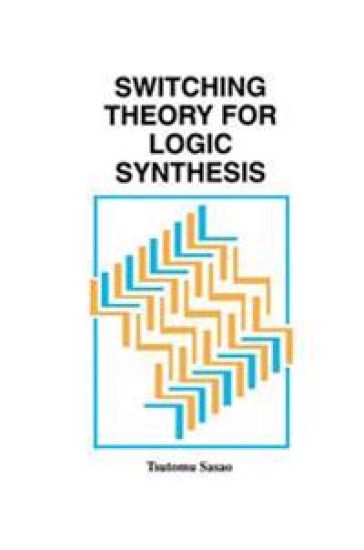
Switching Theory for Logic Synthesis

Switching Theory for Logic Synthesis

Tsutomu Sasao

Springer-Verlag New York Inc.
2012
nidottu
Switching Theory for Logic Synthesis covers the basic topics of switching theory and logic synthesis in fourteen chapters. Chapters 1 through 5 provide the mathematical foundation. Chapters 6 through 8 include an introduction to sequential circuits, optimization of sequential machines and asynchronous sequential circuits. Chapters 9 through 14 are the main feature of the book. These chapters introduce and explain various topics that make up the subject of logic synthesis: multi-valued input two-valued output function, logic design for PLDs/FPGAs, EXOR-based design, and complexity theories of logic networks. An appendix providing a history of switching theory is included. The reference list consists of over four hundred entries. Switching Theory for Logic Synthesis is based on the author's lectures at Kyushu Institute of Technology as well as seminars for CAD engineers from various Japanese technology companies. Switching Theory for Logic Synthesis will be of interest to CAD professionals and students at the advanced level. It is also useful as a textbook, as each chapter contains examples, illustrations, and exercises.
Memory-Based Logic Synthesis

Memory-Based Logic Synthesis

Tsutomu Sasao

Springer-Verlag New York Inc.
2011
sidottu
This book describes the synthesis of logic functions using memories. It is useful to design field programmable gate arrays (FPGAs) that contain both small-scale memories, called look-up tables (LUTs), and medium-scale memories, called embedded memories. This is a valuable reference for both FPGA system designers and CAD tool developers, concerned with logic synthesis for FPGAs.
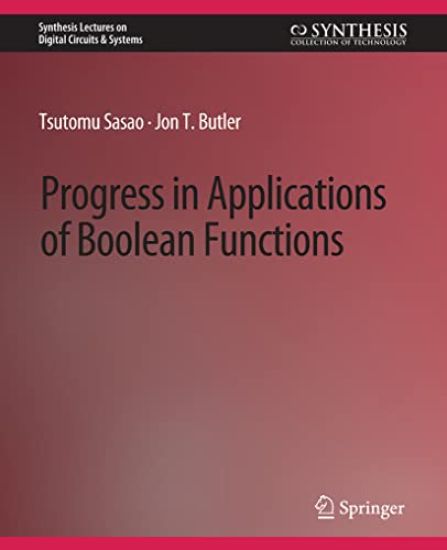
Progress in Applications of Boolean Functions

Progress in Applications of Boolean Functions

Tsutomu Sasao; Jon Butler

Springer International Publishing AG
2009
nidottu
This book brings together five topics on the application of Boolean functions. They are 1. Equivalence classes of Boolean functions: The number of n-variable functions is large, even for values as small as n = 6, and there has been much research on classifying functions. There are many classifications, each with their own distinct merit. 2. Boolean functions for cryptography: The process of encrypting/decrypting plaintext messages often depends on Boolean functions with specific properties. For example, highly nonlinear functions are valued because they are less susceptible to linear attacks. 3. Boolean differential calculus: An operation analogous to taking the derivative of a real-valued function offers important insight into the properties of Boolean functions. One can determine tests or susceptibility to hazards. 4. Reversible logic: Most logic functions are irreversible; it is impossible to reconstruct the input, given the output. However, Boolean functions that are reversible arenecessary for quantum computing, and hold significant promise for low-power computing. 5. Data mining: The process of extracting subtle patterns from enormous amounts of data has benefited from the use of a graph-based representation of Boolean functions. This has use in surveillance, fraud detection, scientific discovery including bio-informatics, genetics, medicine, and education. Written by experts, these chapters present a tutorial view of new and emerging technologies in Boolean functions. Table of Contents: Equivalence Classes of Boolean Functions / Boolean Functions for Cryptography / Boolean Differential Calculus / Synthesis of Boolean Functions in Reversible Logic / Data Mining Using Binary Decision Diagrams
Switching Theory for Logic Synthesis
Switching Theory for Logic Synthesis covers the basic topics of switching theory and logic synthesis in fourteen chapters. Chapters 1 through 5 provide the mathematical foundation. Chapters 6 through 8 include an introduction to sequential circuits, optimization of sequential machines and asynchronous sequential circuits. Chapters 9 through 14 are the main feature of the book. These chapters introduce and explain various topics that make up the subject of logic synthesis: multi-valued input two-valued output function, logic design for PLDs/FPGAs, EXOR-based design, and complexity theories of logic networks. An appendix providing a history of switching theory is included. The reference list consists of over four hundred entries. Switching Theory for Logic Synthesis is based on the author's lectures at Kyushu Institute of Technology as well as seminars for CAD engineers from various Japanese technology companies. Switching Theory for Logic Synthesis will be of interest to CAD professionals and students at the advanced level. It is also useful as a textbook, as each chapter contains examples, illustrations, and exercises.