Kirjojen hintavertailu. Mukana 12 390 323 kirjaa ja 12 kauppaa.

Kirjailija

U.S. Dixit

Kirjat ja teokset yhdessä paikassa: 6 kirjaa, julkaisuja vuosilta 2008-2025, suosituimpien joukossa Modeling of Metal Forming and Machining Processes. Vertaile teosten hintoja ja tarkista saatavuus suomalaisista kirjakaupoista.

6 kirjaa

Kirjojen julkaisuhaarukka 2008-2025.

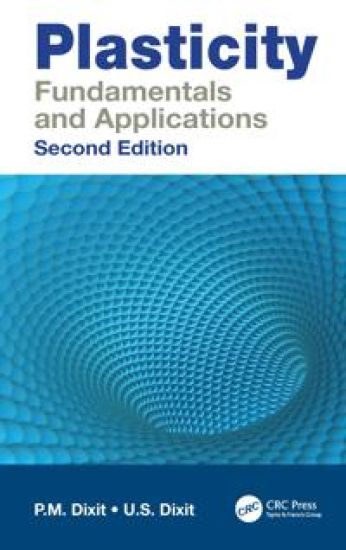
Plasticity

Plasticity

P.M. Dixit; U.S. Dixit

TAYLOR FRANCIS LTD
2025
sidottu
This book covers the fundamentals of the elastic-plastic deformation including stress, strain, constitutive relations, fracture, anisotropy and contact problems along with a discussion of updated Lagrangian and Eulerian formulations. The second edition includes new material on thermal effects in plasticity and an introduction to crystal plasticity with review of all the chapters including more solved examples and a solutions manual.Features:Explores the physics behind the equations and computational aspects of plasticity.Reviews the latest developments in fracture mechanics including elasto-plastic behavior of solids.Explains anisotropy, thermal effects, dynamics plasticity, contact mechanics and ductile fracture.Provides introduction to crystal plasticity.Includes real-life examples in the form of solved and unsolved examples, and practice problems including MATLAB® and solutions manual.This textbook is aimed at senior undergraduate and graduate students in mechanics and mechanical engineering.
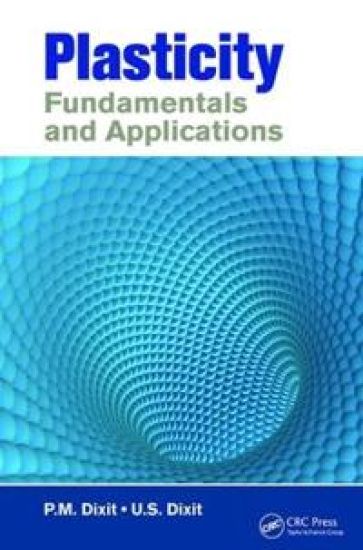
Plasticity

Plasticity

P.M. Dixit; U.S. Dixit

CRC Press
2018
nidottu
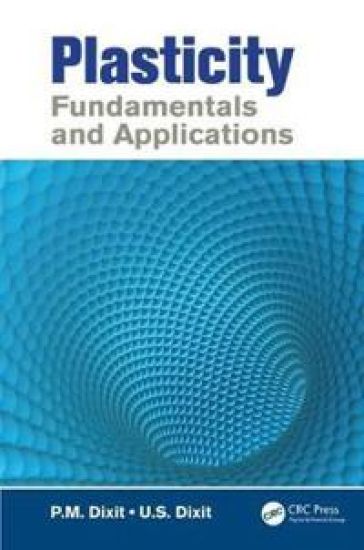
Explores the Principles of PlasticityMost undergraduate programs lack an undergraduate plasticity theory course, and many graduate programs in design and manufacturing lack a course on plasticity—leaving a number of engineering students without adequate information on the subject. Emphasizing stresses generated in the material and its effect, Plasticity: Fundamentals and Applications effectively addresses this need. This book fills a void by introducing the basic fundamentals of solid mechanics of deformable bodies. It provides a thorough understanding of plasticity theory, introduces the concepts of plasticity, and discusses relevant applications. Studies the Effects of Forces and Motions on SolidsThe authors make a point of highlighting the importance of plastic deformation, and also discuss the concepts of elasticity (for a clear understanding of plasticity, the elasticity theory must also be understood). In addition, they present information on updated Lagrangian and Eulerian formulations for the modeling of metal forming and machining.Topics covered include:StressStrainConstitutive relationsFractureAnisotropyContact problems Plasticity: Fundamentals and Applications enables students to understand the basic fundamentals of plasticity theory, effectively use commercial finite-element (FE) software, and eventually develop their own code. It also provides suitable reference material for mechanical/civil/aerospace engineers, material processing engineers, applied mechanics researchers, mathematicians, and other industry professionals.
Plasticity

Plasticity

P.M. Dixit; U.S. Dixit

CRC Press Inc
2014
sidottu
Explores the Principles of PlasticityMost undergraduate programs lack an undergraduate plasticity theory course, and many graduate programs in design and manufacturing lack a course on plasticity—leaving a number of engineering students without adequate information on the subject. Emphasizing stresses generated in the material and its effect, Plasticity: Fundamentals and Applications effectively addresses this need. This book fills a void by introducing the basic fundamentals of solid mechanics of deformable bodies. It provides a thorough understanding of plasticity theory, introduces the concepts of plasticity, and discusses relevant applications. Studies the Effects of Forces and Motions on SolidsThe authors make a point of highlighting the importance of plastic deformation, and also discuss the concepts of elasticity (for a clear understanding of plasticity, the elasticity theory must also be understood). In addition, they present information on updated Lagrangian and Eulerian formulations for the modeling of metal forming and machining.Topics covered include:StressStrainConstitutive relationsFractureAnisotropyContact problems Plasticity: Fundamentals and Applications enables students to understand the basic fundamentals of plasticity theory, effectively use commercial finite-element (FE) software, and eventually develop their own code. It also provides suitable reference material for mechanical/civil/aerospace engineers, material processing engineers, applied mechanics researchers, mathematicians, and other industry professionals.
Environmentally Friendly Machining

Environmentally Friendly Machining

U.S. Dixit; D.K. Sarma; J. Paulo Davim

Springer-Verlag New York Inc.
2012
nidottu
Environment-Friendly Machining provides an in-depth overview of environmentally-friendly machining processes, covering numerous different types of machining in order to identify which practice is the most environmentally sustainable. The book discusses three systems at length: machining with minimal cutting fluid, air-cooled machining and dry machining. Also covered is a way to conserve energy during machining processes, along with useful data and detailed descriptions for developing and utilizing the most efficient modern machining tools. Researchers and engineers looking for sustainable machining solutions will find Environment-Friendly Machining to be a useful volume.
Modeling of Metal Forming and Machining Processes

Modeling of Metal Forming and Machining Processes

Prakash Mahadeo Dixit; U.S. Dixit

Springer London Ltd
2010
nidottu
The use of computational techniques is increasing day by day in the manufacturing sector. Process modeling and optimization with the help of computers can reduce expensive and time consuming experiments for manufacturing good quality products. Metal forming and machining are two prominent manufacturing processes. Both of these processes involve large deformation of elasto-plastic materials due to applied loads. In metal forming, the material is plastically deformed without causing fracture. On the other hand, in machining, the material is deformed till fracture, in order to remove material in the form of chips. To understand the physics of metal forming and machining processes, one needs to understand the kinematics of large deformation (dependence of deformation and its rate on displacement) as well as the constitutive behavior of elasto-plastic materials (dependence of internal forces on deformation and its rate). Once the physics is understood, these phenomena have to be converted to mathematical relations in the form of differential equations. The interaction of the work-piece with the tools/dies and other surroundings also needs to be expressed in a mathematical form (known as the boundary and initial conditions). In this book, the first four chapters essentially discuss the physics of metal forming and machining processes. The physical behavior of the work-piece during the processes is modeled in the form of differential equations and boundary and initial conditions.
Modeling of Metal Forming and Machining Processes

Modeling of Metal Forming and Machining Processes

Prakash Mahadeo Dixit; U.S. Dixit

Springer London Ltd
2008
sidottu
The use of computational techniques is increasing day by day in the manufacturing sector. Process modeling and optimization with the help of computers can reduce expensive and time consuming experiments for manufacturing good quality products. Metal forming and machining are two prominent manufacturing processes. Both of these processes involve large deformation of elasto-plastic materials due to applied loads. In metal forming, the material is plastically deformed without causing fracture. On the other hand, in machining, the material is deformed till fracture, in order to remove material in the form of chips. To understand the physics of metal forming and machining processes, one needs to understand the kinematics of large deformation (dependence of deformation and its rate on displacement) as well as the constitutive behavior of elasto-plastic materials (dependence of internal forces on deformation and its rate). Once the physics is understood, these phenomena have to be converted to mathematical relations in the form of differential equations. The interaction of the work-piece with the tools/dies and other surroundings also needs to be expressed in a mathematical form (known as the boundary and initial conditions). In this book, the first four chapters essentially discuss the physics of metal forming and machining processes. The physical behavior of the work-piece during the processes is modeled in the form of differential equations and boundary and initial conditions.