Kirjojen hintavertailu. Mukana 12 657 676 kirjaa ja 12 kauppaa.
Kirjailija
Ugo Amaldi
Kirjat ja teokset yhdessä paikassa: 3 kirjaa, julkaisuja vuosilta 2006-2015, suosituimpien joukossa Elementary Particles - Accelerators and Colliders. Vertaile teosten hintoja ja tarkista saatavuus suomalaisista kirjakaupoista.
Ugo Amaldi; Norbert Angert; Klaus Bethge; Frederick Bordry; Werner Herr; Friedhelm Caspers; Jean-Pierre Delahaye; Wolfram Fischer; Etienne Forest; Brennan Goddard; Markus Brugger; Helmut Burkhardt; Susanna Guiducci; Klaus Hanke; Jim Hinton; Werner Hofmann; Stephen D. Holmes; Kurt Hübner; Yacine Kadi; Michael Lamont; Ralph Wolfgang Assmann; Oliver Brüning; Roland Garoby; Ralph Steinhagen; Rogelio Tomás García; Jörg Wenninger; Luca Bottura Bottura; Erk Jensen; Jose Miguel Jimenez; Owain Rhodri Jones; Bernhard Holzer; John Jowett
After a historical consideration of the types and evolution of accelerators the physics of particle beams is provided in detail. Topics dealt with comprise linear and nonlinear beam dynamics, collective phenomena in beams, and interactions of beams with the surroundings. The design and principles of synchrotrons, circular and linear colliders, and of linear accelerators are discussed next. Also technological aspects of accelerators (magnets, RF cavities, cryogenics, power supply, vacuum, beam instrumentation, injection and extraction) are reviewed, as well as accelerator operation (parameter control, beam feedback system, orbit correction, luminosity optimization). After introducing the largest accelerators and colliders of their times the application of accelerators and storage rings in industry, medicine, basic science, and energy research is discussed, including also synchrotron radiation sources and spallation sources. Finally, cosmic accelerators and an outlook for the future are given.
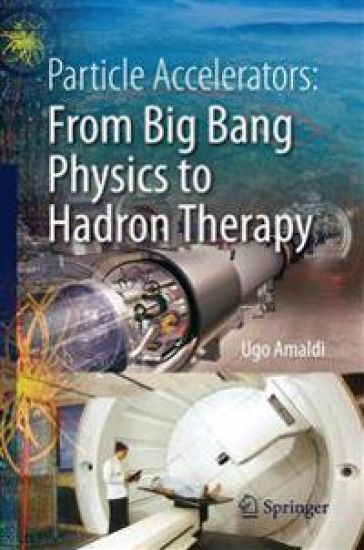
Rather than focusing on the contributions of theoretical physicists to the understanding of the subatomic world and of the beginning of the universe - as most popular science books on particle physics do - this book is different in that, firstly, the main focus is on machine inventors and builders and, secondly, particle accelerators are not only described as discovery tools but also for their contributions to tumour diagnosis and therapy. The characters of well-known (e.g. Ernest Lawrence) and mostly unknown actors (e.g. Nicholas Christofilos) are outlined, including many colourful quotations. The overall picture supports the author’s motto: “Physics is beautiful and useful”.Advance appraisal:“Accelerators go all the way from the unique and gargantuan Large Hadron Collider to thousands of smaller versions in hospitals and industry. Ugo Amaldi has experience across the range. He has worked at CERN and has for many years been driving the application ofaccelerators in medicine. This is a must-read introduction to this frontier of modern technology, written beautifully by a world expert.”Frank Close, Professor of Physics at Oxford University author of "The Infinity Puzzle"“This book should be read by school teachers and all those interested in the exploration of the microcosm and its relation to cosmology, and in the use of accelerators for medical applications. With a light hand and without formulae the author easily explains complicated matters, spicing up the text with amusing historical anecdotes. His reputation as an outstanding scientist in all the fields treated guarantees high standards.”Herwig Schopper, former CERN Director General author of "LEP - The Lord of the Collider Rings at CERN"“This book tells the story of modern physics with an unusual emphasis on the machine-builders who made it all possible, and their machines. Learning toaccelerate particles has enabled physicists to probe the subatomic world and gain a deeper understanding of the cosmos. It has also brought numerous benefits to medicine, from the primitive X-ray machines of over a century ago to today's developments in hadron therapy for cancer. Amaldi tells this story in a most fascinating way.”Edward Witten, Professor of Mathematical Physics at the Institute for Advanced Study in Princeton; Fields Medal (1990)