Kirjojen hintavertailu. Mukana 12 390 323 kirjaa ja 12 kauppaa.

Kirjailija

Ugo Mattei

Kirjat ja teokset yhdessä paikassa: 10 kirjaa, julkaisuja vuosilta 1998-2019, suosituimpien joukossa Introduction to Italian Law. Vertaile teosten hintoja ja tarkista saatavuus suomalaisista kirjakaupoista.

10 kirjaa

Kirjojen julkaisuhaarukka 1998-2019.

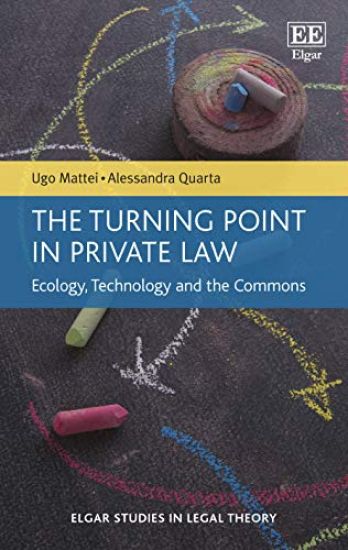
The Turning Point in Private Law

The Turning Point in Private Law

Ugo Mattei; Alessandra Quarta

Edward Elgar Publishing Ltd
2019
nidottu
Can private law assume an ecological meaning? Can property and contract defend nature? Is tort law an adequate tool for paying environmental damages to future generations? This book explores potential resolutions to these questions, analyzing the evolution of legal thinking in relation to the topics of legal personality, property, contract and tort.In this forward thinking book, Mattei and Quarta suggest a list of basic principles upon which a new, ecological legal system could be based. Taking private law to represent an ally in the defence of our future, they offer a clear characterization of the fundamental legal institutions of common law and civil law, considering the challenges of the Anthropogenic era, technological tools of the Internet era, and the global rise of the commons. Summarizing the fundamental institutions of private law: property rights, legal personality, contract, and tort, the authors reveal the limits of these legal institutions in relation to historical international evolution and their regulation in the contexts of catastrophic ecological issues and technological developments.Engaging and thoughtful, this book will be interesting reading for legal scholars and academics of private law and, in particular, those wishing to understand the role of law when facing technological and ecological challenges.
The Turning Point in Private Law

The Turning Point in Private Law

Ugo Mattei; Alessandra Quarta

Edward Elgar Publishing Ltd
2018
sidottu
Can private law assume an ecological meaning? Can property and contract defend nature? Is tort law an adequate tool for paying environmental damages to future generations? This book explores potential resolutions to these questions, analyzing the evolution of legal thinking in relation to the topics of legal personality, property, contract and tort.In this forward thinking book, Mattei and Quarta suggest a list of basic principles upon which a new, ecological legal system could be based. Taking private law to represent an ally in the defence of our future, they offer a clear characterization of the fundamental legal institutions of common law and civil law, considering the challenges of the Anthropogenic era, technological tools of the Internet era, and the global rise of the commons. Summarizing the fundamental institutions of private law: property rights, legal personality, contract, and tort, the authors reveal the limits of these legal institutions in relation to historical international evolution and their regulation in the contexts of catastrophic ecological issues and technological developments.Engaging and thoughtful, this book will be interesting reading for legal scholars and academics of private law and, in particular, those wishing to understand the role of law when facing technological and ecological challenges.
Gemensam nytta

Gemensam nytta

Ugo Mattei

Balders förlag
2016
nidottu
EXPROPRIERING är reglerat i lag så att den enskilde garanteras eersättning om hens mark tas i anspråk för andra syften. Men när stater eller kommuner säljer ut det som tillhör alla, och alltså även efterlevande släkten, då finns ingen motsvarande reglering. I Gemensam nytta undersöker den itanienske juridikprofessorn Ugo Mattei hur synen på det gemensammaförändrats från medeltiden till idag och visar hur centrala mänskliga behov och intressen blir klämnda mellan staters och privata aktörers jakt på vinst. Boken skrevs som en manifest och har väkt livlig debatt i Italien och runt om Europa, genom sitt pasionerande och sakkunniga försvar för allmänningen och våra gemensamma tillgångar.
Plunder

Plunder

Ugo Mattei; Laura Nader

Wiley-Blackwell (an imprint of John Wiley Sons Ltd)
2008
nidottu
Plunder examines the dark side of the Rule of Law and explores how it has been used as a powerful political weapon by Western countries in order to legitimize plunder – the practice of violent extraction by stronger political actors victimizing weaker ones. Challenges traditionally held beliefs in the sanctity of the Rule of Law by exposing its dark sideExamines the Rule of Law's relationship with 'plunder' – the practice of violent extraction by stronger political actors victimizing weaker ones – in the service of Western cultural and economic dominationProvides global examples of plunder: of oil in Iraq; of ideas in the form of Western patents and intellectual property rights imposed on weaker peoples; and of liberty in the United StatesDares to ask the paradoxical question – is the Rule of Law itself illegal?
Plunder

Plunder

Ugo Mattei; Laura Nader

Wiley-Blackwell (an imprint of John Wiley Sons Ltd)
2008
sidottu
Plunder examines the dark side of the Rule of Law and explores how it has been used as a powerful political weapon by Western countries in order to legitimize plunder – the practice of violent extraction by stronger political actors victimizing weaker ones. Challenges traditionally held beliefs in the sanctity of the Rule of Law by exposing its dark sideExamines the Rule of Law's relationship with 'plunder' – the practice of violent extraction by stronger political actors victimizing weaker ones – in the service of Western cultural and economic dominationProvides global examples of plunder: of oil in Iraq; of ideas in the form of Western patents and intellectual property rights imposed on weaker peoples; and of liberty in the United StatesDares to ask the paradoxical question – is the Rule of Law itself illegal?
The European Codification Process

The European Codification Process

Ugo Mattei

Kluwer Law International
2003
sidottu
This volume contains thoughts on the issue of Codification of European Private Law and on the present state of European Private Law by one of the protagonists of the debate that is unfolding in Europe. Taking a sometimes sharply critical view, Professor Mattei attempts to unveil what he considers biases, strategies and ideologies that affect the European legal process. The work attempts to open a basic and genuine political debate between legal scholars that Mattei considers an unavoidable pre-requisite of any major reform process in private law. Challenging the claim of technocratic neutrality shared by much of the most influential European legal academy, Mattei uses the tools of Comparative Law and Economics to set priorities on the table and to show some of the real stakes of the present process. The work explores fundamental areas of European private law, from the sources to contracts to trust law.
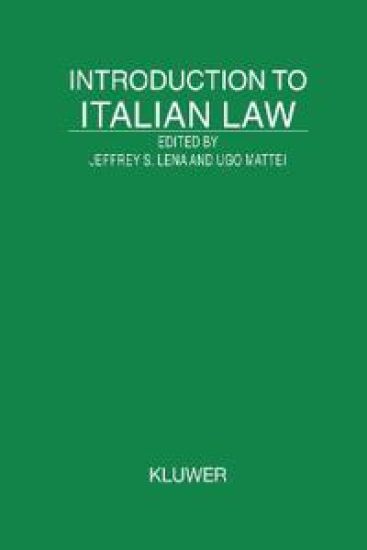
Introduction to Italian Law

Introduction to Italian Law

Jeffrey S. Lena; Ugo Mattei

Kluwer Law International
2002
sidottu
This is an introduction to the main features of the Italian legal system. Its 18 chapters cover: the system of private international law; the altered and expanded body of family law; the code of criminal procedure; changes in civil procedure; the effects of European legislation on Italian municipal law; the reformation of administrative law; and the computer-assisted research tools and techniques used to research Italian law.
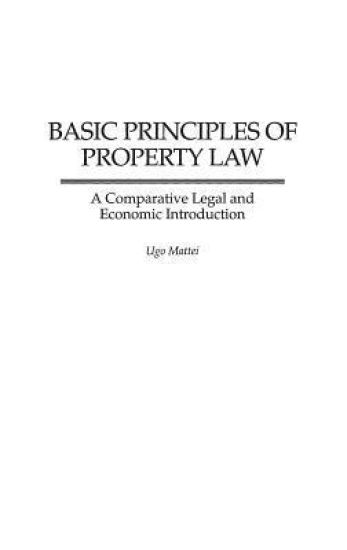
Basic Principles of Property Law

Basic Principles of Property Law

Ugo Mattei

Praeger Publishers Inc
2000
sidottu
The first attempt to address comparative property law in a common integrative framework, this study discusses German, Italian, French, American, and British property law as mere variations based upon a few fundamental themes through which these nations developed legal systems to provide responses to common economic problems and to set legal foundations for working markets. Basic Principles of Property Law was produced to offer a common framework for the discussion of the law of property within countries in transition, thus it has its basis, not on just one legal system, but on the institutional commonalties that make western property law a working market institution. It offers a major challenge to conventional thinking that in property law the differences between common law and civil law are so important that common core research is impossible. Mattei hopes to guide the reader to think comparatively about property by shedding many preconceived formalistic abstractions. The substance of property law, he argues, is much more common throughout the Western legal tradition than legal scholars would have us believe. Through a set format and accessible writing, this book looks at national legal traditions as responses to common economic problems. It sets the foundations for further much needed integrative comparative legal research in the domain of property law.