Kirjojen hintavertailu. Mukana 12 390 323 kirjaa ja 12 kauppaa.

Kirjailija

Ulrich Baer

Kirjat ja teokset yhdessä paikassa: 30 kirjaa, julkaisuja vuosilta 2000-2025, suosituimpien joukossa The Great Gatsby (Warbler Classics). Vertaile teosten hintoja ja tarkista saatavuus suomalaisista kirjakaupoista.

30 kirjaa

Kirjojen julkaisuhaarukka 2000-2025.

Heart of Darkness (Warbler Classics)

Heart of Darkness (Warbler Classics)

Joseph Conrad; Ulrich Baer

Warbler Classics
2020
pokkari
Heart of Darkness describes a steamboat voyage up and down the Congo River by a British sea captain named Charles Marlow, who is commissioned to fetch a renegade ivory collector called Kurtz. On the trip Marlow witnesses scenes of shocking abuse, culminating in his encounter with Kurtz. Even while Africa and its people remain opaque to Marlow, the hunt for Kurtz becomes a haunting journey of self-discovery and a spectacular indictment of European imperialism. This complex meditation on colonialism, civilization, and corruptibility has enthralled readers for more than a hundred years and inspired dozens of adaptations, including Francis Ford Coppola's Vietnam War film Apocalypse Now (1979).
Frankenstein

Frankenstein

Mary Shelley; Ulrich Baer

Warbler Classics
2019
pokkari
Frankenstein is the most celebrated horror story ever written and one of the best-selling books of all time. It is the tale of Victor Frankenstein, a scientist whose unbridled quest for the secret of life unleashes a creature that embodies our deepest fears about the moral bounds of human progress. Ever since its publication in 1818, readers have been fascinated with the iconic image of Frankenstein's monster and the unresolved ethical questions his creation challenges us to answer.At once a cautionary tale and a gripping novel about the destructive potential in human ingenuity and the desperate search for love and attachment, Frankenstein lives on in countless re-imaginings in literature and film. This Warbler Classics edition uses Shelley's original 1818 text and includes an afterword by Ulrich Baer, Mary Shelley's introduction to the 1831 edition, and a detailed biographical timeline.
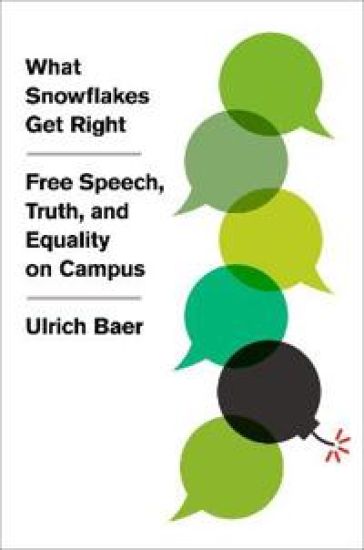
What Snowflakes Get Right

What Snowflakes Get Right

Ulrich Baer

Oxford University Press Inc
2019
sidottu
Angry debates about polarizing speakers have roiled college campuses. Conservatives accuse universities of muzzling unpopular opinions, betraying their values of open inquiry; students sympathetic to the left openly advocate against completely unregulated speech, asking for "safe spaces" and protection against visiting speakers and even curricula they feel disrespects them. Some even call these students "snowflakes"-too fragile to be exposed to opinions and ideas that challenge their worldviews. How might universities resolve these debates about free speech, which pit their students' welfare against the university's commitment to free inquiry and open debate? Ulrich Baer here provides a new way of looking at this dilemma. He explains how the current dichotomy is false and is not really about the feelings of offended students, or protecting an open marketplace of ideas. Rather, what is really at stake is our democracy's commitment to equality, and the university's critical role as an arbiter of truth. He shows how and why free speech has become the rallying cry that forges an otherwise uneasy alliance of liberals and ultra-conservatives, and why this First Amendment absolutism is untenable in law and society in general. He draws on law, philosophy, and his extensive experience as a university administrator to show that the lens of equality can resolve this impasse, and can allow the university to serve as a model for democracy that upholds both truth and equality as its founding principles.
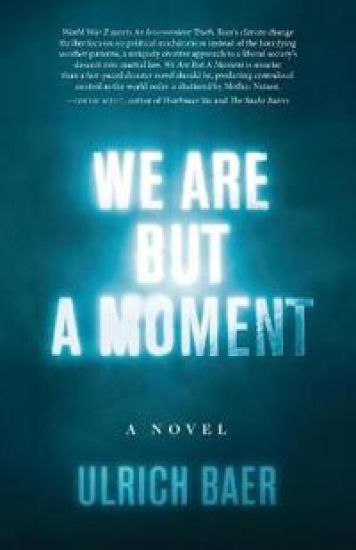
We Are But a Moment

We Are But a Moment

Ulrich Baer

Warbler Press
2017
pokkari
We Are But a Moment takes the reader on a brisk tour of the globe that vividly imagines the inescapable crisis of the near future posed by overpopulation, diminishing natural resources, climate change, species extinction, and economic tumult. It is 2025, and a young White House aide, Aleks, finds himself locked up in quarantine when he tested positive after a routine briefing from a hotspot. Aleks recounts how our much-admired female president became a globally revered leader who unites much of the world under the environmental banner. Aleks's position as environmental advisor to the president's policy team gives him a privileged insider's view into the political maneuvering that has led to U.S. global dominance. When he discovers unfamiliar files on his computer, he is thrown into a moral crisis over who he trusts, what he believes, and the value of the causes for which he has been fighting as he grapples to make sense of the people and events that led to his quarantine. Philosophical rather than prescriptive, the book is about how we live and die in the 21st century, what we consume, how we inhabit our world, and whether we can all live and love in the future.
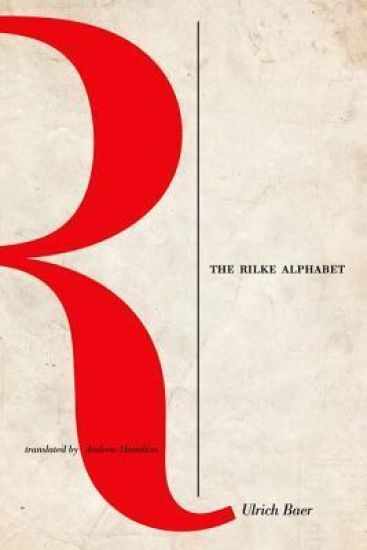
The Rilke Alphabet

The Rilke Alphabet

Ulrich Baer

Fordham University Press
2014
pokkari
The enduring power of Rainer Maria Rilke's poetry rests with his claim that all we need for a better life on earth is already given to us, in the here and now. In twenty-six engaging and accessible essays, Ulrich Baer's The Rilke Alphabet examines this promise by one of the greatest poets in any tradition that even the smallest overlooked word may unlock life's mysteries to us. Fueled by an unebbing passion and indeed love for Rilke's poetry, Baer examines twenty-six words that are not only unexpected but also problematic, controversial, and even scandalous in Rilke's work. In twenty-six mesmerizing essays that eschew jargon and teutonic learnedness for the pleasures and risks of unflinchingly engaging with a great artist's genius, Baer sheds new light on Rilke's politics, his creative process, and his deepest and enduring thoughts about life, art, politics, sexuality, love, and death. The Rilke Alphabet shows how Rilke's work provides an uncannily apt guide to life even in our vexingly postmodern condition. Whether it is a love letter to frogs, a problematic brief infatuation with Mussolini, a sustained reflection on the Buddha, the evasion of the influence of powerful precursors, or the unambiguous assertion that freedom must be lived in order to be known, Rilke's writings pull us deeply into life. Baer's decades-long engagement with Rilke as a scholar, translator, and editor of Rilke's writings allows him to reveal unique aspects of Rilke's work. The Rilke Alphabet will surprise and delight Rilke fans, intrigue newcomers to his work, and deepen every reader's sense of the power of poetry to penetrate the mysteries and confusions of our world.
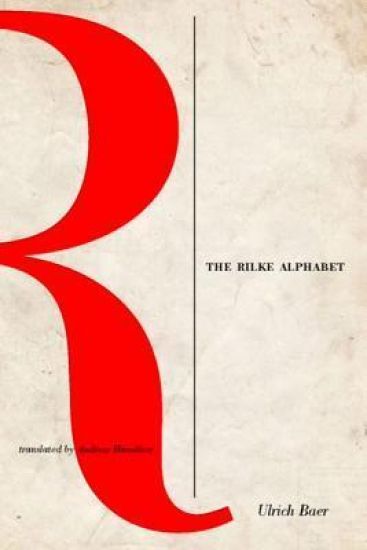
The Rilke Alphabet

The Rilke Alphabet

Ulrich Baer

Fordham University Press
2014
sidottu
The enduring power of Rainer Maria Rilke's poetry rests with his claim that all we need for a better life on earth is already given to us, in the here and now. In twenty-six engaging and accessible essays, Ulrich Baer's The Rilke Alphabet examines this promise by one of the greatest poets in any tradition that even the smallest overlooked word may unlock life's mysteries to us. Fueled by an unebbing passion and indeed love for Rilke's poetry, Baer examines twenty-six words that are not only unexpected but also problematic, controversial, and even scandalous in Rilke's work. In twenty-six mesmerizing essays that eschew jargon and teutonic learnedness for the pleasures and risks of unflinchingly engaging with a great artist's genius, Baer sheds new light on Rilke's politics, his creative process, and his deepest and enduring thoughts about life, art, politics, sexuality, love, and death. The Rilke Alphabet shows how Rilke's work provides an uncannily apt guide to life even in our vexingly postmodern condition. Whether it is a love letter to frogs, a problematic brief infatuation with Mussolini, a sustained reflection on the Buddha, the evasion of the influence of powerful precursors, or the unambiguous assertion that freedom must be lived in order to be known, Rilke's writings pull us deeply into life. Baer's decades-long engagement with Rilke as a scholar, translator, and editor of Rilke's writings allows him to reveal unique aspects of Rilke's work. The Rilke Alphabet will surprise and delight Rilke fans, intrigue newcomers to his work, and deepen every reader's sense of the power of poetry to penetrate the mysteries and confusions of our world.

Remnants of Song

Remnants of Song

Ulrich Baer

Stanford University Press
2000
sidottu
In a bold reassessment, this book analyzes the works of Charles Baudelaire and Paul Celan, two poets who frame our sense of modern poetry and define the beginning and end of modernity itself. The two poets share a feature that seems to block their placement in such an easy chronological or historical scheme: each accounts for an experience that will not fully enter memory, but dissipates in the mind in the form of trauma, fragments, and shock. While Baudelaire, as Paul Valéry was the first to show, explores the trauma of the minute personal shocks of everyday existence in modern life, Celan engages with the catastrophic magnitude of the Holocaust and how it has altered our understanding of history. Can we relate the shocks registered in Baudelaire's poems to the historical horror addressed in Celan's work without denying either the singularity of suffering and loss or the uniqueness of the historical event of the Shoah? Drawing on trauma studies and Holocaust research, Remnants of Song challenges existing interpretations of Baudelaire and Celan by constantly holding in view both the aesthetic dimension of their works and their historical import. The author demonstrates that the act of engaging with a poem on its own terms may serve as an important model for an ethical response to the radical experiences of trauma. Answering Adorno's famous dictum that there can be no poetry after Auschwitz, he shows that Celan's poetry continues to posit its own truth by drawing on Baudelaire as a precedent—yet it does so in ways that have little to do with conventional understandings of history.