Kirjojen hintavertailu. Mukana 12 459 402 kirjaa ja 12 kauppaa.

Kirjailija

Ulrich (EDT) Goebel

Kirjat ja teokset yhdessä paikassa: 6 kirjaa, julkaisuja vuosilta 2005-2011, suosituimpien joukossa Fruhneuhochdeutsches Worterbuch. Vertaile teosten hintoja ja tarkista saatavuus suomalaisista kirjakaupoista.

6 kirjaa

Kirjojen julkaisuhaarukka 2005-2011.

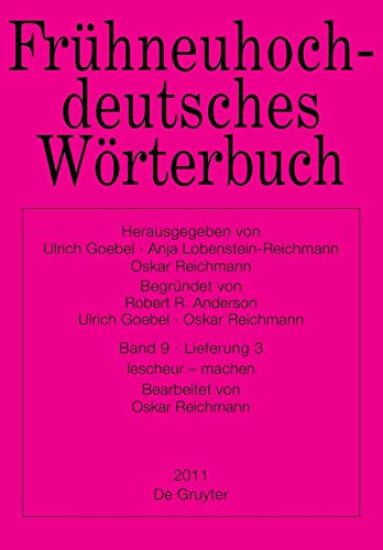
Fruhneuhochdeutsches Worterbuch

Fruhneuhochdeutsches Worterbuch

Ulrich (EDT) Goebel; Anja (EDT) Lobenstein-Reichmann; Oskar (EDT) Reichmann

De Gruyter
2011
pokkari
The Early New High German Dictionary is an alphabetically-ordered sense dictionary of the varieties of High German from the 14th to 17th century. Its entries are arranged as follows: Each headword is followed by concise information on the inflectional morphology and (in the case of etymologically isolated words or words that are difficult to classify) brief references to the etymology. This is followed by the core of each entry, namely, the explanation of the various senses of a word, which have been numbered. References to time, region and text type provide important information about the dimensions in which each sense of a word was used. The cumulative naming of semantically-related words and typical syntagmatic contexts provide insight into the structural, lexical correlations. A detailed block of examples per sense demonstrates the word in its original usage.
Fruhneuhochdeutsches Worterbuch

Fruhneuhochdeutsches Worterbuch

Ulrich (EDT) Goebel; Anja (EDT) Lobenstein-Reichmann; Oskar (EDT) Reichmann

De Gruyter
2009
pokkari
The Early New High German Dictionary is an alphabetically-ordered sense dictionary of the varieties of High German from the 14th to 17th century. Its entries are arranged as follows: Each headword is followed by concise information on the inflectional morphology and (in the case of etymologically isolated words or words that are difficult to classify) brief references to the etymology. This is followed by the core of each entry, namely, the explanation of the various senses of a word, which have been numbered. References to time, region and text type provide important information about the dimensions in which each sense of a word was used. The cumulative naming of semantically-related words and typical syntagmatic contexts provide insight into the structural, lexical correlations. A detailed block of examples per sense demonstrates the word in its original usage.
Fruhneuhochdeutsches Worterbuch

Fruhneuhochdeutsches Worterbuch

Ulrich (EDT) Goebel; Anja (EDT) Lobenstein-Reichmann; Oskar (EDT) Reichmann

De Gruyter
2007
pokkari
The Early New High German Dictionary is an alphabetically-ordered sense dictionary of the varieties of High German from the 14th to 17th century. Its entries are arranged as follows: Each headword is followed by concise information on the inflectional morphology and (in the case of etymologically isolated words or words that are difficult to classify) brief references to the etymology. This is followed by the core of each entry, namely, the explanation of the various senses of a word, which have been numbered. References to time, region and text type provide important information about the dimensions in which each sense of a word was used. The cumulative naming of semantically-related words and typical syntagmatic contexts provide insight into the structural, lexical correlations. A detailed block of examples per sense demonstrates the word in its original usage.
Fruhneuhochdeutsches Worterbuch

Fruhneuhochdeutsches Worterbuch

Ulrich (EDT) Goebel

De Gruyter
2007
pokkari
The Early New High German Dictionary is an alphabetically-ordered sense dictionary of the varieties of High German from the 14th to 17th century. Its entries are arranged as follows: Each headword is followed by concise information on the inflectional morphology and (in the case of etymologically isolated words or words that are difficult to classify) brief references to the etymology. This is followed by the core of each entry, namely, the explanation of the various senses of a word, which have been numbered. References to time, region and text type provide important information about the dimensions in which each sense of a word was used. The cumulative naming of semantically-related words and typical syntagmatic contexts provide insight into the structural, lexical correlations. A detailed block of examples per sense demonstrates the word in its original usage.
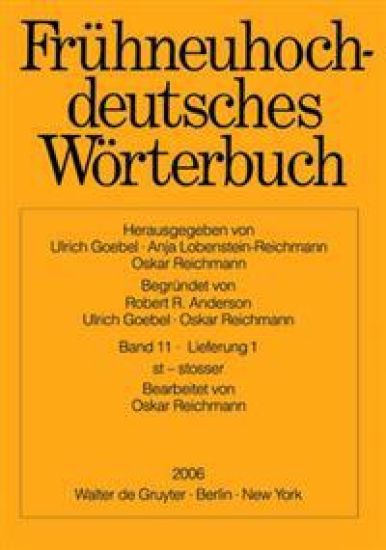
Frühneuhochdeutsches Wörterbuch

Frühneuhochdeutsches Wörterbuch

Ulrich (EDT) Goebel; Oskar (EDT) Reichmann

De Gruyter
2006
pokkari
The Early New High German Dictionary is an alphabetically-ordered sense dictionary of the varieties of High German from the 14th to 17th century. Its entries are arranged as follows: Each headword is followed by concise information on the inflectional morphology and (in the case of etymologically isolated words or words that are difficult to classify) brief references to the etymology. This is followed by the core of each entry, namely, the explanation of the various senses of a word, which have been numbered. References to time, region and text type provide important information about the dimensions in which each sense of a word was used. The cumulative naming of semantically-related words and typical syntagmatic contexts provide insight into the structural, lexical correlations. A detailed block of examples per sense demonstrates the word in its original usage.
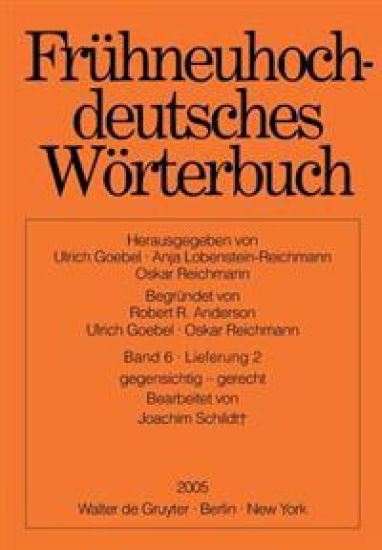
Fruhneuhochdeutsches Worterbuch

Fruhneuhochdeutsches Worterbuch

Robert R. (EDT) Anderson; Ulrich (EDT) Goebel; Oskar (EDT) Reichmann

De Gruyter
2005
pokkari
The Early New High German Dictionary is an alphabetically-ordered sense dictionary of the varieties of High German from the 14th to 17th century. Its entries are arranged as follows: Each headword is followed by concise information on the inflectional morphology and (in the case of etymologically isolated words or words that are difficult to classify) brief references to the etymology. This is followed by the core of each entry, namely, the explanation of the various senses of a word, which have been numbered. References to time, region and text type provide important information about the dimensions in which each sense of a word was used. The cumulative naming of semantically-related words and typical syntagmatic contexts provide insight into the structural, lexical correlations. A detailed block of examples per sense demonstrates the word in its original usage.