Kirjojen hintavertailu. Mukana 12 595 353 kirjaa ja 12 kauppaa.

Kirjailija

Ulrich Müller

Kirjat ja teokset yhdessä paikassa: 34 kirjaa, julkaisuja vuosilta 1992-2026, suosituimpien joukossa Encounters: Medieval Economy in 50 Objects. Vertaile teosten hintoja ja tarkista saatavuus suomalaisista kirjakaupoista.

Mukana myös kirjoitusasut: Ulrich Muller

34 kirjaa

Kirjojen julkaisuhaarukka 1992-2026.

Encounters: Medieval Economy in 50 Objects

Encounters: Medieval Economy in 50 Objects

Tanja Skambraks; Christina Antenhofer; Ulrich Müller; Elisabeth Gruber

TAYLOR FRANCIS LTD
2026
sidottu
Exploring medieval economy through its artifacts, this book presents 50 object biographies that illuminate daily life, economic ethics, production, trade, and finance, offering a tangible perspective on the systems of the long medieval period. Combining the expertise of three historians and an archaeologist, this book bridges abstract theory with the material realities of the past. This volume examines fifty diverse artifacts, including tally sticks, tools, glassware, and coins, to provide a human-centered understanding of the commercial revolution, agricultural innovations, and the emergence of a consumer society between 500 and 1600. The content is organized into five parts, focusing on economic thought, production, distribution, finance, and everyday life. Empowering students to integrate material culture as a crucial primary source, the book reveals the evolving mentalities and innovative practices that shaped medieval economic behaviour and laid the foundations of our modern world. Encounters: Medieval Economy in 50 Objects is written for a broad audience, including undergraduate and postgraduate students in history, archaeology, and art history who are seeking a tangible, source-based approach to medieval economy. It is an essential resource for instructors looking for a modular, object-oriented teaching tool that connects material culture with economic theory, providing a refreshing alternative to traditional text-heavy histories. Museum professionals, heritage specialists, and history enthusiasts will also find its accessible narrative and focus on "object biographies" invaluable for contextualizing collections and understanding how everyday items drove the transition to a modern consumer society.
Encounters: Medieval Economy in 50 Objects

Encounters: Medieval Economy in 50 Objects

Tanja Skambraks; Christina Antenhofer; Ulrich Müller; Elisabeth Gruber

TAYLOR FRANCIS LTD
2026
nidottu
Exploring medieval economy through its artifacts, this book presents 50 object biographies that illuminate daily life, economic ethics, production, trade, and finance, offering a tangible perspective on the systems of the long medieval period. Combining the expertise of three historians and an archaeologist, this book bridges abstract theory with the material realities of the past. This volume examines fifty diverse artifacts, including tally sticks, tools, glassware, and coins, to provide a human-centered understanding of the commercial revolution, agricultural innovations, and the emergence of a consumer society between 500 and 1600. The content is organized into five parts, focusing on economic thought, production, distribution, finance, and everyday life. Empowering students to integrate material culture as a crucial primary source, the book reveals the evolving mentalities and innovative practices that shaped medieval economic behaviour and laid the foundations of our modern world. Encounters: Medieval Economy in 50 Objects is written for a broad audience, including undergraduate and postgraduate students in history, archaeology, and art history who are seeking a tangible, source-based approach to medieval economy. It is an essential resource for instructors looking for a modular, object-oriented teaching tool that connects material culture with economic theory, providing a refreshing alternative to traditional text-heavy histories. Museum professionals, heritage specialists, and history enthusiasts will also find its accessible narrative and focus on "object biographies" invaluable for contextualizing collections and understanding how everyday items drove the transition to a modern consumer society.

Anorganische Strukturchemie

Anorganische Strukturchemie

Ulrich Müller

Springer Fachmedien Wiesbaden
2025
nidottu
In dem Lehrbuch für Studenten der Chemie werden wichtige Aspekte und Zusammenhänge der Strukturen anorganisch-chemischer Verbindungen dargelegt. Die Strukturmerkmale von Molekülverbindungen wie auch von Festkörpern werden behandelt und an anschaulichen Beispielen erläutert. So weit wie möglich werden diese Strukturen mit einfachen und eingängigen Theorien erklärt (Gillespie-Nyholm-Theorie, Ligandenfeldtheorie, Ionenradienverhältnisse, Pauling-Regeln, (8-N)-Regel u.ä.), es wird aber auch auf die moderne Bindungstheorie eingegangen. Wichtige Festkörperstrukturen werden wiederholte Male und dabei jedes Mal von einem anderen Standpunkt betrachtet. Zusammenhänge zwischen Struktur und physikalischen Eigenschaften werden herausgearbeitet.
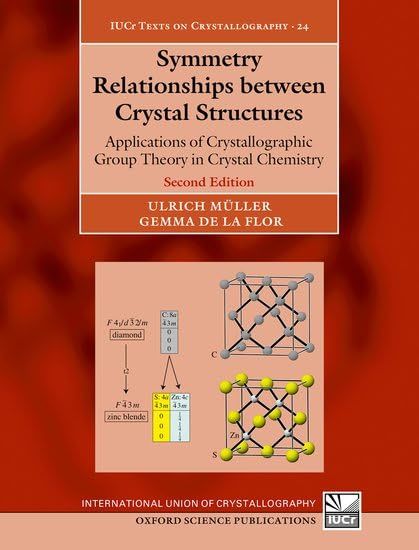
Symmetry Relationships between Crystal Structures

Symmetry Relationships between Crystal Structures

Ulrich Müller; Gemma de la Flor

Oxford University Press
2024
sidottu
In crystal chemistry and crystal physics, the relations between the symmetry groups (space groups) of crystalline solids are of particular importance. Part I of this book presents the necessary mathematical foundations and tools: the fundamentals of crystallography with special emphasis on symmetry, the theory of the crystallographic groups, and the formalisms of the needed crystallographic computations. Part II gives an insight into applications to problems in crystal chemistry. With the aid of numerous examples, it is shown how crystallographic group theory can be used to make evident the relationships between crystal structures, to set up a systematic order in the huge amount of known crystal structures, to predict crystal structures, to analyse phase transitions and topotactic chemical reactions in the solid state, to understand the formation of domains and twins in crystals, and to avoid errors in crystal structure determinations. Part III delves further into some specific topics, namely the isomorphic subgroups of space groups, the theory of phase transitions, and computer programs dedicated to crystallographic group theory. In this new edition, several topics have been extended to cover the latest scientific findings, a new chapter has been added dealing with pertinent computer programs, and references have been updated.
Symmetriebeziehungen zwischen Kristallstrukturen

Symmetriebeziehungen zwischen Kristallstrukturen

Ulrich Müller

Springer Fachmedien Wiesbaden
2023
nidottu
In der Kristallchemie spielen die Beziehungen zwischen den Symmetriegruppen (Raumgruppen) kristalliner Feststoffe eine besondere Rolle. In Teil 1 dieses Buches sind die mathematischen Hilfsmittel zusammengestellt: die Grundbegriffe der Kristallographie, insbesondere der Symmetrielehre, die Theorie der kristallographischen Gruppen und die Formalismen der hier gebrauchten kristallographischen Berechnungen. In Teil 2 des Buches wird die Anwendung auf Probleme der Kristallchemie aufgezeigt. Zahlreiche Beispiele illustrieren, wie mit der kristallographischen Gruppentheorie Verwandtschaften zwischen Kristallstrukturen aufgezeigt werden, Ordnung in die Unmenge der Kristallstrukturen gebracht wird, mögliche Kristallstrukturtypen vorhergesagt werden können, Phasenumwandlungen analysiert werden, das Phänomen der Domänen- und Zwillingsbildung in Kristallen zu verstehen ist und Fehler bei der Kristallstrukturanalyse vermeidbar sind. In Teil 3 des Buches werden einige spezielle Aspekte vertieft, darunter zur Theorie der Phasenumwandlungen, und es werden nützliche Computer-Programme zur kristallographischen Gruppentheorie und für kristallographische Berechnungen vorgestellt.
The Development of Children’s Thinking

The Development of Children’s Thinking

Jeremy Carpendale; Ulrich Muller; Charlie Lewis

SAGE Publications Ltd
2017
sidottu
The Development of Children’s Thinking offers undergraduate and graduate students in psychology and other disciplines an introduction to several core areas of developmental psychology. It examines recent empirical research within the context of longstanding theoretical debates. In particular, it shows how a grasp of classic theories within developmental psychology is vital for a grasp of new areas of research such as cognitive neuroscience that have impacted on our understanding of how children develop. The focus of this book will be on infancy and childhood, and it looks at: Theories and context of development How developmental psychology attempts to reconcile influences of nature and nurture Communication in infancy as a precursor to later thinking Language development in primates and young children Cognitive and social development, including the child’s understanding of the mind How studies of moral reasoning reflect upon our understanding of development
The Development of Children’s Thinking

The Development of Children’s Thinking

Jeremy Carpendale; Ulrich Muller; Charlie Lewis

SAGE Publications Ltd
2017
nidottu
The Development of Children’s Thinking offers undergraduate and graduate students in psychology and other disciplines an introduction to several core areas of developmental psychology. It examines recent empirical research within the context of longstanding theoretical debates. In particular, it shows how a grasp of classic theories within developmental psychology is vital for a grasp of new areas of research such as cognitive neuroscience that have impacted on our understanding of how children develop. The focus of this book will be on infancy and childhood, and it looks at: Theories and context of development How developmental psychology attempts to reconcile influences of nature and nurture Communication in infancy as a precursor to later thinking Language development in primates and young children Cognitive and social development, including the child’s understanding of the mind How studies of moral reasoning reflect upon our understanding of development
Carsharing in Deutschland

Carsharing in Deutschland

Wolfgang Rid; Gerhard Parzinger; Michael Grausam; Ulrich Müller; Carolin Herdtle

Springer Fachmedien Wiesbaden
2017
nidottu
Sowohl die Elektromobilität als auch Carsharing-Konzepte besitzen hohe Bedeutung im Rahmen nachhaltiger Mobilitätskonzepte und der Energiewende in Deutschland. Daher lohnt sich ein Blick auf die aktuelle Situation, die Potenziale und die Erfolgsfaktoren bezüglich des Einsatzes von Elektrofahrzeugen in Carsharing-Angeboten. Wo steht das Carsharing-Prinzip heute und welche Voraussetzungen bietet es für den Einsatz von Elektrofahrzeugen: Wie kann durch Carsharing und der Einsatz von Elektrofahrzeugen im Carsharing die Entwicklung neuer Mobilitätsformen vorangebracht werden, was sind die Betreiber- und Geschäftsmodelle? Welche möglichen Hürden müssen dabei überwunden werden, wann ist Carsharing wirtschaftlich und was sind weitere zentrale Erfolgsfaktoren für eCarsharing in Deutschland?
Symmetry Relationships between Crystal Structures

Symmetry Relationships between Crystal Structures

Ulrich Müller

Oxford University Press
2017
nidottu
In crystal chemistry and crystal physics, the relations between the symmetry groups (space groups) of crystalline solids are of special importance. Part 1 of this book presents the necessary mathematical foundations and tools: the fundamentals of crystallography with special emphasis on symmetry, the theory of the crystallographic groups, and the formalisms of the needed crystallographic computations. Part 2 gives an insight into applications to problems in crystal chemistry. With the aid of numerous examples, it is shown how crystallographic group theory can be used to make evident relationships between crystal structures, to set up a systematic order in the huge amount of known crystal structures, to predict crystal structures, to analyse phase transitions and topotactic reactions in the solid state, to understand the formation of domains and twins in crystals, and to avoid errors in crystal structure determinations. A broad range of end-of-chapter exercises offers the possibility to apply the learned material. Worked-out solutions to the exercises can be found at the end of the book.