
Kirjailija
Ulrike Schmidt
Kirjat ja teokset yhdessä paikassa: 14 kirjaa, julkaisuja vuosilta 1997-2025, suosituimpien joukossa Von Kränzen und Körben. Vertaile teosten hintoja ja tarkista saatavuus suomalaisista kirjakaupoista.
14 kirjaa
Kirjojen julkaisuhaarukka 1997-2025.
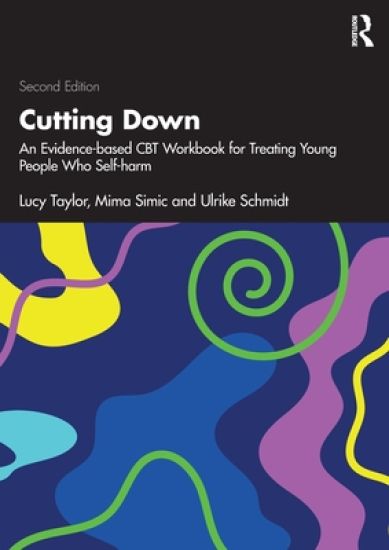
Cutting Down provides a practical and accessible treatment programme based on Cognitive Behaviour Therapy (CBT) principles for young people who self-harm.This fully revised and updated second edition includes new techniques from ‘third’ wave CBT, Acceptance Commitment Therapy (ACT) and Dialectical Behaviour Therapy (DBT). This enriches the material and brings the concepts up to date. Another key addition to this new edition is the inclusion of strategies for young people who engage in suicidal behaviour. The manual is evidence based and focuses on a flexible and formulation driven model to direct treatment in around 15 sessions for young people and six sessions for parents and caregivers. It provides a clear structure for each session and an easy-to-follow outline on how the therapist should deliver each session. The content of each session is supported by handouts and worksheets which can be used within sessions or as homework between sessions.Enhanced with online resources, the workbook will be useful for all professionals working with young people who self-harm across a wide range of settings from schools, primary care and voluntary sector, to community mental health services and inpatient units.
Cutting Down provides a practical and accessible treatment programme based on Cognitive Behaviour Therapy (CBT) principles for young people who self-harm.This fully revised and updated second edition includes new techniques from ‘third’ wave CBT, Acceptance Commitment Therapy (ACT) and Dialectical Behaviour Therapy (DBT). This enriches the material and brings the concepts up to date. Another key addition to this new edition is the inclusion of strategies for young people who engage in suicidal behaviour. The manual is evidence based and focuses on a flexible and formulation driven model to direct treatment in around 15 sessions for young people and six sessions for parents and caregivers. It provides a clear structure for each session and an easy-to-follow outline on how the therapist should deliver each session. The content of each session is supported by handouts and worksheets which can be used within sessions or as homework between sessions.Enhanced with online resources, the workbook will be useful for all professionals working with young people who self-harm across a wide range of settings from schools, primary care and voluntary sector, to community mental health services and inpatient units.

A Cognitive-Interpersonal Therapy Workbook for Treating Anorexia Nervosa
Ulrike Schmidt; Helen Startup; Janet Treasure
Routledge
2018
sidottu
Based on the authors' pioneering work and up-to-date research at London's Maudsley hospital, A Cognitive Interpersonal Therapy Workbook for Treating Anorexia Nervosa provides adults with anorexia nervosa and the professionals working alongside them with a practical resource to work through together.The approach described is recommended by the National Institute of Clinical and Care Excellence (NICE) as a first-line, evidence-based treatment for adults with anorexia nervosa. A Cognitive Interpersonal Therapy Workbook for Treating Anorexia Nervosa provides adults with anorexia nervosa and the professionals working alongside them with a practical resource to work through together.The manual is divided into accessible modules, providing a co-ordinated, step-by-step guide to recovery. Modules include: Nutrition Developing treatment goals Exploring thinking styles Developing an identity beyond anorexia.A Cognitive Interpersonal Therapy Workbook for Treating Anorexia Nervosa is a highly beneficial aid to recovery for those with the condition, their families and mental health professionals.
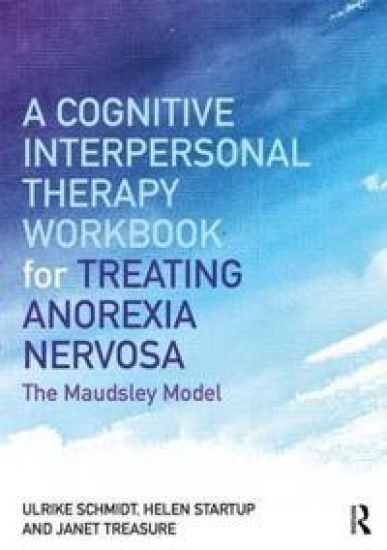
A Cognitive-Interpersonal Therapy Workbook for Treating Anorexia Nervosa
Ulrike Schmidt; Helen Startup; Janet Treasure
Routledge
2018
nidottu
Based on the authors' pioneering work and up-to-date research at London's Maudsley hospital, A Cognitive Interpersonal Therapy Workbook for Treating Anorexia Nervosa provides adults with anorexia nervosa and the professionals working alongside them with a practical resource to work through together.The approach described is recommended by the National Institute of Clinical and Care Excellence (NICE) as a first-line, evidence-based treatment for adults with anorexia nervosa. A Cognitive Interpersonal Therapy Workbook for Treating Anorexia Nervosa provides adults with anorexia nervosa and the professionals working alongside them with a practical resource to work through together.The manual is divided into accessible modules, providing a co-ordinated, step-by-step guide to recovery. Modules include: Nutrition Developing treatment goals Exploring thinking styles Developing an identity beyond anorexia.A Cognitive Interpersonal Therapy Workbook for Treating Anorexia Nervosa is a highly beneficial aid to recovery for those with the condition, their families and mental health professionals.

In many countries there has been an alarming increase in rates of suicide and self-harm, yet the stigma attached to these difficulties often leads to sub-optimal care.Life After Self-Harm: A Guide to the Future is written for individuals who have deliberately harmed themselves. Developed through a major research project the contents of the manual have been informed and shaped by many users and expert professionals. Illustrated with multiple case-histories, it teaches users important skills:for understanding and evaluating self-harmfor keeping safe in crisisfor dealing with seemingly insolvable problemsfor developing coping strategiesfor re-connecting with life.Health workers who regularly come into contact with individuals who have self-harmed will find the wealth of practical advice in this book extremely valuable for recommendation to patients either as a self-help book, or in the context of brief therapy.

Getting Better Bite by Bite is an essential, authoritative and evidence-based self-help programmethat has been used by bulimia sufferersfor over 20 years. This new edition maintains the essence of the original book, while updating its content for today's readers, drawing on the latest knowledge of the biology and psychology of bulimia and its treatment. The book provides step-by-step guidance for change based on solid research. The use of everyday language, stimulating contemporary case study story-telling and evocative illustrations in Bite by Bite provide encouragement, hope and new perspectives for all readers. This handy-sized book fills a need for easy-to-understand information about Bulimia Nervosa, a serious and prevalent eating disorder. Ulrike Schmidt and Janet Treasure are world-renowned researchers and authorities on eating disorders, and June Alexander, a former sufferer of anorexia and bulimia, is a respected writer and internationally-known eating disorder awareness advocate. Getting Better Bite by Bite is a valuable resource - for sufferers, for their families, and for the health professionals and carers treating them.
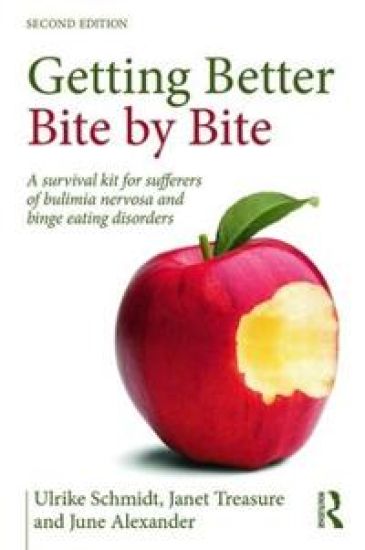
Getting Better Bite by Bite is an essential, authoritative and evidence-based self-help programmethat has been used by bulimia sufferersfor over 20 years. This new edition maintains the essence of the original book, while updating its content for today's readers, drawing on the latest knowledge of the biology and psychology of bulimia and its treatment. The book provides step-by-step guidance for change based on solid research. The use of everyday language, stimulating contemporary case study story-telling and evocative illustrations in Bite by Bite provide encouragement, hope and new perspectives for all readers. This handy-sized book fills a need for easy-to-understand information about Bulimia Nervosa, a serious and prevalent eating disorder. Ulrike Schmidt and Janet Treasure are world-renowned researchers and authorities on eating disorders, and June Alexander, a former sufferer of anorexia and bulimia, is a respected writer and internationally-known eating disorder awareness advocate. Getting Better Bite by Bite is a valuable resource - for sufferers, for their families, and for the health professionals and carers treating them.

Clinician's Guide: Getting Better Bit(e) by Bit(e)
Janet Treasure; Ulrike Schmidt
Routledge
2015
nidottu
The publication four years ago of Getting Better Bit(e) by Bit(e), written by two eating disorder specialists at London's world-famous Maudsley Hospital, was a milestone in the treatment of bulimia.For the first time a self-help book was shown, by rigorous clinical trials, to cure a significant fraction of women suffering from bulimia, and to reduce the therapist contact time needed by others. Getting Better Bit(e) by Bit(e) offered an efficient way of treating bulimic patients, which would be valued by any resource-conscious health service.The authors of Getting Better Bit(e) by Bit(e) have now written this Clinician's Guide, to help health care professionals maximize the benefit that patients obtain from the self-help book. Based on the authors' wide-ranging experience of treating eating disorder patients, it provides a step-by-step account of how the chapters in Getting Better Bit(e) by Bit(e) can be used to ameliorate various aspects of bulimics' difficulties, with examples drawn from real patients' case histories. Particular emphasis is given to the problem of motivating patients who are reluctant to change their behaviour, using Miller and Rollnick's motivational interviewing approach.The Clinician's Guide to Getting Better Bit(e) by Bit(e) will be invaluable for all those treating sufferers of bulimia.

Written for individuals who have deliberately harmed themselves, this text teaches users important skills: for understanding and evaluating self-harm; for keeping safe in crisis; for dealing with seemingly insolvable problems; for developing coping strategies; and for re-connecting with life.
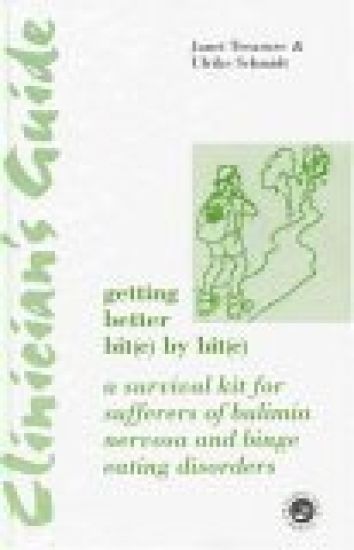
Clinician's Guide: Getting Better Bit(e) by Bit(e)
Janet Treasure; Ulrike Schmidt
Psychology Press Ltd
1997
sidottu
The publication four years ago of Getting Better Bit(e) by Bit(e), written by two eating disorder specialists at London's world-famous Maudsley Hospital, was a milestone in the treatment of bulimia.For the first time a self-help book was shown, by rigorous clinical trials, to cure a significant fraction of women suffering from bulimia, and to reduce the therapist contact time needed by others. Getting Better Bit(e) by Bit(e) offered an efficient way of treating bulimic patients, which would be valued by any resource-conscious health service.The authors of Getting Better Bit(e) by Bit(e) have now written this Clinician's Guide, to help health care professionals maximize the benefit that patients obtain from the self-help book. Based on the authors' wide-ranging experience of treating eating disorder patients, it provides a step-by-step account of how the chapters in Getting Better Bit(e) by Bit(e) can be used to ameliorate various aspects of bulimics' difficulties, with examples drawn from real patients' case histories. Particular emphasis is given to the problem of motivating patients who are reluctant to change their behaviour, using Miller and Rollnick's motivational interviewing approach.The Clinician's Guide to Getting Better Bit(e) by Bit(e) will be invaluable for all those treating sufferers of bulimia.