
Kirjailija
Ute Frevert
Kirjat ja teokset yhdessä paikassa: 24 kirjaa, julkaisuja vuosilta 1986-2024, suosituimpien joukossa Wie Kinder fühlen lernten. Vertaile teosten hintoja ja tarkista saatavuus suomalaisista kirjakaupoista.
24 kirjaa
Kirjojen julkaisuhaarukka 1986-2024.

Emotions make history, and they have a history. They influence historical events such as revolutions, riots and protest movements. At the same time, they are shaped by historical experiences tied to family upbringing, educational and cultural institutions, work and the home.Writing the History of Emotions shows how emotions like love, trust, honour, pride, shame, empathy and greed have impacted historical change since the 18th century and were themselves dependent on social, political and economic environments. Importantly, this book provides a timely exploration of racialized, gendered, class-based notions of emotions. This exciting addition to Bloomsbury’s successful Writing History series analyses how emotions matter in and to history, and how they are themselves objects of history.Here, leading scholar Ute Frevert eschews a traditional chronological history of emotions in favour of an innovative collection which transgresses time periods to illustrate the different emotional meanings one particular material object has had throughout history. This book sheds light on how emotions have been used, instrumentalised and manipulated both to propel and suspend democratic politics. In doing so, it opens a rich new avenue of research for the history of emotions.

Emotions make history, and they have a history. They influence historical events such as revolutions, riots and protest movements. At the same time, they are shaped by historical experiences tied to family upbringing, educational and cultural institutions, work and the home.Writing the History of Emotions shows how emotions like love, trust, honour, pride, shame, empathy and greed have impacted historical change since the 18th century and were themselves dependent on social, political and economic environments. Importantly, this book provides a timely exploration of racialized, gendered, class-based notions of emotions. This exciting addition to Bloomsbury’s successful Writing History series analyses how emotions matter in and to history, and how they are themselves objects of history.Here, leading scholar Ute Frevert eschews a traditional chronological history of emotions in favour of an innovative collection which transgresses time periods to illustrate the different emotional meanings one particular material object has had throughout history. This book sheds light on how emotions have been used, instrumentalised and manipulated both to propel and suspend democratic politics. In doing so, it opens a rich new avenue of research for the history of emotions.
Emotions make history and have their own history. Exploring the emotional worlds of the German people, this book tells a very different story of the twentieth century. Ute Frevert reveals how emotions have shaped and influenced not only individuals but entire societies. Politicians use emotions, and institutions frame them, while social movements work with and through them. Ute Frevert's engaging analysis of twenty essential and powerful emotions – including anger, grief, hate, love, pride, shame and trust – explores how emotions coloured major events and developments from the German Empire to the Federal Republic until this very day. Emotions also have a history, illustrated by the changing forms, meanings and atmosphere of various emotions in twentieth-century Germany: for example, hate was a driving force behind National Socialism but is out of place in a democracy. Around 1900, people associated practices with love or nostalgia that do not resonate with us today. Showcasing why Germans were enthusiastic about the war in 1914 and proud of their national football team in 2006, this book highlights the historical power of emotions as much as their own historicity.

Emotions make history and have their own history. Exploring the emotional worlds of the German people, this book tells a very different story of the twentieth century. Ute Frevert reveals how emotions have shaped and influenced not only individuals but entire societies. Politicians use emotions, and institutions frame them, while social movements work with and through them. Ute Frevert's engaging analysis of twenty essential and powerful emotions – including anger, grief, hate, love, pride, shame and trust – explores how emotions coloured major events and developments from the German Empire to the Federal Republic until this very day. Emotions also have a history, illustrated by the changing forms, meanings and atmosphere of various emotions in twentieth-century Germany: for example, hate was a driving force behind National Socialism but is out of place in a democracy. Around 1900, people associated practices with love or nostalgia that do not resonate with us today. Showcasing why Germans were enthusiastic about the war in 1914 and proud of their national football team in 2006, this book highlights the historical power of emotions as much as their own historicity.
Feeling Political
Ute Frevert; Kerstin Maria Pahl; Francesco Buscemi; Philipp Nielsen; Agnes Arndt; Michael Amico; Karsten Lichau; Hannah Malone; Julia Wambach; Juliane Brauer; Caroline Moine
Springer Nature Switzerland AG
2022
sidottu
Historicizing both emotions and politics, this open access book argues that the historical work of emotion is most clearly understood in terms of the dynamics of institutionalization. This is shown in twelve case studies that focus on decisive moments in European and US history from 1800 until today. Each case study clarifies how emotions were central to people’s political engagement and its effects. The sources range from parliamentary buildings and social movements, to images and speeches of presidents, from fascist cemeteries to the International Criminal Court. Both the timeframe and the geographical focus have been chosen to highlight the increasingly participatory character of nineteenth- and twentieth-century politics, which is inconceivable without the work of emotions.

Feeling Political
Ute Frevert; Kerstin Maria Pahl; Francesco Buscemi; Philipp Nielsen; Agnes Arndt; Michael Amico; Karsten Lichau; Hannah Malone; Julia Wambach; Juliane Brauer; Caroline Moine
Springer Nature Switzerland AG
2022
nidottu
Historicizing both emotions and politics, this open access book argues that the historical work of emotion is most clearly understood in terms of the dynamics of institutionalization. This is shown in twelve case studies that focus on decisive moments in European and US history from 1800 until today. Each case study clarifies how emotions were central to people’s political engagement and its effects. The sources range from parliamentary buildings and social movements, to images and speeches of presidents, from fascist cemeteries to the International Criminal Court. Both the timeframe and the geographical focus have been chosen to highlight the increasingly participatory character of nineteenth- and twentieth-century politics, which is inconceivable without the work of emotions.

Academic résumés tell us as much about the person as they do about their subject and its history. Ute Frevert gave important impetus to social and gender history through trend-setting publications. Early on, she also worked out the history-forming power of individual feelings and located them in their historical ties. Today the historian is considered to be the most influential representative of a new field of research in this country, but also far beyond the German linguistic borders: the history of emotions in modern times. This volume brings together 22 texts: programmatic essays that paved the way, stimulating individual studies and previously unpublished lectures that demonstrate the appeal and value of the history of emotions. In an award-winning linguistic style, both elegant and precise, the selection presents a carefully composed synthesis of three decades that testifies to the power of feelings in history.

Passion Leidenschaft
Petra Marx; Ute Frevert; Ursula Frohne; Stephanie Eichberg; Ulrich Heinen; Klaus Niehr; Kerstin Thomas; Susanne Witzgall
Deutscher Kunstverlag
2020
sidottu
Envy and anger, love and hate, desire and jealousy—the depiction of heartrending, very dramatic, deeply exhilarating, or deeply upsetting figures and scenes has been a central theme throughout the history of European art. Great emotions change the world, influence our thinking and beliefs, and lead to war and resistance. In politics and society, emotions are more relevant than ever. In a large special exhibition at the LWL-Museum für Kunst und Kultur in Münster and the accompanying catalogue, some artworks provide a historical overview from the beginnings in antiquity until the present day. Brought together are paintings, sculptures, photos, and video installations by Matthias Grünewald, Leonardo da Vinci, Peter Paul Rubens, Camille Claudel, Edvard Munch, Käthe Kollwitz, Bill Viola, Maria Lassnig, and many more.

In a brilliant procession through the last 250 years, Ute Frevert looks at the role that public humiliation has played in modern society, showing how humiliation - and the feeling of shame that it engenders - has been used as a means of coercion and control, from the worlds of politics and international diplomacy through to the education of children and the administration of justice. We learn the stories of the French women whose hair was compulsorily shaven as a punishment for alleged relations with German soldiers during the occupation of France, and of the transgressors in the USA who are made to carry a sign announcing their presence when walking down busy streets. Bringing the story right up to the present, we see how the internet and social media pillorying have made public shaming a ubiquitous phenomenon. Using a multitude of both historical and contemporary examples, Ute Frevert shows how humiliation has been used as a tool over the last 250 years (and how it still is today), a story that reveals remarkable similarities across different times and places. And we see how the art of humiliation is in no way a thing of the past but has been re-invented for the 21st century, in a world where such humiliation is inflicted not from above by the political powers that be but by our social peers.


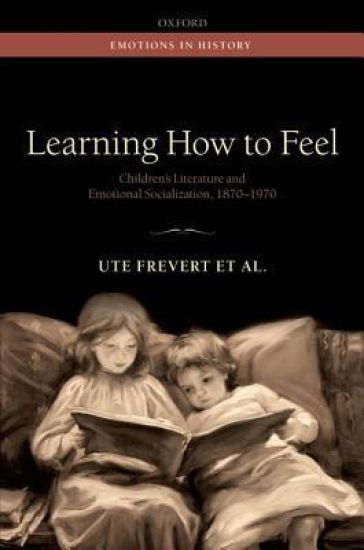
Learning How to Feel
Ute Frevert; Pascal Eitler; Stephanie Olsen; Uffa Jensen; Margrit Pernau; Daniel Brückenhaus; Magdalena Beljan; Benno Gammerl; Anja Laukötter; Bettina Hitzer; Jan Plamper; Juliane Brauer; Joachim C. Häberlen
Oxford University Press
2014
sidottu
Learning How to Feel explores the ways in which children and adolescents learn not just how to express emotions that are thought to be pre-existing, but actually how to feel. The volume assumes that the embryonic ability to feel unfolds through a complex dialogue with the social and cultural environment and specifically through reading material. The fundamental formation takes place in childhood and youth. A multi-authored historical monograph, Learning How to Feel uses children's literature and advice manuals to access the training practices and learning processes for a wide range of emotions in the modern age, circa 1870-1970. The study takes an international approach, covering a broad array of social, cultural, and political milieus in Britain, Germany, India, Russia, France, Canada, and the United States. Learning How to Feel places multidirectional learning processes at the centre of the discussion, through the concept of practical knowledge. The book innovatively draws a framework for broad historical change during the course of the period. Emotional interaction between adult and child gave way to a focus on emotional interactions among children, while gender categories became less distinct. Children were increasingly taught to take responsibility for their own emotional development, to find 'authenticity' for themselves. In the context of changing social, political, cultural, and gender agendas, the building of nations, subjects and citizens, and the forging of moral and religious values, Learning How to Feel demonstrates how children were provided with emotional learning tools through their reading matter to navigate their emotional lives.

Emotional Lexicons
Ute Frevert; Christian Bailey; Pascal Eitler; Benno Gammerl; Bettina Hitzer; Margrit Pernau; Monique Scheer; Anne Schmidt; Nina Verheyen
Oxford University Press
2014
sidottu
Emotions are as old as humankind. But what do we know about them and what importance do we assign to them? Emotional Lexicons is the first cultural history of terms of emotion found in German, French, and English language encyclopaedias since the late seventeenth century. Insofar as these reference works formulated normative concepts, they documented shifts in the way the educated middle classes were taught to conceptualise emotion by a literary medium targeted specifically to them. As well as providing a record of changing language use (and the surrounding debates), many encyclopaedia articles went further than simply providing basic knowledge; they also presented a moral vision to their readers and guidelines for behaviour. Implicitly or explicitly, they participated in fundamental discussions on human nature: Are emotions in the mind or in the body? Can we "read" another person's feelings in their face? Do animals have feelings? Are men less emotional than women? Are there differences between the emotions of children and adults? Can emotions be "civilised"? Can they make us sick? Do groups feel together? Do our emotions connect us with others or create distance? The answers to these questions are historically contingent, showing that emotional knowledge was and still is closely linked to the social, cultural, and political structures of modern societies. Emotional Lexicons analyses European discourses in science, as well as in broader society, about affects, passions, sentiments, and emotions. It does not presume to refine our understanding of what emotions actually are, but rather to present the spectrum of knowledge about emotion embodied in concepts whose meanings shift through time, in order to enrich our own concept of emotion and to lend nuances to the interdisciplinary conversation about them.
Coming to terms with emotions and how they influence human behaviour, seems to be of the utmost importance to societies that are obsessed with everything "neuro." On the other hand, emotions have become an object of constant individual and social manipulation since "emotional intelligence" emerged as a buzzword of our times. Reflecting on this burgeoning interest in human emotions makes one think of how this interest developed and what fuelled it. From a historian's point of view, it can be traced back to classical antiquity. But it has undergone shifts and changes which can in turn shed light on social concepts of the self and its relation to other human beings (and nature). The volume focuses on the historicity of emotions and explores the processes that brought them to the fore of public interest and debate.

'German militarism' has long been understood to be a central element of German society. Considering the role of militarism, this book investigates how conscription has contributed to instilling a strong sense of military commitment amongst the German public.A Nation in Barracks tells the story of how military-civil relations have evolved in Germany during the last two hundred years. Focusing on the introduction and development of military conscription, the author looks at its relationship to state citizenship, nation building, gender formation and the concept of violence. She begins with the early nineteenth century, when conscription was first used in Prussia and initially met with harsh criticism from all aspects of society, and continues through to the two Germanies of the post-1949 period. The book covers the Prussian model used during World War I, the Weimar Republic when no conscription was enforced and the mass military mobilization of the Third Reich.Throughout this comprehensive account, acclaimed historian Ute Frevert examines how civil society deals with institutionalized violence and how this affects models of citizenship and gender relations.

'German militarism' has long been understood to be a central element of German society. Considering the role of militarism, this book investigates how conscription has contributed to instilling a strong sense of military commitment amongst the German public.A Nation in Barracks tells the story of how military-civil relations have evolved in Germany during the last two hundred years. Focusing on the introduction and development of military conscription, the author looks at its relationship to state citizenship, nation building, gender formation and the concept of violence. She begins with the early nineteenth century, when conscription was first used in Prussia and initially met with harsh criticism from all aspects of society, and continues through to the two Germanies of the post-1949 period. The book covers the Prussian model used during World War I, the Weimar Republic when no conscription was enforced and the mass military mobilization of the Third Reich.Throughout this comprehensive account, acclaimed historian Ute Frevert examines how civil society deals with institutionalized violence and how this affects models of citizenship and gender relations.