Kirjojen hintavertailu. Mukana 12 595 353 kirjaa ja 12 kauppaa.

Kirjailija

Utpal Banerjee

Kirjat ja teokset yhdessä paikassa: 9 kirjaa, julkaisuja vuosilta 1993-2018, suosituimpien joukossa Instruction Level Parallelism. Vertaile teosten hintoja ja tarkista saatavuus suomalaisista kirjakaupoista.

9 kirjaa

Kirjojen julkaisuhaarukka 1993-2018.

Instruction Level Parallelism

Instruction Level Parallelism

Alex Aiken; Utpal Banerjee; Arun Kejariwal; Alexandru Nicolau

Springer-Verlag New York Inc.
2018
nidottu
This book precisely formulates and simplifies the presentation of Instruction Level Parallelism (ILP) compilation techniques. It uniquely offers consistent and uniform descriptions of the code transformations involved. Due to the ubiquitous nature of ILP in virtually every processor built today, from general purpose CPUs to application-specific and embedded processors, this book is useful to the student, the practitioner and also the researcher of advanced compilation techniques. With an emphasis on fine-grain instruction level parallelism, this book will also prove interesting to researchers and students of parallelism at large, in as much as the techniques described yield insights that go beyond superscalar and VLIW (Very Long Instruction Word) machines compilation and are more widely applicable to optimizing compilers in general. ILP techniques have found wide and crucial application in Design Automation, where they have been used extensively in the optimization of performanceas well as area and power minimization of computer designs.
Instruction Level Parallelism

Instruction Level Parallelism

Alex Aiken; Utpal Banerjee; Arun Kejariwal; Alexandru Nicolau

Springer-Verlag New York Inc.
2016
sidottu
This book precisely formulates and simplifies the presentation of Instruction Level Parallelism (ILP) compilation techniques. It uniquely offers consistent and uniform descriptions of the code transformations involved. Due to the ubiquitous nature of ILP in virtually every processor built today, from general purpose CPUs to application-specific and embedded processors, this book is useful to the student, the practitioner and also the researcher of advanced compilation techniques. With an emphasis on fine-grain instruction level parallelism, this book will also prove interesting to researchers and students of parallelism at large, in as much as the techniques described yield insights that go beyond superscalar and VLIW (Very Long Instruction Word) machines compilation and are more widely applicable to optimizing compilers in general. ILP techniques have found wide and crucial application in Design Automation, where they have been used extensively in the optimization of performanceas well as area and power minimization of computer designs.
Dependence Analysis for Supercomputing

Dependence Analysis for Supercomputing

Utpal Banerjee

Springer-Verlag New York Inc.
2013
nidottu
This book is on dependence concepts and general methods for dependence testing. Here, dependence means data dependence and the tests are compile-time tests. We felt the time was ripe to create a solid theory of the subject, to provide the research community with a uniform conceptual framework in which things fit together nicely. How successful we have been in meeting these goals, of course, remains to be seen. We do not try to include all the minute details that are known, nor do we deal with clever tricks that all good programmers would want to use. We do try to convince the reader that there is a mathematical basis consisting of theories of bounds of linear functions and linear diophantine equations, that levels and direction vectors are concepts that arise rather natu­ rally, that different dependence tests are really special cases of some general tests, and so on. Some mathematical maturity is needed for a good understand­ ing of the book: mainly calculus and linear algebra. We have cov­ ered diophantine equations rather thoroughly and given a descrip­ of some matrix theory ideas that are not very widely known. tion A reader familiar with linear programming would quickly recog­ nize several concepts. We have learned a great deal from the works of M. Wolfe, and K. Kennedy and R. Allen. Wolfe's Ph. D. thesis at the University of Illinois and Kennedy & Allen's paper on vectorization of Fortran programs are still very useful sources on this subject.
Dependence Analysis

Dependence Analysis

Utpal Banerjee

Springer-Verlag New York Inc.
2013
nidottu
Dependence Analysis may be considered to be the second edition of the author's 1988 book, Dependence Analysis for Supercomputing. It is, however, a completely new work that subsumes the material of the 1988 publication. This book is the third volume in the series Loop Transformations for Restructuring Compilers. This series has been designed to provide a complete mathematical theory of transformations that can be used to automatically change a sequential program containing FORTRAN-like do loops into an equivalent parallel form. In Dependence Analysis, the author extends the model to a program consisting of do loops and assignment statements, where the loops need not be sequentially nested and are allowed to have arbitrary strides. In the context of such a program, the author studies, in detail, dependence between statements of the program caused by program variables that are elements of arrays. Dependence Analysis is directed toward graduate and undergraduate students, and professional writers of restructuring compilers. The prerequisite for the book consists of some knowledge of programming languages, and familiarity with calculus and graph theory. No knowledge of linear programming is required.
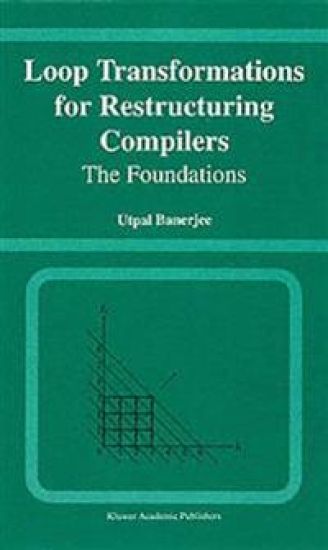
Loop Transformations for Restructuring Compilers

Loop Transformations for Restructuring Compilers

Utpal Banerjee

Springer-Verlag New York Inc.
2013
nidottu
Automatic transformation of a sequential program into a parallel form is a subject that presents a great intellectual challenge and promises great practical rewards. There is a tremendous investment in existing sequential programs, and scientists and engineers continue to write their application programs in sequential languages (primarily in Fortran),but the demand for increasing speed is constant. The job of a restructuring compiler is to discover the dependence structure of a given program and transform the program in a way that is consistent with both that dependence structure and the characteristics of the given machine. Much attention in this field of research has been focused on the Fortran do loop. This is where one expects to find major chunks of computation that need to be performed repeatedly for different values of the index variable. Many loop transformations have been designed over the years, and several of them can be found in any parallelizing compiler currently in use in industry or at a university research facility. Loop Transformations for Restructuring Compilers: The Foundations provides a rigorous theory of loop transformations. The transformations are developed in a consistent mathematical framework using objects like directed graphs, matrices and linear equations. The algorithms that implement the transformations can then be precisely described in terms of certain abstract mathematical algorithms. The book provides the general mathematical background needed for loop transformations (including those basic mathematical algorithms), discusses data dependence, and introduces the major transformations. The next volume will build a detailed theory of loop transformations based on the material developed here. Loop Transformations for Restructuring Compilers: The Foundations presents a theory of loop transformations that is rigorous and yet reader-friendly.
Loop Parallelization

Loop Parallelization

Utpal Banerjee

Springer-Verlag New York Inc.
2010
nidottu
Automatic transformation of a sequential program into a parallel form is a subject that presents a great intellectual challenge and promises a great practical award. There is a tremendous investment in existing sequential programs, and scientists and engineers continue to write their application programs in sequential languages (primarily in Fortran). The demand for higher speedups increases. The job of a restructuring compiler is to discover the dependence structure and the characteristics of the given machine. Much attention has been focused on the Fortran do loop. This is where one expects to find major chunks of computation that need to be performed repeatedly for different values of the index variable. Many loop transformations have been designed over the years, and several of them can be found in any parallelizing compiler currently in use in industry or at a university research facility. The book series on KappaLoop Transformations for Restructuring Compilerskappa provides a rigorous theory of loop transformations and dependence analysis. We want to develop the transformations in a consistent mathematical framework using objects like directed graphs, matrices, and linear equations. Then, the algorithms that implement the transformations can be precisely described in terms of certain abstract mathematical algorithms. The first volume, Loop Transformations for Restructuring Compilers: The Foundations, provided the general mathematical background needed for loop transformations (including those basic mathematical algorithms), discussed data dependence, and introduced the major transformations. The current volume, Loop Parallelization, builds a detailed theory of iteration-level loop transformations based on the material developed in the previous book.
Dependence Analysis

Dependence Analysis

Utpal Banerjee

Springer
1996
sidottu
Dependence Analysis may be considered to be the second edition of the author's 1988 book, Dependence Analysis for Supercomputing. It is, however, a completely new work that subsumes the material of the 1988 publication. This book is the third volume in the series Loop Transformations for Restructuring Compilers. This series has been designed to provide a complete mathematical theory of transformations that can be used to automatically change a sequential program containing FORTRAN-like do loops into an equivalent parallel form. In Dependence Analysis, the author extends the model to a program consisting of do loops and assignment statements, where the loops need not be sequentially nested and are allowed to have arbitrary strides. In the context of such a program, the author studies, in detail, dependence between statements of the program caused by program variables that are elements of arrays. Dependence Analysis is directed toward graduate and undergraduate students, and professional writers of restructuring compilers. The prerequisite for the book consists of some knowledge of programming languages, and familiarity with calculus and graph theory. No knowledge of linear programming is required.
Loop Parallelization

Loop Parallelization

Utpal Banerjee

Springer
1994
sidottu
Automatic transformation of a sequential program into a parallel form is a subject that presents a great intellectual challenge and promises a great practical award. There is a tremendous investment in existing sequential programs, and scientists and engineers continue to write their application programs in sequential languages (primarily in Fortran). The demand for higher speedups increases. The job of a restructuring compiler is to discover the dependence structure and the characteristics of the given machine. Much attention has been focused on the Fortran do loop. This is where one expects to find major chunks of computation that need to be performed repeatedly for different values of the index variable. Many loop transformations have been designed over the years, and several of them can be found in any parallelizing compiler currently in use in industry or at a university research facility. The book series on KappaLoop Transformations for Restructuring Compilerskappa provides a rigorous theory of loop transformations and dependence analysis. We want to develop the transformations in a consistent mathematical framework using objects like directed graphs, matrices, and linear equations. Then, the algorithms that implement the transformations can be precisely described in terms of certain abstract mathematical algorithms. The first volume, Loop Transformations for Restructuring Compilers: The Foundations, provided the general mathematical background needed for loop transformations (including those basic mathematical algorithms), discussed data dependence, and introduced the major transformations. The current volume, Loop Parallelization, builds a detailed theory of iteration-level loop transformations based on the material developed in the previous book.
Loop Transformations for Restructuring Compilers
Automatic transformation of a sequential program into a parallel form is a subject that presents a great intellectual challenge and promises great practical rewards. There is a tremendous investment in existing sequential programs, and scientists and engineers continue to write their application programs in sequential languages (primarily in Fortran),but the demand for increasing speed is constant. The job of a restructuring compiler is to discover the dependence structure of a given program and transform the program in a way that is consistent with both that dependence structure and the characteristics of the given machine. Much attention in this field of research has been focused on the Fortran do loop. This is where one expects to find major chunks of computation that need to be performed repeatedly for different values of the index variable. Many loop transformations have been designed over the years, and several of them can be found in any parallelizing compiler currently in use in industry or at a university research facility. Loop Transformations for Restructuring Compilers: The Foundations provides a rigorous theory of loop transformations. The transformations are developed in a consistent mathematical framework using objects like directed graphs, matrices and linear equations. The algorithms that implement the transformations can then be precisely described in terms of certain abstract mathematical algorithms. The book provides the general mathematical background needed for loop transformations (including those basic mathematical algorithms), discusses data dependence, and introduces the major transformations. The next volume will build a detailed theory of loop transformations based on the material developed here. Loop Transformations for Restructuring Compilers: The Foundations presents a theory of loop transformations that is rigorous and yet reader-friendly.