Kirjojen hintavertailu. Mukana 12 390 323 kirjaa ja 12 kauppaa.

Kirjailija

Uwe M. Borghoff

Kirjat ja teokset yhdessä paikassa: 5 kirjaa, julkaisuja vuosilta 1992-2010, suosituimpien joukossa Catalogue of Distributed File/Operating Systems. Vertaile teosten hintoja ja tarkista saatavuus suomalaisista kirjakaupoista.

5 kirjaa

Kirjojen julkaisuhaarukka 1992-2010.

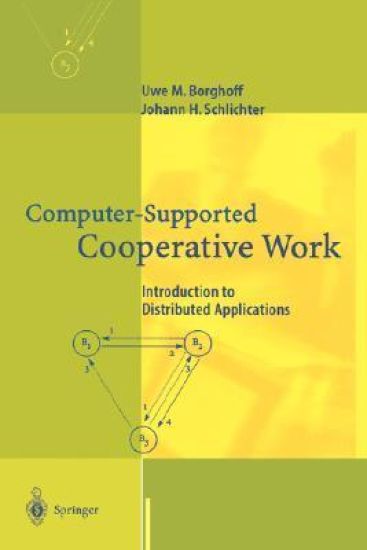
Computer-Supported Cooperative Work

Computer-Supported Cooperative Work

Uwe M. Borghoff; Johann H. Schlichter

Springer-Verlag Berlin and Heidelberg GmbH Co. K
2010
nidottu
The terms groupware and CSCW (computer-supported cooperative work) have received significant attention in computer science and related disciplines for quite some time now. This book is a revised and extended version of the 2nd edition of the German textbook "Rechnergestützte Gruppenarbeit: Eine Einführung in verteilte Anwendungen". It has two main objectives: first, to outline the meaning of both terms, and second, to point out both the numer­ ous opportunities for users of groupware and the risks of applying such sys­ tems. The book intends to introduce an area of distributed systems, namely the computer support of individuals trying to solve a common problem in cooperation with each other but not necessarily having identical work pi aces or working times. Computer-supported cooperative work is an interdisciplinary application domain. It can be viewed as a synergism between the areas of distributed sys­ tems and (multimedia-) communication on the one hand and between those of information science and socio-organizational theory on the other hand. Thus, the book is meant to help students of aH these disciplines, as weH as users and developers of systems which have communication and cooperation within groups as top priorities.
Long-Term Preservation of Digital Documents

Long-Term Preservation of Digital Documents

Uwe M. Borghoff; Peter Rödig; Jan Scheffczyk; Lothar Schmitz

Springer-Verlag Berlin and Heidelberg GmbH Co. K
2010
nidottu
Key to our culture is that we can disseminate information, and then maintain and access it over time. While we are rapidly advancing from vulnerable physical solutions to superior, digital media, preserving and using data over the long term involves complicated research challenges and organization efforts. Uwe Borghoff and his coauthors address the problem of storing, reading, and using digital data for periods longer than 50 years. They briefly describe several markup and document description languages like TIFF, PDF, HTML, and XML, explain the most important techniques such as migration and emulation, and present the OAIS (Open Archival Information System) Reference Model. To complement this background information on the technology issues the authors present the most relevant international preservation projects, such as the Dublin Core Metadata Initiative, and experiences from sample projects run by the Cornell University Library and the National Library of the Netherlands. A rated survey list of available systems and tools completes the book. With this broad overview, the authors address librarians who preserve our digital heritage, computer scientists who develop technologies that access data, and information managers engaged with the social and methodological requirements of long-term information access.
Long-Term Preservation of Digital Documents

Long-Term Preservation of Digital Documents

Uwe M. Borghoff; Peter Rödig; Jan Scheffczyk; Lothar Schmitz

Springer-Verlag Berlin and Heidelberg GmbH Co. K
2006
sidottu
Key to our culture is that we can disseminate information, and then maintain and access it over time. While we are rapidly advancing from vulnerable physical solutions to superior, digital media, preserving and using data over the long term involves complicated research challenges and organization efforts. Uwe Borghoff and his coauthors address the problem of storing, reading, and using digital data for periods longer than 50 years. They briefly describe several markup and document description languages like TIFF, PDF, HTML, and XML, explain the most important techniques such as migration and emulation, and present the OAIS (Open Archival Information System) Reference Model. To complement this background information on the technology issues the authors present the most relevant international preservation projects, such as the Dublin Core Metadata Initiative, and experiences from sample projects run by the Cornell University Library and the National Library of the Netherlands. A rated survey list of available systems and tools completes the book. With this broad overview, the authors address librarians who preserve our digital heritage, computer scientists who develop technologies that access data, and information managers engaged with the social and methodological requirements of long-term information access.
Computer-Supported Cooperative Work

Computer-Supported Cooperative Work

Uwe M. Borghoff; Johann H. Schlichter

Springer-Verlag Berlin and Heidelberg GmbH Co. K
2000
sidottu
The terms groupware and CSCW (Computer-Supported Cooperative Work) have received attention in computer science and related disciplines. This book outlines the meaning of both terms, and points out both the numerous opportunities for users of CSCW systems and the risks of applying them.
Catalogue of Distributed File/Operating Systems

Catalogue of Distributed File/Operating Systems

Uwe M. Borghoff

Springer-Verlag Berlin and Heidelberg GmbH Co. K
1992
nidottu
In general, distributed systems can be classified into Distributed File Systems (DFS) and Distributed Operating Systems (DOS). The survey which follows distinguishes be­ tween DFS approaches in Chapters 2-3, and DOS approaches in Chapters 4-5. Within DFS and DOS, I further distinguish "traditional" and object-oriented approaches. A traditional approach is one where processes are the active components in the systems and where the name space is hierarchically organized. In a centralized environment, UNIX would be a good example of a traditional approach. On the other hand, an object-oriented approach deals with objects in which all information is encapsulated. Some systems of importance do not fit into the DFS/DOS classification. I call these systems "closely related" and put them into Chapter 6. Chapter 7 contains a table of comparison. This table gives a lucid overview summarizing the information provided and allowing for quick access. The last chapter is added for the sake of completeness. It contains very brief descriptions of other related systems. These systems are of minor interest or do not provide transparency at all. Sometimes I had to assign a system to this chapter simply for lack of adequate information about it.