Kirjojen hintavertailu. Mukana 12 525 499 kirjaa ja 12 kauppaa.

Kirjailija

Uwe Steinhoff

Kirjat ja teokset yhdessä paikassa: 10 kirjaa, julkaisuja vuosilta 2006-2024, suosituimpien joukossa Effiziente Ethik: Über Rationalität, Selbstformung, Politik Und Postmoderne. Vertaile teosten hintoja ja tarkista saatavuus suomalaisista kirjakaupoista.

10 kirjaa

Kirjojen julkaisuhaarukka 2006-2024.

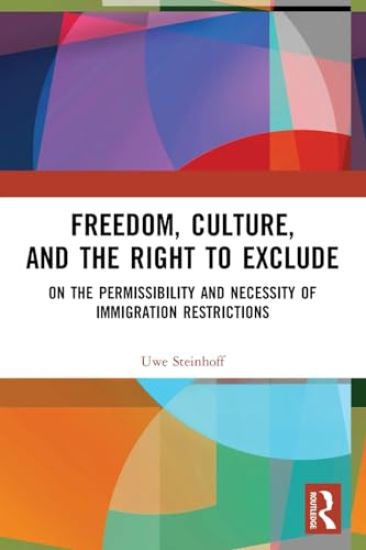
Freedom, Culture, and the Right to Exclude

Freedom, Culture, and the Right to Exclude

Uwe Steinhoff

TAYLOR FRANCIS LTD
2024
nidottu
This book argues that citizens have a moral right to decide by which criteria they grant migrants citizenship, as well as to control access to their territory in the first place. In developing and defending this argument, it critically engages numerous objections, thus providing the reader with a thorough overview of the current debate on the ethics of immigration and exclusion.The author’s argument is based on a straightforwardly individualist and liberal starting point. One of the rights granted by liberalism is freedom of association, which also comprises the right not to associate with people with whom one does not want to associate. While this is an individual right, it can be exercised collectively like many other individual rights. Thus, people can decide to collectively organize into an association pursuing certain goals; and subject to certain provisos, this gives rise to legitimate claims to space and territory in which they pursue these goals. The author shows that this right is far-reaching and robust, which entails an equally far-reaching and robust right to exclude. Moreover, he demonstrates that large-scale immigration from illiberal cultures tends to severely compromise the way of life, the values, and the institutions of liberal democracies in ways routinely ignored by apologists for multiculturalism.Freedom, Culture, and the Right to Exclude will be of interest to scholars and advanced students working in applied ethics, political philosophy, political theory, and law.
The Ethics of War and the Force of Law

The Ethics of War and the Force of Law

Uwe Steinhoff

TAYLOR FRANCIS LTD
2022
nidottu
This book provides a thorough critical overview of the current debate on the ethics of war, as well as a modern just war theory that can give practical action-guidance by recognizing and explaining the moral force of widely accepted law.Traditionalist, Walzerian, and "revisionist" approaches have dominated contemporary debates about the classical jus ad bellum and jus in bello requirements in just war theory. In this book, Uwe Steinhoff corrects widely spread misinterpretations of these competing views and spells out the implications for the ethics of war. His approach is unique in that it complements the usual analysis in terms of self-defense with an emphasis on the importance of other justifications that are often lumped together under the heading of "lesser evil." It also draws on criminal law and legal scholarship, which has been largely ignored by just war theorists. Ultimately, Steinhoff rejects arguments in favor of "moral fundamentalism"— the view that the laws and customs of war must simply follow an immutable morality. In contrast, he argues that widely accepted laws and conventions of war are partly constitutive of the moral rules that apply in a conflict.The Ethics of War and the Force of Law will be of interest to scholars and advanced students working in just war theory, applied ethics, political philosophy, political theory, philosophy of law, and criminal and military law.
Freedom, Culture, and the Right to Exclude

Freedom, Culture, and the Right to Exclude

Uwe Steinhoff

TAYLOR FRANCIS LTD
2022
sidottu
This book argues that citizens have a moral right to decide by which criteria they grant migrants citizenship, as well as to control access to their territory in the first place. In developing and defending this argument, it critically engages numerous objections, thus providing the reader with a thorough overview of the current debate on the ethics of immigration and exclusion.The author’s argument is based on a straightforwardly individualist and liberal starting point. One of the rights granted by liberalism is freedom of association, which also comprises the right not to associate with people with whom one does not want to associate. While this is an individual right, it can be exercised collectively like many other individual rights. Thus, people can decide to collectively organize into an association pursuing certain goals; and subject to certain provisos, this gives rise to legitimate claims to space and territory in which they pursue these goals. The author shows that this right is far-reaching and robust, which entails an equally far-reaching and robust right to exclude. Moreover, he demonstrates that large-scale immigration from illiberal cultures tends to severely compromise the way of life, the values, and the institutions of liberal democracies in ways routinely ignored by apologists for multiculturalism.Freedom, Culture, and the Right to Exclude will be of interest to scholars and advanced students working in applied ethics, political philosophy, political theory, and law.
Self-Defense, Necessity, and Punishment

Self-Defense, Necessity, and Punishment

Uwe Steinhoff

Taylor Francis Ltd
2021
nidottu
This book offers a philosophical analysis of the moral and legal justifications for the use of force. While the book focuses on the ethics self-defense, it also explores its relation to lesser evil justifications, public authority, the justification of punishment, and the ethics of war.Steinhoff’s account of the moral use of force covers a wide range of topics, including the nature of justification in general, the precise elements of different justifications, the logic of claim- and liberty-rights and of rights forfeiture, the value of human life and its limits, and the principles of reciprocity and precaution. While the author’s analysis is primarily philosophical, it is informed by a metaethical stance that also places heavy emphasis on existing law and legal scholarship. In doing so, the book appeals to widely shared moral intuitions, precepts, and concepts grounded in criminal law.Self-Defense, Necessity, and Punishment offers the most comprehensive and systematic account of the ethics of self-defense. It will be of interest to scholars and graduate students working in applied ethics and moral philosophy, philosophy of law, and political philosophy.
The Ethics of War and the Force of Law
This book provides a thorough critical overview of the current debate on the ethics of war, as well as a modern just war theory that can give practical action-guidance by recognizing and explaining the moral force of widely accepted law.Traditionalist, Walzerian, and "revisionist" approaches have dominated contemporary debates about the classical jus ad bellum and jus in bello requirements in just war theory. In this book, Uwe Steinhoff corrects widely spread misinterpretations of these competing views and spells out the implications for the ethics of war. His approach is unique in that it complements the usual analysis in terms of self-defense with an emphasis on the importance of other justifications that are often lumped together under the heading of "lesser evil." It also draws on criminal law and legal scholarship, which has been largely ignored by just war theorists. Ultimately, Steinhoff rejects arguments in favor of "moral fundamentalism"— the view that the laws and customs of war must simply follow an immutable morality. In contrast, he argues that widely accepted laws and conventions of war are partly constitutive of the moral rules that apply in a conflict.The Ethics of War and the Force of Law will be of interest to scholars and advanced students working in just war theory, applied ethics, political philosophy, political theory, philosophy of law, and criminal and military law.
Self-Defense, Necessity, and Punishment
This book offers a philosophical analysis of the moral and legal justifications for the use of force. While the book focuses on the ethics self-defense, it also explores its relation to lesser evil justifications, public authority, the justification of punishment, and the ethics of war.Steinhoff’s account of the moral use of force covers a wide range of topics, including the nature of justification in general, the precise elements of different justifications, the logic of claim- and liberty-rights and of rights forfeiture, the value of human life and its limits, and the principles of reciprocity and precaution. While the author’s analysis is primarily philosophical, it is informed by a metaethical stance that also places heavy emphasis on existing law and legal scholarship. In doing so, the book appeals to widely shared moral intuitions, precepts, and concepts grounded in criminal law.Self-Defense, Necessity, and Punishment offers the most comprehensive and systematic account of the ethics of self-defense. It will be of interest to scholars and graduate students working in applied ethics and moral philosophy, philosophy of law, and political philosophy.
The Philosophy of Jürgen Habermas

The Philosophy of Jürgen Habermas

Uwe Steinhoff

Oxford University Press
2009
sidottu
Jürgen Habermas seeks to defend the Enlightenment and with it an ëmphatical¨, üncurtailed¨ conception of reason against the post-modern critique of reason on the one hand, and against so-called scientism (which would include critical rationalism and the greater part of analytical philosophy) on the other. His objection to the former is that it is self-contradictory and politically defeatist; his objection to the latter is that, thanks to a standard of rationality derived from the natural sciences or from Weber's concept of purposive rationality, it leaves normative questions to irrational decisions. Habermas wants to offer an alternative, trying to develop a theory of communicative action that can clarify the normative foundations of a critical theory of society as well as provide a fruitful theoretical framework for empirical social research. This study is a comprehensive and detailed analysis and sustained critique of Habermas' philosophical system since his pragmatist turn in the seventies. It clearly and precisely depicts Habermas' long chain of arguments leading from an analysis of speech acts to a discourse theory of law and the democratic constitutional state. Along the way the study examines, among other things, Habermas' theory of communicative action, transcendental and universal pragmatics and the argument from ¨performative contradictions¨, discourse ethics, the consensus theory of truth, Habermas' ideas on developmental psychology, communicative pathologies and social evolution, his theory of social order, the analysis of the tensions between system and lifeworld, his theory of modernity, and his theory of deliberative democracy. For all Habermas students this study will prove indispensable.
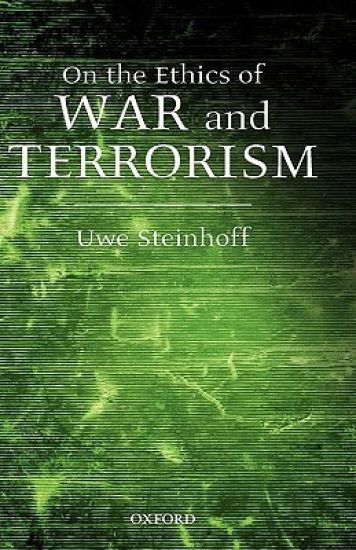
On the Ethics of War and Terrorism

On the Ethics of War and Terrorism

Uwe Steinhoff

Oxford University Press
2007
sidottu
In this book Uwe Steinhoff describes and explains the basic tenets of just war theory and gives a precise, succinct and highly critical account of its present status and of the most important and controversial current debates surrounding it. Rejecting certain in effect medieval assumptions of traditional just war theory and advancing a liberal outlook, Steinhoff argues that every single individual is a legitimate authority and has under certain circumstances the right to declare war on others or the state. He also argues that the just cause cannot be established independently of the other criteria of jus ad bellum (the justification of entering a war), except for right intention, which he interprets more leniently than the tradition does. Turning to jus in bello (which governs the conduct of a war) he criticises the Doctrine of Double Effect and concludes that insofar as wars kill innocents, and be it as "collateral damage", they cannot be just but at best justified as the lesser evil. Steinhoff gives particular attention to the question why soldiers, allegedly, are legitimate targets and civilians not. Discussing four approaches to the explanation of the difference he argues that the four principles underlying them all need to be taken into account and outlines how their weighing can proceed if applied to concrete cases. The resulting approach does not square the distinction between legitimate and illegitimate targets with the distinction between soldiers and civilians, which has extremely important consequences for the conduct of war. Finally, Steinhoff analyses the concept of terrorism and argues that some forms of "terrorism" are actually no terrorism at all and that even terrorism proper can under certain circumstances be justified. This book is a project of the Oxford Leverhulme Programme on the Changing Character of War.
Effiziente Ethik: Über Rationalität, Selbstformung, Politik Und Postmoderne
In der Wahl der eigenen Ethik liegt die gr te, zumeist ungenutzte M glichkeit menschlicher Selbstformung und Freiheit. Das Buch legt dar, wie eine solche Wahl zweckrational zu erfolgen hat und argumentiert, da es f r die meisten Menschen unter den meisten Umst nden rational ist, sich eine liberale Ethik sowohl zu eigen zu machen als auch national und global zu f rdern. Der Liberalismus baut allerdings auf gewisse in j ngster Zeit nicht unumstrittene GrundvorausSetzungen, insbesondere auf das autonome Individuum, die universalistisch verstandene Rationalit t und den realistischen Wahrheitsbegriff. Diese VorausSetzungen werden gegen kommunitaristische und vor allem postmodernistische Einw nde im Stile der Subjekt- und Rationalit tskritik verteidigt. Zudem werden sich oft als Alternativen zum Liberalismus darstellende postmodernistische Ethik- und Politikkonzeptionen wie u.a. die Derridas, L vinas', Foucaults oder Lyotards im einzelnen analysiert und zur ckgewiesen. Die Er rterung der m glichen institutionellen Formen einer liberalen politischen Ordnung gelangt schlie lich zu dem Ergebnis, da Institutionen allein zum Schutz und zur Radikalisierung einer liberalen Ordnung nicht ausreichen, auch nicht eine 'kritische ffentlichkeit'. Vielmehr bedarf es wehrhafter Individuen. In der Entwicklung seiner Argumentation f hrt dieses Buch in direkter AuseinanderSetzung mit den aktuellsten philosophischen Debatten sowohl in ewige Themen der Philosophie ein als auch ber bisherige ethische Ans tze hinaus.
Kritik Der Kommunikativen Rationalität: Eine Darstellung Und Kritik Der Kommunikationstheoretischen Philosophie Von Jürgen Habermas Und Karl-Otto Apel
Dieses Buch bietet eine umfassende und detaillierte Darstellung und Analyse der kommunikationstheoretischen Philosophie von J rgen Habermas und Karl-Otto Apel. Es zeichnet deren langen Argumentationsgang von einer Analyse von Sprechakten bis hin zu einer Diskurstheorie des Rechts und des demokratischen Rechtsstaats genau und klar nach und unterzieht ihn in jedem seiner Schritte einer rigorosen Kritik. Zu den Stationen der Studie geh ren unter anderem die Apelschen und Habermasschen Versuche, eine "kommunikative" oder "diskursive" Rationalit t von der Zweckrationalit t abzugrenzen, die Transzendentalpragmatik, die DiskurSethik, die Konsenstheorie der Wahrheit sowie Habermas' Bem hungen, seine Theorie "empirisch" zu bew hren, und sein Anspruch, mit ihr eine kritische Theorie der Gesellschaft zu liefern. Damit betrifft die Studie nicht nur die Habermasschen und Apelschen Theorien selbst, sondern auch all jene philosophischen, soziologischen, psychologischen und politischen Konzeptionen, die auf Elemente der j ngeren Frankfurter Schule affirmativ zur ckgreifen.