Kirjojen hintavertailu. Mukana 12 595 353 kirjaa ja 12 kauppaa.

Kirjailija

V.I. Arnold

Kirjat ja teokset yhdessä paikassa: 6 kirjaa, julkaisuja vuosilta 1988-2012, suosituimpien joukossa Dynamical Systems V. Vertaile teosten hintoja ja tarkista saatavuus suomalaisista kirjakaupoista.

Mukana myös kirjoitusasut: V. I. Arnold

6 kirjaa

Kirjojen julkaisuhaarukka 1988-2012.

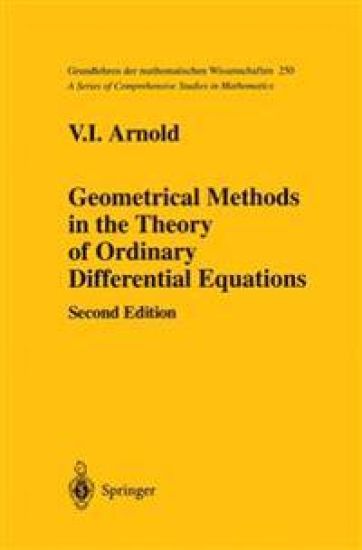
Geometrical Methods in the Theory of Ordinary Differential Equations
Since the first edition of this book, geometrical methods in the theory of ordinary differential equations have become very popular and some progress has been made partly with the help of computers. Much of this progress is represented in this revised, expanded edition, including such topics as the Feigenbaum universality of period doubling, the Zoladec solution, the Iljashenko proof, the Ecalle and Voronin theory, the Varchenko and Hovanski theorems, and the Neistadt theory. In the selection of material for this book, the author explains basic ideas and methods applicable to the study of differential equations. Special efforts were made to keep the basic ideas free from excessive technicalities. Thus the most fundamental questions are considered in great detail, while of the more special and difficult parts of the theory have the character of a survey. Consequently, the reader needs only a general mathematical knowledge to easily follow this text. It is directed to mathematicians, aswell as all users of the theory of differential equations.
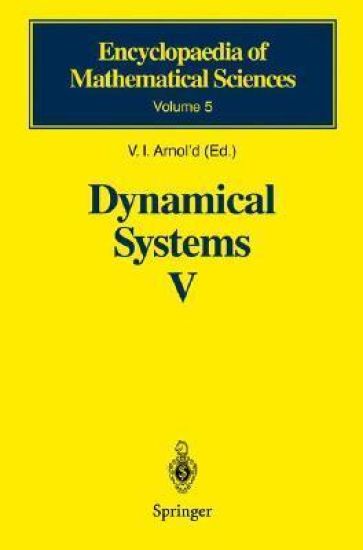
Dynamical Systems V

Dynamical Systems V

V.I. Arnold; V.S. Afrajmovich; Yu.S. Il'yashenko; L.P. Shil'nikov

Springer-Verlag Berlin and Heidelberg GmbH Co. K
1999
nidottu
Bifurcation theory and catastrophe theory are two well-known areas within the field of dynamical systems. Both are studies of smooth systems, focusing on properties that seem to be manifestly non-smooth. Bifurcation theory is concerned with the sudden changes that occur in a system when one or more parameters are varied. Examples of such are familiar to students of differential equations, from phase portraits. Understanding the bifurcations of the differential equations that describe real physical systems provides important information about the behavior of the systems. Catastrophe theory became quite famous during the 1970's, mostly because of the sensation caused by the usually less than rigorous applications of its principal ideas to "hot topics", such as the characterization of personalities and the difference between a "genius" and a "maniac". Catastrophe theory is accurately described as singularity theory and its (genuine) applications. The authors of this book, previously published as Volume 5 of the Encyclopaedia, have given a masterly exposition of these two theories, with penetrating insight.
Singularity Theory I

Singularity Theory I

V.I. Arnold; V.V. Goryunov; O.V. Lyashko; V.A. Vasil'ev

Springer-Verlag Berlin and Heidelberg GmbH Co. K
1998
nidottu
From the reviews: "... My general impression is of a particularly nice book, with a well-balanced bibliography, recommended!"Mededelingen van Het Wiskundig Genootschap, 1995"... The authors offer here an up to date guide to the topic and its main applications, including a number of new results. It is very convenient for the reader, a carefully prepared and extensive bibliography ... makes it easy to find the necessary details when needed. The books (EMS 6 and EMS 39) describe a lot of interesting topics. ... Both volumes are a very valuable addition to the library of any mathematician or physicist interested in modern mathematical analysis."European Mathematical Society Newsletter, 1994
Dynamical Systems I

Dynamical Systems I

D.V. Anosov; S.Kh. Aranson; V.I. Arnold; I.U. Bronshtein; V.Z. Grines; Yu.S. Ilyashenko

Springer-Verlag Berlin and Heidelberg GmbH Co. K
1996
nidottu
From the reviews: "The reading is very easy and pleasant for the non-mathematician, which is really noteworthy. The two chapters enunciate the basic principles of the field, ... indicate connections with other fields of mathematics and sketch the motivation behind the various concepts which are introduced.... What is particularly pleasant is the fact that the authors are quite successful in giving to the reader the feeling behind the demonstrations which are sketched. Another point to notice is the existence of an annotated extended bibliography and a very complete index. This really enhances the value of this book and puts it at the level of a particularly interesting reference tool. I thus strongly recommend to buy this very interesting and stimulating book." Journal de Physique
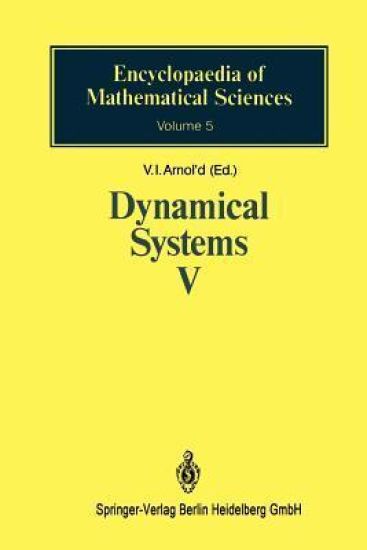
Dynamical Systems V

Dynamical Systems V

V. I. Arnold; V.S. Afrajmovich; Yu.S Ilyashenko; L.P. Shil'nikov

Springer-Verlag Berlin and Heidelberg GmbH Co. K
1994
sidottu
Bifurcation theory and catastrophe theory are two well-known areas within the field of dynamical systems. Both are studies of smooth systems, focusing on properties that seem to be manifestly non-smooth. Bifurcation theory is concerned with the sudden changes that occur in a system when one or more parameters are varied. Examples of such are familiar to students of differential equations, from phase portraits. Understanding the bifurcations of the differential equations that describe real physical systems provides important information about the behavior of the systems. Catastrophe theory became quite famous during the 1970's, mostly because of the sensation caused by the usually less than rigorous applications of its principal ideas to "hot topics", such as the characterization of personalities and the difference between a "genius" and a "maniac". Catastrophe theory is accurately described as singularity theory and its (genuine) applications. The authors of this book, previously published as Volume 5 of the Encyclopaedia, have given a masterly exposition of these two theories, with penetrating insight.
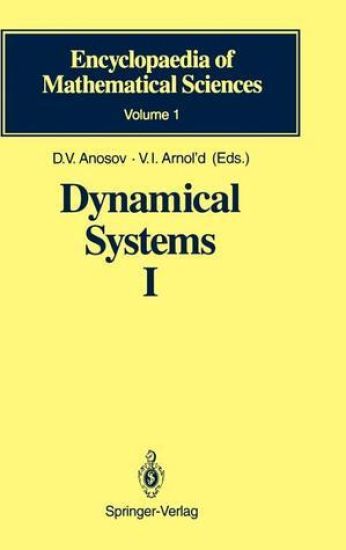
Dynamical Systems I

Dynamical Systems I

D.V. Anosov; S.Kh. Aranson; V.I. Arnold; I.U. Bronshtein; V.Z. Grines; Yu.S. Ilyashenko

Springer-Verlag Berlin and Heidelberg GmbH Co. K
1988
sidottu
From the reviews: "The reading is very easy and pleasant for the non-mathematician, which is really noteworthy. The two chapters enunciate the basic principles of the field, ... indicate connections with other fields of mathematics and sketch the motivation behind the various concepts which are introduced.... What is particularly pleasant is the fact that the authors are quite successful in giving to the reader the feeling behind the demonstrations which are sketched. Another point to notice is the existence of an annotated extended bibliography and a very complete index. This really enhances the value of this book and puts it at the level of a particularly interesting reference tool. I thus strongly recommend to buy this very interesting and stimulating book." Journal de Physique