Kirjojen hintavertailu. Mukana 12 535 728 kirjaa ja 12 kauppaa.

Kirjailija

V.S. Varadarajan

Kirjat ja teokset yhdessä paikassa: 11 kirjaa, julkaisuja vuosilta 1977-2014, suosituimpien joukossa Lie Groups, Lie Algebras, and Their Representations. Vertaile teosten hintoja ja tarkista saatavuus suomalaisista kirjakaupoista.

Mukana myös kirjoitusasut: V. S. Varadarajan

11 kirjaa

Kirjojen julkaisuhaarukka 1977-2014.

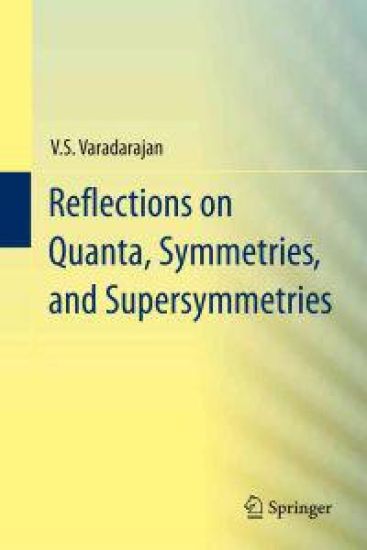
Reflections on Quanta, Symmetries, and Supersymmetries

Reflections on Quanta, Symmetries, and Supersymmetries

V.S. Varadarajan

Springer-Verlag New York Inc.
2014
nidottu
This is a collection of essays based on lectures that author has given on various occasions on foundation of quantum theory, symmetries and representation theory, and the quantum theory of the superworld created by physicists. The lectures are linked by a unifying theme: how the quantum world and superworld appear under the lens of symmetry and supersymmetry. In the world of ultra-small times and distances such as the Planck length and Planck time, physicists believe no measurements are possible and so the structure of spacetime itself is an unknown that has to be first understood. There have been suggestions (Volovich hypothesis) that world geometry at such energy regimes is non-archimedian and some of the lectures explore the consequences of such a hypothesis. Ultimately, symmetries and supersymmetries are described by the representation of groups and supergroups. The author's interest in representation is a lifelong one and evolved slowly, and owes a great deal to conversations and discussions he had with George Mackey and Harish-Chandra. The book concludes with a retrospective look at these conversations.
Geometry of Quantum Theory

Geometry of Quantum Theory

V.S. Varadarajan

Springer-Verlag New York Inc.
2013
nidottu
The present work is the first volume of a substantially enlarged version of the mimeographed notes of a course of lectures first given by me in the Indian Statistical Institute, Calcutta, India, during 1964-65. When it was suggested that these lectures be developed into a book, I readily agreed and took the opportunity to extend the scope of the material covered. No background in physics is in principle necessary for understand­ ing the essential ideas in this work. However, a high degree of mathematical maturity is certainly indispensable. It is safe to say that I aim at an audience composed of professional mathematicians, advanced graduate students, and, hopefully, the rapidly increasing group of mathematical physicists who are attracted to fundamental mathematical questions. Over the years, the mathematics of quantum theory has become more abstract and, consequently, simpler. Hilbert spaces have been used from the very beginning and, after Weyl and Wigner, group representations havecome in conclusively. Recent discoveries seem to indicate that the role of group representations is destined for further expansion, not to speak of the impact of the theory of several complex variables and function-space analysis. But all of this pertains to the world of interacting subatomic particles; the more modest view of the microscopic world presented in this book requires somewhat less. The reader with a knowledge of abstract integration, Hilbert space theory, and topological groups will find the going easy.
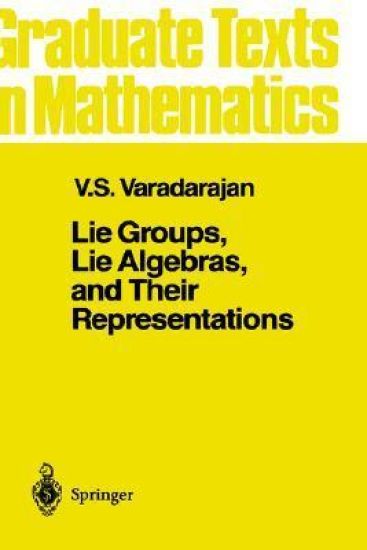
Lie Groups, Lie Algebras, and Their Representations

Lie Groups, Lie Algebras, and Their Representations

V.S. Varadarajan

Springer-Verlag New York Inc.
2013
nidottu
This book has grown out of a set of lecture notes I had prepared for a course on Lie groups in 1966. When I lectured again on the subject in 1972, I revised the notes substantially. It is the revised version that is now appearing in book form. The theory of Lie groups plays a fundamental role in many areas of mathematics. There are a number of books on the subject currently available -most notably those of Chevalley, Jacobson, and Bourbaki-which present various aspects of the theory in great depth. However, 1 feei there is a need for a single book in English which develops both the algebraic and analytic aspects of the theory and which goes into the representation theory of semi­ simple Lie groups and Lie algebras in detail. This book is an attempt to fiii this need. It is my hope that this book will introduce the aspiring graduate student as well as the nonspecialist mathematician to the fundamental themes of the subject. I have made no attempt to discuss infinite-dimensional representations. This is a very active field, and a proper treatment of it would require another volume (if not more) of this size. However, the reader who wants to take up this theory will find that this book prepares him reasonably well for that task.
Reflections on Quanta, Symmetries, and Supersymmetries

Reflections on Quanta, Symmetries, and Supersymmetries

V.S. Varadarajan

Springer-Verlag New York Inc.
2011
sidottu
This is a collection of essays based on lectures that author has given on various occasions on foundation of quantum theory, symmetries and representation theory, and the quantum theory of the superworld created by physicists. The lectures are linked by a unifying theme: how the quantum world and superworld appear under the lens of symmetry and supersymmetry. In the world of ultra-small times and distances such as the Planck length and Planck time, physicists believe no measurements are possible and so the structure of spacetime itself is an unknown that has to be first understood. There have been suggestions (Volovich hypothesis) that world geometry at such energy regimes is non-archimedian and some of the lectures explore the consequences of such a hypothesis. Ultimately, symmetries and supersymmetries are described by the representation of groups and supergroups. The author's interest in representation is a lifelong one and evolved slowly, and owes a great deal to conversations and discussions he had with George Mackey and Harish-Chandra. The book concludes with a retrospective look at these conversations.
Geometry of Quantum Theory

Geometry of Quantum Theory

V.S. Varadarajan

Springer-Verlag New York Inc.
2006
nidottu
It was about four years ago that Springer-Verlag suggested that a revised edition in a single volume of my two-volume work may be worthwhile. I agreed enthusiastically but the project was delayed for many reasons, one of the most important of which was that I did not have at that time any clear idea as to how the revision was to be carried out. Eventually I decided to leave intact most ofthe original material, but make the current edition a little more up-to-date by adding, in the form of notes to the individual chapters, some recent references and occasional brief discussions of topics not treated in the original text. The only substantive change from the earlier work is in the treatment of projective geometry; Chapters II through V of the original Volume I have been condensed and streamlined into a single Chapter II. I wish to express my deep gratitude to Donald Babbitt for his generous advice that helped me in organizing this revision, and to Springer-Verlag for their patience and understanding that went beyond what one has a right to expect from a publisher. I suppose an author's feelings are always mixed when one of his books that is comparatively old is brought out once again.
Euler Through Time

Euler Through Time

V. S. Varadarajan

Amer Mathematical Society
2006
sidottu
Euler is one of the greatest and most prolific mathematicians of all time. He wrote the first accessible books on calculus, created the theory of circular functions, and discovered new areas of research such as elliptic integrals, the calculus of variations, graph theory, divergent series, and so on. It took hundreds of years for his successors to develop in full the theories he began, and some of his themes are still at the center of today's mathematics. It is of great interest therefore to examine his work and its relation to current mathematics. This book attempts to do that. In number theory the discoveries he made empirically would require for their eventual understanding such sophisticated developments as the reciprocity laws and class field theory.His pioneering work on elliptic integrals is the precursor of the modern theory of abelian functions and abelian integrals. His evaluation of zeta and multizeta values is not only a fantastic and exciting story but very relevant to us, because they are at the confluence of much research in algebraic geometry and number theory today (Chapters 2 and 3 of the book).Anticipating his successors by more than a century, Euler created a theory of summation of series that do not converge in the traditional manner.Chapter 5 of the book treats the progression of ideas regarding divergent series from Euler to many parts of modern analysis and quantum physics. The last chapter contains a brief treatment of Euler products. Euler discovered the product formula over the primes for the zeta function as well as for a small number of what are now called Dirichlet $L$-functions. Here the book goes into the development of the theory of such Euler products and the role they play in number theory, thus offering the reader a glimpse of current developments (the Langlands program). For other wonderful titles written by this author see: "Supersymmetry for Mathematicians: An Introduction", "The Mathematical Legacy of Harish-Chandra: A Celebration of Representation Theory and Harmonic Analysis", "The Selected Works of V.S. Varadarajan", and "Algebra in Ancient and Modern Times".
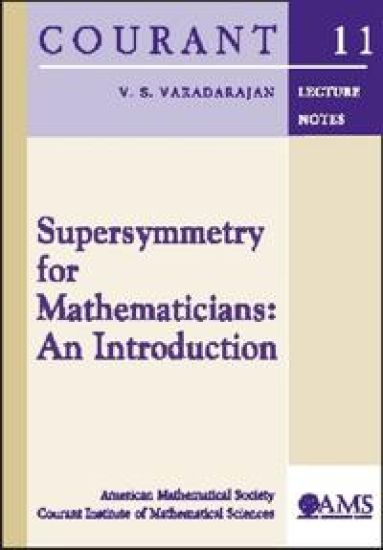
Supersymmetry For Mathematicians

Supersymmetry For Mathematicians

V. S. Varadarajan

Amer Mathematical Society
2004
pokkari
Supersymmetry has been studied by theoretical physicists since the early 1970s. Nowadays, because of its novelty and significance - in both mathematics and physics - the issues it raises attract the interest of mathematicians. Written by the well-known mathematician, V. S. Varadarajan, this book presents a cogent and self-contained exposition of the foundations of supersymmetry for the mathematically-minded reader. It begins with a brief introduction to the physical foundations of the theory, in particular, to the classification of relativistic particles and their wave equations, such as those of Dirac and Weyl. It then continues with the development of the theory of supermanifolds, stressing the analogy with the Grothendieck theory of schemes.Here, Varadarajan develops all the super linear algebra needed for the book and establishes the basic theorems: differential and integral calculus in supermanifolds, Frobenius theorem, foundations of the theory of super Lie groups, and so on.A special feature is the in-depth treatment of the theory of spinors in all dimensions and signatures, which is the basis of all supergeometry developments in both physics and mathematics, especially in quantum field theory and supergravity. The material is suitable for graduate students and mathematicians interested in the mathematical theory of supersymmetry. The book is recommended for independent study. For other wonderful titles written by this author see: Euler through "Time: A New Look at Old Themes", "The Mathematical Legacy of Harish-Chandra: A Celebration of Representation Theory and Harmonic Analysis", "The Selected Works of V.S. Varadarajan", and "Algebra in Ancient and Modern Times".
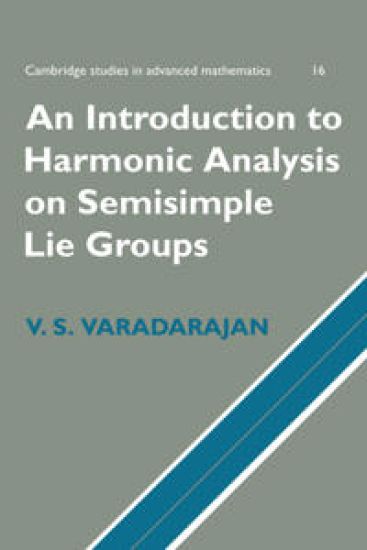
An Introduction to Harmonic Analysis on Semisimple Lie Groups

An Introduction to Harmonic Analysis on Semisimple Lie Groups

V. S. Varadarajan

Cambridge University Press
1999
pokkari
Now in paperback, this graduate-level textbook is an introduction to the representation theory of semi-simple Lie groups. As such, it will be suitable for research students in algebra and analysis, and for research mathematicians requiring a readable account of the topic. The author emphasizes the development of the central themes of the subject in the context of special examples, without losing sight of its general flow and structure. The author begins with an account of compact groups and discusses the Harish-Chandra modules of SL(2,R) and SL(2,C). Professor Varadarajan then introduces the Plancherel formula and Schwartz spaces, and shows how these lead to the Harish-Chandra theory of Eisenstein integrals. The final sections are devoted to considering the irreducible characters of semi-simple Lie groups, including explicit calculations of SL(2,R). The book concludes with appendices sketching some basic topics with a comprehensive guide to further reading.
Algebra in Ancient and Modern Times

Algebra in Ancient and Modern Times

V. S. Varadarajan

Amer Mathematical Society
1998
pokkari
This text offers a special account of Indian work in diophantine equations during the 6th through 12th centuries and Italian work on solutions of cubic and biquadratic equations from the 11th through 16th centuries. The volume traces the historical development of algebra and the theory of equations from ancient times to the beginning of modern algebra, outlining some modern themes such as the fundamental theorem of algebra, Clifford algebras, and quarternions. It is geared toward undergraduates who have no background in calculus. For other wonderful titles written by this author see: "Euler through Time: A New Look at Old Themes", "Supersymmetry for Mathematicians: An Introduction", "The Mathematical Legacy of Harish-Chandra: A Celebration of Representation Theory and Harmonic Analysis", and "The Selected Works of V.S. Varadarajan".
Lie Groups, Lie Algebras, and Their Representations

Lie Groups, Lie Algebras, and Their Representations

V.S. Varadarajan

Springer-Verlag New York Inc.
1984
sidottu
This book has grown out of a set of lecture notes I had prepared for a course on Lie groups in 1966. When I lectured again on the subject in 1972, I revised the notes substantially. It is the revised version that is now appearing in book form. The theory of Lie groups plays a fundamental role in many areas of mathematics. There are a number of books on the subject currently available -most notably those of Chevalley, Jacobson, and Bourbaki-which present various aspects of the theory in great depth. However, 1 feei there is a need for a single book in English which develops both the algebraic and analytic aspects of the theory and which goes into the representation theory of semi­ simple Lie groups and Lie algebras in detail. This book is an attempt to fiii this need. It is my hope that this book will introduce the aspiring graduate student as well as the nonspecialist mathematician to the fundamental themes of the subject. I have made no attempt to discuss infinite-dimensional representations. This is a very active field, and a proper treatment of it would require another volume (if not more) of this size. However, the reader who wants to take up this theory will find that this book prepares him reasonably well for that task.