Kirjojen hintavertailu. Mukana 12 254 403 kirjaa ja 12 kauppaa.

Kirjailija

Valerie Kinloch

Kirjat ja teokset yhdessä paikassa: 5 kirjaa, julkaisuja vuosilta 2006-2021, suosituimpien joukossa June Jordan. Vertaile teosten hintoja ja tarkista saatavuus suomalaisista kirjakaupoista.

5 kirjaa

Kirjojen julkaisuhaarukka 2006-2021.

Where Is the Justice?

Where Is the Justice?

Valerie Kinloch; Emily A. Nemeth; Tamara T. Butler; Grace D. Player

Teachers' College Press
2021
sidottu
This inspirational book is about engaged pedagogies, an approach to teaching and learning that centers dialogue, listening, equity, and connection among stakeholders who understand the human and ecological cost of inequality. The authors share their story of working with students, teachers, teacher educators, families, community members, and union leaders to create transformative practices within and beyond public school classrooms. This collaborative work occurred within various spaces—inside school buildings, libraries, churches, community gardens, nonprofit organizations, etc.—and afforded opportunities to grapple with engaged pedagogies in times of political crisis. Featuring descriptions from a district-wide initiative, this book offers practical and theoretical resources for educators wanting to center justice in their work with students. Through question-posing, color images, empirical observations, and use of scholarly and practitioner-driven literature, readers will learn how to use these resources to reconfigure schools and classrooms as sites of engagement for equity, justice, and love.Book Features:Provides a sound approach to deeply taking up the work of justice and engaged pedagogies.Presents linguistic, cultural, theoretical, and practical ideas that can be used and implemented immediately. Includes reflective questions, found poetry, lesson ideas, storytelling as narrative, and examples of engaged pedagogies. Shares stories from a district-wide initiative that embedded engaged pedagogies within classrooms, counseling offices, and libraries.Showcases original artwork and images in full color by Grace D. Player, one of the coauthors.
Where Is the Justice?

Where Is the Justice?

Valerie Kinloch; Emily A. Nemeth; Tamara T. Butler; Grace D. Player

Teachers' College Press
2021
nidottu
This inspirational book is about engaged pedagogies, an approach to teaching and learning that centers dialogue, listening, equity, and connection among stakeholders who understand the human and ecological cost of inequality. The authors share their story of working with students, teachers, teacher educators, families, community members, and union leaders to create transformative practices within and beyond public school classrooms. This collaborative work occurred within various spaces—inside school buildings, libraries, churches, community gardens, nonprofit organizations, etc.—and afforded opportunities to grapple with engaged pedagogies in times of political crisis. Featuring descriptions from a district-wide initiative, this book offers practical and theoretical resources for educators wanting to center justice in their work with students. Through question-posing, color images, empirical observations, and use of scholarly and practitioner-driven literature, readers will learn how to use these resources to reconfigure schools and classrooms as sites of engagement for equity, justice, and love.Book Features:Provides a sound approach to deeply taking up the work of justice and engaged pedagogies.Presents linguistic, cultural, theoretical, and practical ideas that can be used and implemented immediately. Includes reflective questions, found poetry, lesson ideas, storytelling as narrative, and examples of engaged pedagogies. Shares stories from a district-wide initiative that embedded engaged pedagogies within classrooms, counseling offices, and libraries.Showcases original artwork and images in full color by Grace D. Player, one of the coauthors.
Crossing Boundaries

Crossing Boundaries

Valerie Kinloch; Shirley Heath Heath

Teachers' College Press
2012
nidottu
In her new book, Valerie Kinloch, award-winning author of Harlem on Our Minds, sheds light on the ways urban youth engage in meaning-making experiences as a way to assert critical, creative, and highly sophisticated perspectives on teaching, learning, and survival. Kinloch rejects deficit models that have traditionally defined the literacy abilities of students of colour, especially African American and Latino/a youth. In contrast, she crosses boundaries to listen to the voices of students attending high school in New York City's Harlem community. In Crossing Boundaries, Kinloch uses a critical teacher-researcher lens to propose new directions for youth literacies and achievements. The text features examples of classroom engagements, student writings and presentations, discussions of texts and current events, and conversations on skills, process, achievement, and underachievement.
Harlem on Our Minds

Harlem on Our Minds

Valerie Kinloch

Teachers' College Press
2009
nidottu
In her new book, Valerie Kinloch investigates how the lives and literacies of youth in New York City's historic Harlem are affected by public attempts to gentrify the community. Kinloch draws connections between race, place, and students' literate identities through interviews with youth, teachers, longtime Black residents, and their new White neighbors. ""Harlem on Our Minds"" is a participatory action narrative that brings emerging theories of social ecology to life for the high school English classroom. Vividly drawn lessons show how teachers can engage urban youth in school-based literacy by linking canonical text, particularly of the Harlem Renaissance, to current events. Centered on the literacy stories of two African American youth and their peers, this book: showcases the multimodal literacy practices of urban youth through photographs, writing samples, student-designed research projects, and more; weaves in multiple voices and perspectives through response pieces by project participants, local teachers, a graduate student, and a community activist; and, features summaries of teaching strategies.
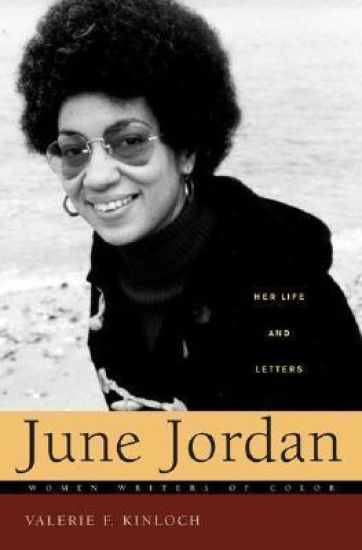
June Jordan

June Jordan

Valerie Kinloch

Praeger Publishers Inc
2006
sidottu
June Jordan was born on July 9, 1936, in Harlem, New York, to Mildred and Granville Jordan, Jamaican natives. During her life, she became one of the most prolific, important, and influential African American writers of her time. Before her death from breast cancer in 2002, Jordan published more than 27 books, including Some of Us Did Not Die, Solider: A Poet's Childhood, Poetry for the People: Finding a Voice through Verse, Haruko Love Poems, and Naming Our Destiny. Her work Civil Wars, a collection of letters and essays, addressed such topics as violence, homosexuality, race, and black feminism. Working in many genres and touching on many themes and issues, Jordan was a powerful force in American literature. This biography reveals the woman, the writer, the poet, the activist, the leader, and the educator in all her complexity. Working in many genres and touching on many themes and issues, June Jordan was a powerful force in American literature. This biography reveals the woman, the writer, the speaker, the poet, the activist, the leader, and the educator in all her complexity. June Jordan was born on July 9, 1936, in Harlem, New York, to Mildred and Granville Jordan, Jamaican natives. During her life, she became one of the most prolific, important, and influential African American writers of her time. Before her death from breast cancer in 2002, Jordan published more than 27 books, including Some of Us Did Not Die, Solider: A Poet's Childhood, Poetry for the People: Finding a Voice through Verse, Haruko Love Poems, and Naming Our Destiny. Her work Civil Wars, a collection of letters and essays, addressed such topics as violence, homosexuality, race, and black feminism. Kinloch offers a life and letters of this prolific writer, delving into both her biography and her contributions as a writer and activist. This approach unveils the power of language in Jordan's poems, essays, speeches, books—and ultimately in her own life—as she challenged political systems of injustice, racism, and sexism. Kinloch examines questions surrounding the pain of writing, the anger of oppression, and the struggle of African American women to assert their voices. Attention is paid to the ways in which Jordan's life informed her writings her perspectives, and her contributions to the global landscape of class, race, and gender issues. The writer's major works are explored in detail, as Kinloch weaves discussions of her life into critical considerations of her writings. Ultimately, this portrait illustrates the ways in which Jordan's career represented her dedication to making words work; her ability to rally and revolutionize the spirit of people invested in decolonization, love, and freedom; and her responsiveness to the world in which she lived.