Kirjailija
Vandana Shiva
Kirjat ja teokset yhdessä paikassa: 40 kirjaa, julkaisuja vuosilta 2002-2025, suosituimpien joukossa Water Wars. Vertaile teosten hintoja ja tarkista saatavuus suomalaisista kirjakaupoista.
40 kirjaa
Kirjojen julkaisuhaarukka 2002-2025.
"The world's most prominent radical scientist." The Guardian Vandana Shiva, a world-renowned environmentalist and campaigner, examines the ‘water wars’ of the twenty-first century: the aggressive privatization by the multinationals of communal water rights. While drought and desertification are intensifying around the world, corporations are aggressively converting free-flowing water into bottled profits. The water wars of the twenty-first century may match -- or even surpass -- the oil wars of the twentieth. In Water Wars: Privatization, Pollution and Profit, acclaimed author Vandana Shiva sheds light on the activists who are fighting corporate manoeuvres to convert this life-sustaining resource into more gold for the elites. In Water Wars, Shiva uses her remarkable knowledge of science and society to outline the emergence of corporate culture and the historical erosion of communal water rights. Using the international water trade and industrial activities such as damming, mining, and aquafarming as her lens, Shiva exposes the destruction of the earth and the disenfranchisement of the world's poor as they are stripped of rights to a precious common good. Shiva calls for a movement to preserve water access for all, and offers a blueprint for global resistance based on examples of successful campaigns.
Grandmother's Wisdom
Vandana Shiva; International Council of Thirteen Indigenous Grandmothers
SYNERGETIC PRESS INC.,U.S.
2024
nidottu
Grandmothers’ Wisdom is a vibrant tribute to the lives of the International Council of Thirteen Indigenous Grandmothers, an unprecedented global alliance of elders who came together in 2004 to protect our planet in crisis and envision a future for the next seven generations. With a foreword by Vandana Shiva and tributes to the grandmothers who have passed on, this special work is a living portrayal of the grandmothers’ upbringing, their encounters with the violence of colonialism and forced assimilation, their awakening to fierce activism, and the ceremonial practices they carry forward from their lineages with tenacity, grace, and devotion.The thirteen remarkable women portrayed in Grandmothers’ Wisdom are keepers of traditional medicine and Indigenous spirituality, preserving ancient wisdom traditions and traditional ecological knowledge that have served our planet earth for millennia. Their stories come from the Amazon rainforest, the Central American highlands, the Sierra Madre of Oaxaca, the plains, deserts and canyons of North America, the Himalayan mountains of Tibet and Nepal, and the forests of Central Africa. The award-winning photography depicts the grandmothers making offerings to all of creation and stewarding earth-based medicines through their practices of divination, energetic cleansing, gathering herbs, and performing initiations with plant medicines.The grandmothers have gathered each year for two decades to pray together in their homelands, promoting deep peace and interconnection through Indigenous ancestral knowledge, cultural preservation, and a reverence for the four elements: earth, air, fire, and water. In a time when contemporary life has left many young people bereft in the rifts between us, these spiritual activists constitute an intercontinental union across differences in culture, language, and ceremonial practice. They are icons for future generations, representing a worldview that honors the richness of our differences as we unite to protect our shared home on planet earth.
In an age of climate catastrophes and extinction, world-renowned environmentalist Vandana Shiva shows why we must turn back to nature and learn, once again, how to live sustainably on planet Earth, beginning with our relationship to food. Four billion years ago, Earth was a hot, lifeless planet. Through the process of evolution, the Earth and its diversity of living organisms gradually reduced the amount of carbon in the atmosphere. About 200,000 years ago, the conditions aligned for our own species – Homo sapiens – to emerge and thrive. But what will it take to continue to survive? In The Nature of Nature, legendary activist and scientist Vandana Shiva argues that food is the currency of life, a thread woven throughout the web of all life, indivisible from Earth and its natural systems. When this interdependence is ruptured, the conditions for the ‘metabolic disorder’ of climate change and countless other ecological imbalances come into being. Proposals put forward by Big Ag and Big Tech to solve the intertwined climate and food crises will only exacerbate both. With clarity and a detailed analysis, Vandana unpacks the false promises made by technology-oriented, lab-intensive digital agriculture, revealing the threats posed by fake and ultra-processed foods – including dangers to the environment, to increasing greenhouse gas emissions, to the health of animals and to our health and food security. In The Nature of Nature, Vandana takes a powerful stand, arguing with urgency and passion for a food and climate future based not on techno-optimism and corporate delusions, but on the natural regeneration of biodiversity in partnership with the planet. Praise for Vandana Shiva: ‘She’s been called the ‘Gandhi of grain,’ the ‘rock star’ of the anti-GMO movement and an ‘eco-warrior goddess.’ . . . Above all, [she] is a staunch believer that the food we eat matters. It makes us who we are, physically, culturally and spiritually.’ BBC ‘All of us who care about the future of Planet Earth must be grateful to Vandana Shiva.’ Jane Goodall, UN Messenger of Peace
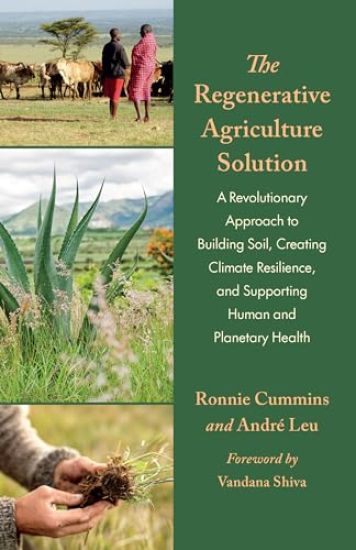
The Regenerative Agriculture Solution
André Leu; Ronnie Cummins; Vandana Shiva
CHELSEA GREEN PUBLISHING CO
2024
nidottu
Is it possible to solve the global climate emergency utilising “waste” agricultural product? The Regenerative Agriculture Solution tells the story of how two brothers – Jose and Gilberto Flores – are at the cutting edge of this approach, pioneering the use of the previously discarded leaves of the agave plant to regenerate agricultural soils, reduce erosion and improve water capture. Amazingly, these innovative, ecologically minded methods also benefit their local economy in Mexico, creating jobs by producing an inexpensive livestock feed supplement that has potential to grow into a multi-billion-dollar industry and change the face of agriculture, animal husbandry, ecosystem restoration and climate change. When Ronnie Cummins, the cofounder of Organic Consumer Association (OCA), met the Flores brothers and saw their agave agroforestry system, he knew they were onto something revolutionary. Having spent decades studying regenerative agriculture, Cummins knew best practice when he saw it, and the scientific data was equally impressive, suggesting projects like this could revolutionise the way we understand and help arrest the climate catastrophe. Sadly, Cummins passed away in April 2023, in the midst of working on this very book telling the Flores brothers’ extraordinary story. Not to leave this work unfinished, Ronnie’s widow and OCA cofounder, Rose, called on their friend, colleague, and Regeneration International’s co-founder André Leu, to complete Ronnie’s work and share the Flores brothers’ breakthroughs in the broader context of global regenerative agriculture. The Regenerative Agriculture Solution is more than a good news story; it’s an agricultural, agroforestry and public policy blueprint, as well as a call to action for organic and regenerative farmers and consumers alike to address the climate, health and environmental crises as well as rural poverty.
'A brilliant book [that] shows a way out of the destructive trap of Anthropocentric arrogance.' Vandana Shiva, from the Foreword 'Read this book if you would like to understand the intelligence of living systems.' Dr Denis Noble, University of Oxford ‘A welcoming yet fiercely challenging and provocative read shining a light on the way we look at the science of life.’ LoveReading What is life? This is arguably the fundamental question in all of science, and yet many scientists believe that life can be reduced to mechanistic factors, such as genes and information codes. But in a world as rich and complex as this one, can such an assertion really be true? Biocivilisations is a thrillingly original look at the mystery of life and a recognition of the complex civilisations of bacteria, viruses, fungi, plants and animals that have preceded the human world by billions of years. Dr Predrag Slijepcevic, senior lecturer in the Department of Life Sciences at Brunel University, reconsiders the limited scope and timeframe of our current ‘scientific revolution’ and shares how – from the tiniest bacteria to the largest mammals – the living world has long fostered ancient biocivilisations: how ants practice agriculture, how insects perform surgery, how trees conduct research, how slime moulds build networks as complex as our modern transportations systems and more. More than 99.99 percent of life on Earth has existed without humanity and life will continue without humans long into the future. Biocivilisations challenges us to reconsider the limited scope and time-window of our current ‘scientific revolution’ and to fundamentally reimagine what we call ‘life on Earth’ by posing a powerful question: Are we really the intelligent masters over nature we think we are?
In this groundbreaking work, two world-renowned scholars argue that ecological destruction and industrial catastrophes constitute a direct threat to everyday life, the maintenance of which has been made the particular responsibility of women. In both industrialized societies and the developing countries, the new wars the world is experiencing, violent ethnic chauvinisms and the malfunctioning of the economy also pose urgent questions for ecofeminists. Is there a relationship between patriarchal oppression and the destruction of nature in the name of profit and progress? How can women counter the violence inherent in these processes? Should they look to a link between the women's movement and other social movements?Maria Mies and Vandana Shiva offer a thought-provoking analysis of these and many other issues from a unique North-South perspective. They critique prevailing economic theories, conventional concepts of women's emancipation, the myth of 'catching up' development, the philosophical foundations of modern science and technology, and the omission of ethics when discussing so many questions, including advances in reproductive technology and biotechnology.In constructing their own ecofeminist epistemology and methodology, these two internationally respected feminist environmental activists look to the potential of movements advocating consumer liberation and subsistence production, sustainability and regeneration. They argue for an acceptance of limits and reciprocity and a rejection of exploitation, the endless commoditization of needs, and violence.
‘One of the world’s most prominent radical scientists.’ The Guardian ‘Vandana Shiva is an expert [on the dangers of gobalization] whose analysis has helped us understand this situation much more deeply.’ Russell Brand A powerful new memoir published to coincide with Vandana Shiva’s 70th birthday. Vandana Shiva has been described in many ways: the ‘Gandhi of Grain,’ ‘a rock star’ in the battle against GMOs, and ‘the most powerful voice’ for people of the developing world. For over four decades she has vociferously advocated for diversity, indigenous knowledge, localisation, and real democracy; she has been at the forefront of seed saving, food sovereignty, and connecting the dots between the destruction of nature, the polarization of societies, and indiscriminate corporate greed. In Terra Viva, Dr Shiva shares her most memorable campaigns, alongside some of the world’s most celebrated activists and environmentalists, all working towards a livable planet and healthier democracies. For the very first time, she also recounts the stories of her childhood in post-partition India – the influence of the Himalayan forests she roamed; her parents, who saw no difference in the education of boys and girls at a time when this was not the norm; and the Chipko movement, whose women were ‘the real custodians of biodiversity-related knowledge.’ Throughout, Shiva’s pursuit of a unique intellectual path marrying quantum physics with science, technology, and environmental policy will captivate the reader. Terra Viva is a celebration of a remarkable life and a clear-eyed assessment of the challenges we face moving forward – including those revealed by the Covid crisis, the privatisation of biotechnology, and the commodification of our biological and natural resources. ‘All of us who care about the future of Planet Earth must be grateful to Vandana Shiva.’ Jane Goodall, UN Messenger of Peace
A synthesis of more than three decades of interdisciplinary research and practice, Agroecology and Regenerative Agriculture: An Evidence-based Guide to Sustainable Solutions for Hunger, Poverty, and Climate Change, provides evidence-based solutions to some of the world's most pressing crises in global ecology, agriculture and public health.Featuring the work of Navdanya, an organization founded by Dr. Vandana Shiva that promotes agroecology, seed freedom, and a vision of Earth Democracy that seeks justice for the Earth and all living beings, this work serves as a guidebook for agriculture scientists, policy makers, environmentalists and every individual who cares about their own health as well as the vitality of the planet.Agroecology and Regenerative Agriculture, provides a detailed analysis of the multiple planetary dilemmas we face due to chemical and industrial agriculture, including land degradation, water depletion, biodiversity erosion, climate change, agrarian crises, and health crises while also focusing on practical and evidence-based solutions.Those solutions include methods of using biodiversity-based organic farming to regenerate soil, conserve water, increase climate change resilience, and ensure food security in rural populations. Dr. Shiva takes an organized approach to these wide-ranging topics and provides practical knowledge that can inform the future of agriculture and sustainable food systems. With detailed scientific evidence, Agroecology and Regenerative Agriculture shows how an ecological agriculture based on working with nature can regenerate the planet, the rural economy and our health.
Growing Stories from India
A Whitney Sanford; Vandana Shiva
THE UNIVERSITY PRESS OF KENTUCKY
2022
nidottu
This volume uses lessons from the Hindu culture to teach the world methods of sustainability. The costs of industrial agriculture are astonishing in terms of damage to the environment, human health, animal suffering, and social equity, and the situation demands that we expand our ecological imagination to meet this crisis. This book uses the story of the deity Balaram and the Yamuna River as a foundation for discussing the global food crisis and illustrating the Hindu origins of agrarian thought, encouraging us to reconsider our relationship with the earth.
The Monsanto Papers
Gilles-Éric Seralini; Jérôme Douzelet; Vandana Shiva
Skyhorse Publishing
2022
sidottu
A David and Goliath battle for truth A specialist in GM foods and pesticides, the biologist Gilles-Éric Seralini has studied their toxicity and effects on people's health for many years. In September 2012, for the first time in a major scientific journal (Food and Chemical Toxicology), he published a study showing the effect on the liver and kidneys of two of Monsanto's flagship products: Roundup weedkiller and the GM foods created to absorb it. Images from the study of tumor-ridden rats fed with GM foods and Roundup went viral. The study was a PR disaster for Monsanto. The multinational soon bounced back and did everything in its power to cover up the study—leaning on the publishers to retract the findings. Monsanto began a series of smear campaigns to discredit Seralini and fellow researchers and intimidate their supporters, while pumping out their own collection of fake research findings and testimonies. These practices were met with huge suspicion, but there was no concrete evidence until, in 2017, Monsanto was ordered to publish tens of thousands of confidential documents in a class-action lawsuit presented by thousands of individuals afflicted with serious illnesses from their use of Roundup. The "Monsanto Papers" that were produced subsequently proved the company’s cynical attempts at a cover-up as well as its fraudulent practices. Gilles-Éric Seralini and Jérôme Douzelet delved into the documents and discovered how, in the pursuit of its own short term economic interests, Monsanto used sophisticated methods of deceit to bypass legislation devised to protect millions of people. Seralini and Douzelet discovered how Monsanto managed to provide phony assessments to conceal the poisons its products contain, thus deceiving the public authorities and the scientific and medical communities.
Eine Erde für alle! - Einssein versus das 1 %
Vandana Shiva; Kartikey Shiva
NEUE ERDE GMBH
2021
pokkari
I Kvinder i Skoven undersøger Vandana Shiva, hvilken rolle Chipko-bevægelsen har haft i de lokale modstande mod den kolonialistiske ekstraktion i form af skovrydning, og det Shiva kalder “eukalyptiseringen”, der har pågået i Indien siden den britiske koloniserings begyndelse, og hvilke konsekvenser dette såkaldte “sociale skovbrug” har haft for lokalsamfund, og særligt for kvinderne, der har levet af og i overensstemmelse med skoven og dens diverse principper.Vandana Shiva beskriver også fælledernes betydning for biodiversiteten, for den indiske husholdning og for det mangfoldige liv, der lever i de områder, der stadig fungerer som fælleder. Shiva skriver:“I dag udgør ‘ødemarksudviklingen’ det sidste skridt mod deres (fælledernes) forsvinding. N.S. Jodha, der har arbejdet meget med fællesejede ressourcer, har vist, hvordan kvinders arbejde og livsvilkårene i de fattigere dele af de rurale samfund er tæt forbundet med træer og græsningsarealer i fællesområderne, idet de understøtter husdyrene og fjerner en del af presset på det opdyrkede land, samtidig med at det øger den organiske tilførsel til planterne gennem animalsk affald.32 Små bønder og arbejdere uden jordbesiddelser kan eje husdyr takket være fælledernes eksistens. Derudover er fællesarealerne i de regnfattige områder med til at sikre de traditionelle landbrugssystemer stabilitet og levedygtighed, der gør det muligt at anvende en integreret og varieret produktionsstrategi ved at bruge afgrøder, husdyr og træer, der polstrer økonomien i de tørre områder, idet de leverer føde, foder og brændsel i de år, hvor høsten slår fejl . Næsten 10% af de fattige familiers ernæring ser ud til at komme direkte fra fællesarealerne. I de fattigste grupper er kvindernes arbejde i næringsøkonomien således tæt forbundet med fælledernes eksistens. Privatiseringen af fællesarealerne gennem ødemarksudvikling er ikke en vildfarelse, men et resultat af den dominans, der udøves af organer som Verdensbanken, og af deres ligegyldighed over for naturens behov og sårbare sociale grupper. For den form for organisationer og organer tæller selvforsyning ikke som økonomisk aktivitet.”Selvom teksten oprindeligt er skrevet i 1988, og selvom situationerne i Indien og i Danmark selvfølgelig er komplet forskellige, så berører teksten alligevel en række forhold, der gør sig gældende i den altoverskyggende finanskapitalistiske virkelighed, vi lever i, og derfor også resonerer med den konflikt, der udspiller sig omkring ‘Fælleden’ i København lige nu. Underviser, kunstner og aktivist Zeenath Hasan skriver i forordet:“Mens jeg skriver dette forord, udspiller en multi-artslig konflikt sig ikke langt fra mit skrivebord i København, hvor aktivister, ejendomsinvestorer, byplanlæggere, politi, den store vandsala-mander, medier og civilsamfund toppes om byggeplaner. Her åbenbares skellet mellem et behov for beboelser til mennesker og bevarelse af økologisk mangfoldighed. Forsoning findes dog ikke nødvendigvis ved at indtage konfliktens polære modsætningspositioner. Jeg inviterer dig til at udføre din læsning af denne oversættelse, som om du trådte igennem en portal ind til en mangfoldighed af måder at relatere til økologien på på tværs af geologisk tid, antropocentrisk overlegenhed og multi-artslige uoverensstemmelser. Før du træder igennem, så brug et øjeblik på at gøre dig bevidst om dit eget metafysiske, metaforiske, ideologiske eller ontologiske forhold til økologien. Overvej hvordan din fortolkning afspejles i ord på et stykke papir, med et like i dit nyhedsfeed, i hudfarven hos dem, der plukker bananer i en plantage, i en appel for et truet bløddyr i en anden hemisfære, i en udånding fra dine læber, i en omfavnelse gennem tiden. Læs derefter oversættelsen for at relatere dig til en ikke så fjern fortid på dine egne vilkår, og sæt dig så ind i, hvordan man kan sameksistere i den ikke så fjerne fremtid.”
Reclaiming the Commons: Biodiversity, Traditional Knowledge, and the Rights of Mother Earth lays out the scientific, legal, political, and cultural struggle to defend the sovereignty of biodiversity and indigenous knowledge.Two decades ago, at the height of globalization, there was an attempt by corporations, and the countries which represent their interests, to privatize and enclose our biological and intellectual commons. The result of this effort has become the massive destabilization of communities all over the world with the expansion of patents and intellectual property rights into the domain of biodiversity.Today, there is a renewed attempt by global corporations to establish a regime in which biological and intellectual resources flow freely from poor countries to rich ones; and from the poorest communities to the richest corporations, with-out regulation. Reclaiming the Commons details the thirty-year cultural, political, scientific, and legal journey to protect biodiversity and indigenous knowledge from the unethical framework corporations impose on humankind in order to lay claim to life on Earth.Vandana Shiva masterfully articulates the devastation this corporate greed has inflicted not only on agricultural communities, but on our planet and our very existence. Ultimately, she poses that the recovery of the commons is essential in restructuring our society into one that can flourish, while protecting and honoring all life on Earth. This, she says, lies in the collective recognition of common creativity and the rediscovery of our place within Nature.
Oneness vs. the 1%: Shattering Illusions, Seeding Freedom
Vandana Shiva; Kartikey Shiva
Chelsea Green Publishing Company
2020
nidottu
With a new epilogue about Bill Gates's global agenda and how we can resist the billionaires' war on life "This is what globalization looks like: Opportunism. Exploitation. Further centralization of power. Further disempowerment of ordinary people. . . . Vandana Shiva is an expert whose analysis has helped us understand this situation much more deeply."--Russell Brand Widespread poverty, social unrest, and economic polarization have become our lived reality as the top 1% of the world's seven-billion-plus population pushes the planet―and all its people―to the social and ecological brink. In Oneness vs. the 1%, Vandana Shiva takes on the billionaire dictators of Gates, Buffet, and Mark Zuckerberg, as well as other modern empires like Big Tech, Big Pharma, and Big Ag, whose blindness to the rights of people, and to the destructive impact of their construct of linear progress, have wrought havoc across the world. Their single-minded pursuit of profit has undemocratically enforced uniformity and monocultures, division and separation, monopolies and external control―over finance, food, energy, information, healthcare, and even relationships. Basing her analysis on explosive facts, Shiva exposes the 1%'s model of philanthrocapitalism, which is about deploying unaccountable money to bypass democratic structures, derail diversity, and impose totalitarian ideas based on One Science, One Agriculture, and One History. Instead, Shiva calls for the resurgence of: Real knowledge Real intelligence Real wealth Real work Real well-being With these core goals, people can reclaim their right to: Live Free. Think Free. Breathe Free. Eat Free.
Widespread poverty and malnutrition, an alarming refugee crisis, social unrest,economic polarisation have become our lived reality as the top 1% of the world’s seven-billion-plus population pushes the planet—and all its people—to the social and ecological brink. In Oneness vs. the 1%, Vandana Shiva takes on the Billionaires Club of Gates, Buffett, Zuckerberg and other modern Mughals, whose blindness to the rights of people, and to the destructive impact of their construct of linear progress, have wrought havoc across the world. Their single-minded pursuit of profit has undemocratically enforced uniformity and monoculture, division and separation, monopolies and external control—over finance, food, energy, information, healthcare, and even relationships. Basing her analysis on explosive little-known facts, Shiva exposes the 1%’s model of philanthrocapitalism, which is about deploying unaccountable money to bypass democratic structures, derail diversity, and impose totalitarianism, so that people can reclaim their right to live free; think free; breathe free; eat free.