Kirjojen hintavertailu. Mukana 12 595 353 kirjaa ja 12 kauppaa.

Kirjailija

Vanessa Watson

Kirjat ja teokset yhdessä paikassa: 10 kirjaa, julkaisuja vuosilta 2001-2020, suosituimpien joukossa Change and Continuity in Spatial Planning. Vertaile teosten hintoja ja tarkista saatavuus suomalaisista kirjakaupoista.

10 kirjaa

Kirjojen julkaisuhaarukka 2001-2020.

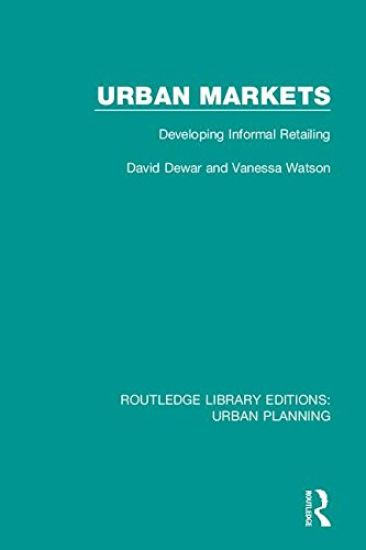
Urban Markets

Urban Markets

David Dewar; Vanessa Watson

Routledge
2020
nidottu
Originally published in 1990, Urban Markets looks at how the informal sector of the economy should be encouraged to assist in the alleviation of problems of poverty and unemployment. Despite this rhetoric, few concrete, implementable ways have been developed. This book is concerned with one such potential strategy which the authors consider to be particularly effective: the creation of both built and open markets for very small retailers and wholesalers. Based on experience of observing such markets in several continents, the authors combine a discussion of the theoretical issues surrounding the creation of urban markets with practical hints of how to establish and run them.
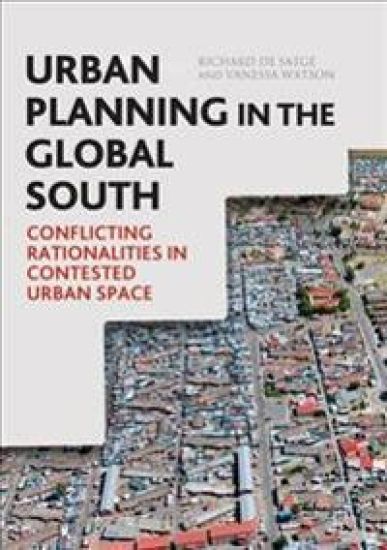
Urban Planning in the Global South

Urban Planning in the Global South

Richard de Satgé; Vanessa Watson

Springer Nature Switzerland AG
2019
nidottu
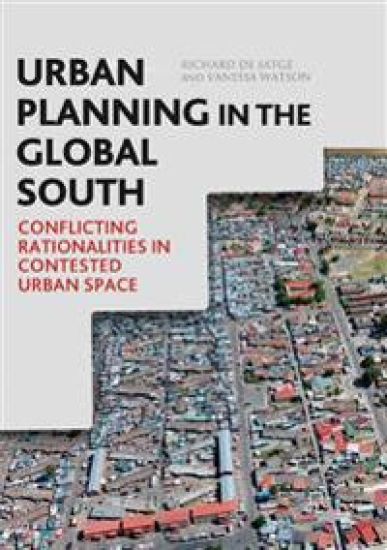
This book addresses the on-going crisis of informality in rapidly growing cities of the global South. The authors offer a Southern perspective on planning theory, explaining how the concept of conflicting rationalities complements and expands upon a theoretical tradition which still primarily speaks to global ‘Northern’ audiences. De Satgé and Watson posit that a significant change is needed in the makeup of urban planning theory and practice – requiring an understanding of the ‘conflict of rationalities’ between state planning and those struggling to survive in urban informal settlements – for social conditions to improve in the global South. Ethnography, as illustrated in the book’s case study – Langa, a township in Cape Town, South Africa – is used to arrive at this conclusion. The authors are thus able to demonstrate how power and conflict between the ambitions of state planners and shack-dwellers, attempting to survive in a resource-poor context, have permeated and shaped all state–society engagement in this planning process.
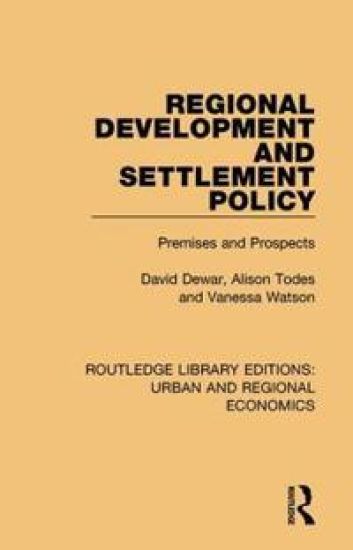
Regional Development and Settlement Policy

Regional Development and Settlement Policy

David Dewar; Alison Todes; Vanessa Watson

Routledge
2018
nidottu
Originally published in 1986. This book focusses on a critical analysis of regional development strategy in South Africa, and shifts over time in that strategy. Regional development theory and thinking about settlement policy have developed largely independently of each other. This book clarifies some of the resulting confusion and points towards a greater integration of the two areas of understanding.The book provides an overview of shifts which occurred in national and regional development theory and the broader social, economic and political factors which influenced these shifts. It identifies the major policy implications of the various development approaches, with particular emphasis placed on the role of settlement policy. The differences between policy approaches and the debates surrounding them are identified and discussed.
Urban Markets

Urban Markets

David Dewar; Vanessa Watson

Routledge
2018
sidottu
Originally published in 1990, Urban Markets looks at how the informal sector of the economy should be encouraged to assist in the alleviation of problems of poverty and unemployment. Despite this rhetoric, few concrete, implementable ways have been developed. This book is concerned with one such potential strategy which the authors consider to be particularly effective: the creation of both built and open markets for very small retailers and wholesalers. Based on experience of observing such markets in several continents, the authors combine a discussion of the theoretical issues surrounding the creation of urban markets with practical hints of how to establish and run them.
Urban Planning in the Global South

Urban Planning in the Global South

Richard de Satgé; Vanessa Watson

Springer International Publishing AG
2018
sidottu
This book addresses the on-going crisis of informality in rapidly growing cities of the global South. The authors offer a Southern perspective on planning theory, explaining how the concept of conflicting rationalities complements and expands upon a theoretical tradition which still primarily speaks to global ‘Northern’ audiences. De Satgé and Watson posit that a significant change is needed in the makeup of urban planning theory and practice – requiring an understanding of the ‘conflict of rationalities’ between state planning and those struggling to survive in urban informal settlements – for social conditions to improve in the global South. Ethnography, as illustrated in the book’s case study – Langa, a township in Cape Town, South Africa – is used to arrive at this conclusion. The authors are thus able to demonstrate how power and conflict between the ambitions of state planners and shack-dwellers, attempting to survive in a resource-poor context, have permeated and shaped all state–society engagement in this planning process.
Regional Development and Settlement Policy

Regional Development and Settlement Policy

David Dewar; Alison Todes; Vanessa Watson

Routledge
2017
sidottu
Originally published in 1986. This book focusses on a critical analysis of regional development strategy in South Africa, and shifts over time in that strategy. Regional development theory and thinking about settlement policy have developed largely independently of each other. This book clarifies some of the resulting confusion and points towards a greater integration of the two areas of understanding.The book provides an overview of shifts which occurred in national and regional development theory and the broader social, economic and political factors which influenced these shifts. It identifies the major policy implications of the various development approaches, with particular emphasis placed on the role of settlement policy. The differences between policy approaches and the debates surrounding them are identified and discussed.
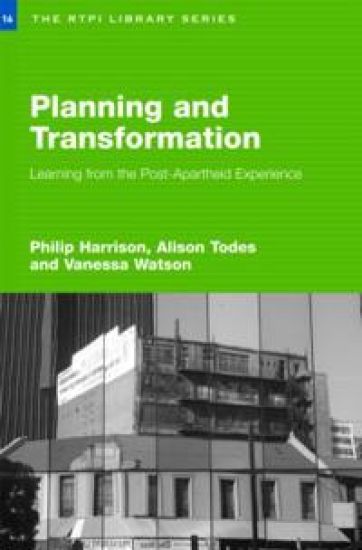
Planning and Transformation

Planning and Transformation

Philip Harrison; Alison Todes; Vanessa Watson

Routledge
2007
sidottu
Planning and Transformation provides a comprehensive view of planning under political transition in South Africa, offering an accessible resource for both students and researchers in an international and a local audience.In the years after the 1994 transition to democracy in South Africa, planners believed they would be able to successfully promote a vision of integrated, equitable and sustainable cities, and counter the spatial distortions created by apartheid. This book covers the experience of the planning community, the extent to which their aims were achieved, and the hindering factors. Although some of the factors affecting planning have been context-specific, the nature of South Africa’s transition and its relationship to global dynamics have meant that many of the issues confronting planners in other parts of the world are echoed here. Issues of governance, integration, market competitiveness, sustainability, democracy and values are significant, and the particular nature of the South African experience lends new insights to thinking on these questions, exploring the possibilities of achievement in the planning field.
Planning and Transformation

Planning and Transformation

Philip Harrison; Alison Todes; Vanessa Watson

Routledge
2007
nidottu
Planning and Transformation provides a comprehensive view of planning under political transition in South Africa, offering an accessible resource for both students and researchers in an international and a local audience.In the years after the 1994 transition to democracy in South Africa, planners believed they would be able to successfully promote a vision of integrated, equitable and sustainable cities, and counter the spatial distortions created by apartheid. This book covers the experience of the planning community, the extent to which their aims were achieved, and the hindering factors. Although some of the factors affecting planning have been context-specific, the nature of South Africa’s transition and its relationship to global dynamics have meant that many of the issues confronting planners in other parts of the world are echoed here. Issues of governance, integration, market competitiveness, sustainability, democracy and values are significant, and the particular nature of the South African experience lends new insights to thinking on these questions, exploring the possibilities of achievement in the planning field.
Change and Continuity in Spatial Planning
Change and Continuity in Spatial Planning addresses a question of enduring interest to planners: can planning really bring about significant and positive change? In South Africa the process of political transition appeared to create the preconditions for planners to demonstrate how their traditional humanitarian and environmental concerns could find concrete expression in the reshaping of the built environment.Integral to this story is how planning practices have been shaped by the past, in a rapidly changing context characterised by a globalising economy, new systems of governance, a changing political ideology, and a culture of intensifying poverty and diversity. More broadly, the book addresses the issue of how planners use power, in situations which themselves represent networks of power relations, where both planners and those they engage with operate through frames of reference fundamentally shaped by place and history.
Change and Continuity in Spatial Planning
Change and Continuity in Spatial Planning addresses a question of enduring interest to planners: can planning really bring about significant and positive change? In South Africa the process of political transition appeared to create the preconditions for planners to demonstrate how their traditional humanitarian and environmental concerns could find concrete expression in the reshaping of the built environment.Integral to this story is how planning practices have been shaped by the past, in a rapidly changing context characterised by a globalising economy, new systems of governance, a changing political ideology, and a culture of intensifying poverty and diversity. More broadly, the book addresses the issue of how planners use power, in situations which themselves represent networks of power relations, where both planners and those they engage with operate through frames of reference fundamentally shaped by place and history.