Kirjojen hintavertailu. Mukana 12 595 353 kirjaa ja 12 kauppaa.

Kirjailija

Vesa A Niskanen

Kirjat ja teokset yhdessä paikassa: 2 kirjaa, julkaisuja vuosilta 2003-2010, suosituimpien joukossa Soft Computing Methods in Human Sciences. Vertaile teosten hintoja ja tarkista saatavuus suomalaisista kirjakaupoista.

2 kirjaa

Kirjojen julkaisuhaarukka 2003-2010.

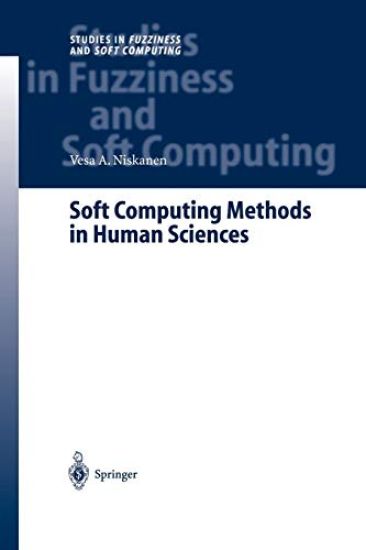
Soft Computing Methods in Human Sciences

Soft Computing Methods in Human Sciences

Vesa A Niskanen

Springer-Verlag Berlin and Heidelberg GmbH Co. K
2010
nidottu
This book considers Soft Computing methods and their applications in the human sciences. Soft Computing methods - including fuzzy systems, neural networks, evolutionary computing and probabilistic reasoning - are state-of-the-art methods in theory formation and model construction. They mainly stem from the natural sciences, and they have already proved to be powerful in their applications because Soft Computing models, particularly fuzzy system models, are simple and correspond well to the actual world and to human reasoning. Hence, we no longer have to use the complicated mathematical models that have prevailed in this research area. Dozens of books and thousands of articles have been devoted to applications of Soft Computing in the natural sciences, but only a few studies have focused on its applications in the human sciences, such as the social and the behavioral sciences - this despite the fact that these novel methods seem to open a number of inspiring prospects in these disciplines. In quantitative research in the human sciences, typical application areas include statistical models that can be replaced by simpler numerical or linguistic Soft Computing models. In qualitative research, Soft Computing methods can enhance modelling because, instead of having to do manual work, we can use computer simulations with approximate and/or linguistic constituents.
Soft Computing Methods in Human Sciences

Soft Computing Methods in Human Sciences

Vesa A Niskanen

Springer-Verlag Berlin and Heidelberg GmbH Co. K
2003
sidottu
This book considers Soft Computing methods and their applications in the human sciences. Soft Computing methods - including fuzzy systems, neural networks, evolutionary computing and probabilistic reasoning - are state-of-the-art methods in theory formation and model construction. They mainly stem from the natural sciences, and they have already proved to be powerful in their applications because Soft Computing models, particularly fuzzy system models, are simple and correspond well to the actual world and to human reasoning. Hence, we no longer have to use the complicated mathematical models that have prevailed in this research area. Dozens of books and thousands of articles have been devoted to applications of Soft Computing in the natural sciences, but only a few studies have focused on its applications in the human sciences, such as the social and the behavioral sciences - this despite the fact that these novel methods seem to open a number of inspiring prospects in these disciplines. In quantitative research in the human sciences, typical application areas include statistical models that can be replaced by simpler numerical or linguistic Soft Computing models. In qualitative research, Soft Computing methods can enhance modelling because, instead of having to do manual work, we can use computer simulations with approximate and/or linguistic constituents.