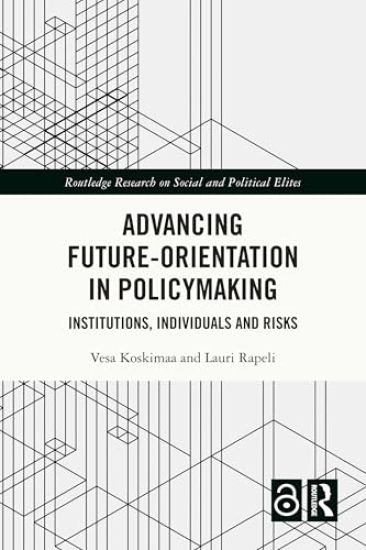
Kirjojen hintavertailu. Mukana 12 312 904 kirjaa ja 12 kauppaa.

Kirjailija

Vesa Koskimaa

Kirjat ja teokset yhdessä paikassa: 3 kirjaa, julkaisuja vuosilta 2016-2026, suosituimpien joukossa Advancing Future-Orientation in Policymaking. Vertaile teosten hintoja ja tarkista saatavuus suomalaisista kirjakaupoista.

3 kirjaa

Kirjojen julkaisuhaarukka 2016-2026.

Advancing Future-Orientation in Policymaking

Advancing Future-Orientation in Policymaking

Vesa Koskimaa; Lauri Rapeli

TAYLOR FRANCIS LTD
2026
nidottu
This book argues that, under certain societal and institutional conditions, party-, interest group- and bureaucracy-based elites can interact positively to extend political timeframes beyond short electoral terms and foster reasoned long-term planning for democratic decision-making. Focusing on Finland within a broader analytic framework and comparative context, it unearths institutions and practices that give the elites capacity to curtail democratic short-sightedness and offer long-term solutions for contemporary threats such as economic globalization, climate change and geopolitical competition. The study also reveals factors that condition the operative capacity of futureregarding institutions. This book will be of key interest to scholars, students and practitioners of political science, public policy and administration, elites and management and futures studies. The Open Access version of this book, available at www.taylorfrancis.com, has been made available under a Creative Commons Attribution-Non- Commercial (CC-BY-NC) 4.0 license.
Advancing Future-Orientation in Policymaking

Advancing Future-Orientation in Policymaking

Vesa Koskimaa; Lauri Rapeli

TAYLOR FRANCIS LTD
2024
sidottu
This book argues that, under certain societal and institutional conditions, party-, interest group- and bureaucracy-based elites can interact positively to extend political timeframes beyond short electoral terms and foster reasoned long-term planning for democratic decision-making.Focusing on Finland within a broader analytic framework and comparative context, it unearths institutions and practices that give the elites capacity to curtail democratic short-sightedness and offer long-term solutions for contemporary threats such as economic globalization, climate change and geopolitical competition. The study also reveals factors that condition the operative capacity of futureregarding institutions.This book will be of key interest to scholars, students and practitioners of political science, public policy and administration, elites and management and futures studies.The Open Access version of this book, available at www.taylorfrancis.com, has been made available under a Creative Commons Attribution-Non- Commercial (CC-BY-NC) 4.0 license.
The Changing Balance of Political Power in Finland

The Changing Balance of Political Power in Finland

Guy-Erik Isaksson; Vesa Koskimaa; Maija Mattila

Santerus Academic Press
2016
pokkari
The political systems of democratic countries are remarkably stable. Even when societies experience significant structural change, the impact of such socio-economic transformation is mainly limited to the party system. Constitutional change regarding political institutions is much less frequent and is often linked to democratization or major domestic crisis as in Central and Eastern Europe. The more affluent Western European countries, on the other hand, display considerable constitutional rigidity. Societies may change, but political systems do not.Finland is a noteworthy exception to this rule. Indeed, Finland is a rare example of a democratic country that has experienced major constitutional reform peacefully without domestic conflict. International literature has traditionally categorized the Finnish political system as semi-presidential, with the executive functions divided between an elected president and a cabinet that is accountable to the parliament. However, recent constitutional reforms have radically transformed Finnish politics. The new constitution, which entered into force in 2000, completed a period of far-reaching constitutional change that curtailed presidential powers and brought the Finnish political system closer to a normal parliamentary democracy. The president is today almost completely excluded from the policy process in domestic matters; leadership by presidents has been replaced with leadership by strong majority governments. In contrast to most democratic countries, the Finnish political system has arguably also become less subject to external constraints. The end of the Cold War removed the shadow of the Soviet Union from Finnish policy-making, but particularly through European Union (EU) membership Finland has become much more involved in global and regional integration.Drawing on unique and comprehensive longitudinal data, this book analyses the distribution of political power in Finland since the 1970s. The objective of the volume is not simply to extrapolate change within and between governing institutions and political parties, but also to understand the causal mechanisms explaining this significant period of constitutional and political reform.