Kirjojen hintavertailu. Mukana 12 595 353 kirjaa ja 12 kauppaa.

Kirjailija

Victor Tadros

Kirjat ja teokset yhdessä paikassa: 8 kirjaa, julkaisuja vuosilta 2005-2020, suosituimpien joukossa Criminal Responsibility. Vertaile teosten hintoja ja tarkista saatavuus suomalaisista kirjakaupoista.

8 kirjaa

Kirjojen julkaisuhaarukka 2005-2020.

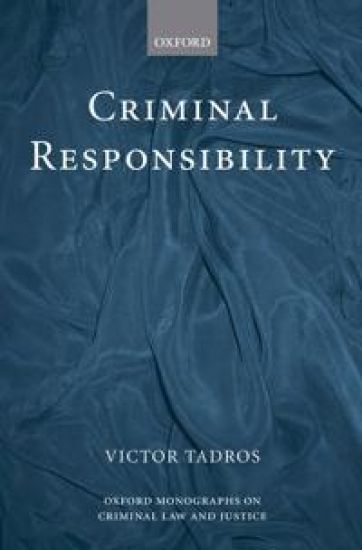
Criminal Responsibility

Criminal Responsibility

Victor Tadros

Oxford University Press
2005
sidottu
This book considers the proper nature and scope of criminal responsibility in the light of its institutional and political role. Tadros begins by providing a general account of criminal responsibility which is based on the relationship between the action that the defendant has performed and his or her character. He then moves on to reconsider some of the central doctrines of criminal responsibility in the light of that account. Part 1 examines the nature of criminal responsibility by exploring what it means for an agent to be responsible for an action and the constraints that there are on holding an agent criminally responsible which arise from the particular social and institutional role that the criminal law has. Tadros develops a character theory of criminal responsibility. Character, he argues, is relevant both in determinig which action an agent is responsible for, as well as the kind of fault that he has in respect of those actions. However, he shows some limitations in the character theory of criminal responsibility as it has been defended to date,developing a version that is not susceptible to the central objections that habe been levelled at character theories. Finally Part 1 investigates the structure of criminal responsibility, considering the distinction between offence and defence, and investigating how best to categorise and structure defences. In Part 2, Tadros moves on to consider some of the central doctrines of criminal responsibility in the light of the general theory developed in Part 1. He examines the proper nature and role of causation and investigates whether there is a general principle o criminal omissions. The book then explores the nature and role that intentions and beliefs ought to nave in a theory of criminal responsibility. Tadros also provides an account of different kinds of defence: exemptions, justifications and excuses. The book includes a thorough account of the different ways in which mental disorders might ground defences, the different kinds of normative standards that the criminal law ought to set in offence and defence contexts, and whether particular deficiencies of the accused ought to be accommondated in setting those standards.

To Do, To Die, To Reason Why

To Do, To Die, To Reason Why

Victor Tadros

Oxford University Press
2020
sidottu
To Do, To Die, To Reason Why offers a new account of the ethics of war and the legal regulation of war. It is especially concerned with the conduct of individuals, including whether they are required to follow orders to go to war, what moral constraints there are on killing in war, what makes people liable to be killed in war, and the extent to which the laws of war ought to reflect the morality of war. Victor Tadros defends a largely anti-authority view about the morality of war, and notable moral constraints on killing in war, such as the Doctrine of Doing and Allowing and a version of the Doctrine of Double Effect. However, he argues that a much wider range of people are liable to be harmed or killed in war than is normally thought to be the case, on grounds of both causal involvement and fairness. And it argues that the laws of war should converge much more closely with the morality of war than is currently the case.
Wrongs and Crimes

Wrongs and Crimes

Victor Tadros

Oxford University Press
2019
nidottu
The Criminalization series arose from an interdisciplinary investigation into criminalization, focussing on the principles that might guide decisions about what kinds of conduct should be criminalized, and the forms that criminalization should take. Developing a normative theory of criminalization, the series tackles the key questions at the heart of the issue: what principles and goals should guide legislators in deciding what to criminalize? How should criminal wrongs be classified and differentiated? How should law enforcement officials apply the law's specifications of offences? The sixth volume in the series offers a philosophical investigation of the relationship between moral wrongdoing and criminalization. Considering they justification of punishment, the nature of harm, the importance of autonomy, inchoate wrongdoing, the role of consent, and the role of the state, the book provides an account of the nature of moral wrong doing, the sources of wrong doing, why wrong doing is the central target of the criminal law, and the ways in which criminalization of non-wrongful conduct might be permissible.
Wrongs and Crimes

Wrongs and Crimes

Victor Tadros

Oxford University Press
2016
sidottu
The Criminalization series arose from an interdisciplinary investigation into criminalization, focussing on the principles that might guide decisions about what kinds of conduct should be criminalized, and the forms that criminalization should take. Developing a normative theory of criminalization, the series tackles the key questions at the heart of the issue: what principles and goals should guide legislators in deciding what to criminalize? How should criminal wrongs be classified and differentiated? How should law enforcement officials apply the law's specifications of offences? The sixth volume in the series offers a philosophical investigation of the relationship between moral wrongdoing and criminalization. Considering they justification of punishment, the nature of harm, the importance of autonomy, inchoate wrongdoing, the role of consent, and the role of the state, the book provides an account of the nature of moral wrong doing, the sources of wrong doing, why wrong doing is the central target of the criminal law, and the ways in which criminalization of non-wrongful conduct might be permissible.
The Ends of Harm

The Ends of Harm

Victor Tadros

Oxford University Press
2013
nidottu
Every modern democratic state imprisons thousands of offenders every year, depriving them of their liberty, causing them a great deal of psychological and sometimes physical harm. Relationships are destroyed, jobs are lost, the risk of the offender being harmed by other offenders is increased and all at great expense to the state. How can this brutal and costly enterprise be justified? Traditionally, philosophers answering this question have argued either that the punishment of wrongdoers is a good in itself (retributivism), or that it is a regrettable means to a valuable end, such as the deterrence of future wrongdoing, and thus justifiable on consequentialist grounds. This book offers a critical examination of those theories and advances a new argument for punishment's justification, calling it the 'duty view'. On this view, the permission to punish offenders is grounded in the duties that they incur in virtue of their wrongdoing. The most important duties that ground the justification of punishment are the duty to recognize that the offender has done wrong and the duty to protect others against wrongdoing. In the light of these duties the state has a permission to punish offenders to ensure that they recognize that what they have done is wrong, but also to protect others from crime. In contrast to other justifications of punishment grounded in deterrence, the duty view is developed in the light of a non-consequentialist moral theory: a theory which endorses constraints on the pursuit of the good. It is shown that it is normally wrong to harm a person as a means to pursue a greater good. However, there are exceptions to this principle in cases where the person harmed has an enforceable duty to pursue the good. The implications of this idea are explored both in the context of self-defence, and then in the context of punishment. Through the systematic exploration of the relationship between self-defence and punishment, the book makes significant progress in defending a plausible set of non-consequentialist moral principles that justify the punishment of wrongdoers, and marks a significant contribution to the philosophical literature on punishment.
The Ends of Harm

The Ends of Harm

Victor Tadros

Oxford University Press
2011
sidottu
Every modern democratic state imprisons thousands of offenders every year, depriving them of their liberty, causing them a great deal of psychological and sometimes physical harm. Relationships are destroyed, jobs are lost, the risk of the offender being harmed by other offenders is increased and all at great expense to the state. How can this brutal and costly enterprise be justified? Traditionally, philosophers answering this question have argued either that the punishment of wrongdoers is a good in itself (retributivism), or that it is a regrettable means to a valuable end, such as the deterrence of future wrongdoing, and thus justifiable on consequentialist grounds. This book offers a critical examination of those theories and advances a new argument for punishment's justification, calling it the 'duty view'. On this view, the permission to punish offenders is grounded in the duties that they incur in virtue of their wrongdoing. The most important duties that ground the justification of punishment are the duty to recognize that the offender has done wrong and the duty to protect others against wrongdoing. In the light of these duties the state has a permission to punish offenders to ensure that they recognize that what they have done is wrong, but also to protect others from crime. In contrast to other justifications of punishment grounded in deterrence, the duty view is developed in the light of a non-consequentialist moral theory: a theory which endorses constraints on the pursuit of the good. It is shown that it is normally wrong to harm a person as a means to pursue a greater good. However, there are exceptions to this principle in cases where the person harmed has an enforceable duty to pursue the good. The implications of this idea are explored both in the context of self-defence, and then in the context of punishment. Through the systematic exploration of the relationship between self-defence and punishment, the book makes significant progress in defending a plausible set of non-consequentialist moral principles that justify the punishment of wrongdoers, and marks a significant contribution to the philosophical literature on punishment.
The Trial on Trial: Volume 3

The Trial on Trial: Volume 3

Lindsay Farmer; R A Duff; Sandra Marshall; Victor Tadros

Hart Publishing
2007
sidottu
The criminal trial is under attack. Traditional principles have been challenged or eroded; in England and Wales the right to trial by jury has been restricted and rules concerning bad character evidence, double jeopardy and the right to silence have been substantially altered to "rebalance" the system in favour of victims. In the pursuit of security, particularly from terrorism, the right to a fair trial has been denied to some altogether. In fact trials have for a long time been an infrequent occurrence, most criminal convictions being the consequence of a guilty plea. Moreover, while this very public struggle over the future of the criminal trial is conducted, there is also a less publicly observed controversy about the significance of trials in modern society. Trials are under normative attack, their value being doubted by those who seek different kinds of process - conciliatory or restorative - to address the needs of victims and move away from the imposition of state power through trials and punishments. This book seeks to develop a normative theory of the criminal trial as a way of defending the importance of trials in our criminal justice system. The trial, it is suggested, calls defendants to answer a charge and, if they are criminally responsible, to account for their conduct. The trial is seen as a communicative process through which the defendant can challenge claims of wrongdoing made against him, including the norms in the light of which those claims are made. The book develops this communicative theory by first making a careful study of the history of trials, before moving on to outline the theory, which is then developed through chapters looking at the practices and principles of trials, alternative regulatory models, the roles of participants, the relationship between investigation and trial and trials as public fora.
Criminal Responsibility

Criminal Responsibility

Victor Tadros

Oxford University Press
2007
nidottu
This book considers the proper nature and scope of criminal responsibility in the light of its institutional and political role. Tadros begins by providing an account of the foundations, both ethical and political, of criminal responsibility, and moves on to reconsider some of the central doctrines of criminal responsibility. Part 1 examines the nature of criminal responsibility by employing a distinctive new conception of autonomy. Tadros explores the nature of autonomy, and asks what it means to respect autonomy. Building upon this consideration of autonomy, Tadros then explores the central conditions of responsibility. He provides the first systematic consideration of the relationship between criminal responsibility and liberal political theory, showing how the conditions of responsibility are articulated in, and restrained by, the institutional setting of the criminal law. In Part 2, Tadros moves on to consider some of the central doctrines of criminal responsibility. He examines the proper nature and role of causation, intentions, and beliefs; asking whether these concepts should be understood as descriptive or normative. The book moves on to provide a systematic normative investigation of the nature and role of criminal omissions and criminal defences. Included are: a thorough account of the different ways in which mental disorders might ground defences, the nature of justification defences, the different kinds of excuse claim and the role that particular characteristics of the accused might have on the standards which the defendant must have met to escape criminal responsibility.