

Kirjailija
Vijay Madisetti
Kirjat ja teokset yhdessä paikassa: 11 kirjaa, julkaisuja vuosilta 1996-2024, suosituimpien joukossa A First Course on Cloud-Based Microservices. Vertaile teosten hintoja ja tarkista saatavuus suomalaisista kirjakaupoista.
11 kirjaa
Kirjojen julkaisuhaarukka 1996-2024.

A recent industry report from Gartner points out that choices related to cloud computing at enterprises have changed from "if" to "how" to build, deploy, consume, manage, secure and integrate cloud services into their operations. The cloud solutions architect is the person who defines the enterprise cloud strategy from a technical point of view and must take responsibility for rolling out these cloud services.Cloud computing is a transformative paradigm that enables scalable, convenient, on-demand access to a shared pool of configurable computing and networking resources, for efficiently delivering applications and services over the Internet. Amazon Web Services (AWS), a leading provider of cloud platforms and services, defines a cloud solutions architect as one who can provide solution plans for the best architectural practices for cloud applications, can design and deploy highly scalable and fault-tolerant services, can assist in lifting legacy applications and shifting them to the cloud, and can identify and plan for data entry and exit from the cloud platform, choose suitable cloud services based on data, compute, and security requirements. Further, the cloud solutions architect also ensures that enterprise offerings conform to sound principles, such as AWS Well-Architected Framework (WAF) for cloud applications and services. We have written this textbook, as part of our expanding "A Hands-On Approach"(TM) series, to meet this need at colleges and universities. This book is written as a textbook for training the next generation of cloud solutions architects for educational programs at colleges and universities, and also accompanying cloud certification programs where students would be interested in obtaining valuable hands-on skills on actual cloud platforms to further develop their knowledge and competency base. The typical reader is expected to have completed a couple of courses in programming using traditional high-level languages at the college level, and is either a senior or a beginning graduate student in one of the science, technology, engineering or mathematics (STEM) fields. The reader is provided the necessary guidance and knowledge to develop working code for real-world cloud computing applications. Concurrent development of practical applications that accompanies traditional instructional material within the book further enhances the learning process, in our opinion. Furthermore, an accompanying website for this book (http: //hands-on-books-series.com) contains additional support for instruction and learning.




Quick-Turnaround ASIC Design in VHDL
N. Bouden-Romdhane; Vijay Madisetti; J.W. Hines
Springer-Verlag New York Inc.
2011
nidottu
From the Foreword..... Modern digital signal processing applications provide a large challenge to the system designer. Algorithms are becoming increasingly complex, and yet they must be realized with tight performance constraints. Nevertheless, these DSP algorithms are often built from many constituent canonical subtasks (e.g., IIR and FIR filters, FFTs) that can be reused in other subtasks. Design is then a problem of composing these core entities into a cohesive whole to provide both the intended functionality and the required performance. In order to organize the design process, there have been two major approaches. The top-down approach starts with an abstract, concise, functional description which can be quickly generated. On the other hand, the bottom-up approach starts from a detailed low-level design where performance can be directly assessed, but where the requisite design and interface detail take a long time to generate. In this book, the authors show a way to effectively resolve this tension by retaining the high-level conciseness of VHDL while parameterizing it to get good fit to specific applications through reuse of core library components. Since they build on a pre-designed set of core elements, accurate area, speed and power estimates can be percolated to high- level design routines which explore the design space. Results are impressive, and the cost model provided will prove to be very useful. Overall, the authors have provided an up-to-date approach, doing a good job at getting performance out of high-level design. The methodology provided makes good use of extant design tools, and is realistic in terms of the industrial design process. The approach is interesting in its own right, but is also of direct utility, and it will give the existing DSP CAD tools a highly competitive alternative. The techniques described have been developed within ARPAs RASSP (Rapid Prototyping of Application Specific SignalProcessors) project, and should be of great interest there, as well as to many industrial designers. Professor Jonathan Allen, Massachusetts Institute of Technology

A Platform-Centric Approach to System-on-Chip (SOC) Design
Vijay Madisetti; Chonlameth Arpnikanondt
Springer-Verlag New York Inc.
2010
nidottu
Increasing system complexity has created a pressing need for better design tools and associated methodologies and languages for meeting the stringent time to market and cost constraints. Platform-centric and platfo- based system-on-chip (SoC) design methodologies, based on reuse of software and hardware functionality, has also gained increasing exposure and usage within the Electronic System-Level (ESL) design communities. The book proposes a new methodology for realizing platform-centric design of complex systems, and presents a detailed plan for its implementation. The proposed plan allows component vendors, system integrators and product developers to collaborate effectively and efficiently to create complex products within budget and schedule constraints. This book focuses more on the use of platforms in the design of products, and not on the design of platforms themselves. Platform-centric design is not for everyone, as some may feel that it does not allow them to differentiate their offering from competitors to a significant degree. However, its proponents may claim that the time-- market and cost advantages of platform-centric design more than compensate for any drawbacks.
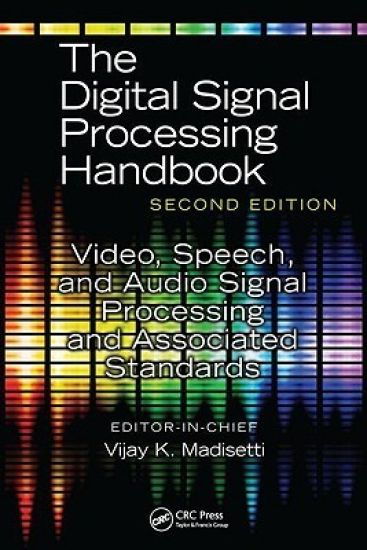
Video, Speech, and Audio Signal Processing and Associated Standards
Vijay Madisetti
CRC Press Inc
2009
sidottu
Now available in a three-volume set, this updated and expanded edition of the bestselling The Digital Signal Processing Handbook continues to provide the engineering community with authoritative coverage of the fundamental and specialized aspects of information-bearing signals in digital form. Encompassing essential background material, technical details, standards, and software, the second edition reflects cutting-edge information on signal processing algorithms and protocols related to speech, audio, multimedia, and video processing technology associated with standards ranging from WiMax to MP3 audio, low-power/high-performance DSPs, color image processing, and chips on video. Drawing on the experience of leading engineers, researchers, and scholars, the three-volume set contains 29 new chapters that address multimedia and Internet technologies, tomography, radar systems, architecture, standards, and future applications in speech, acoustics, video, radar, and telecommunications.This volume, Video, Speech, and Audio Signal Processing and Associated Standards, provides thorough coverage of the basic foundations of speech, audio, image, and video processing and associated applications to broadcast, storage, search and retrieval, and communications.
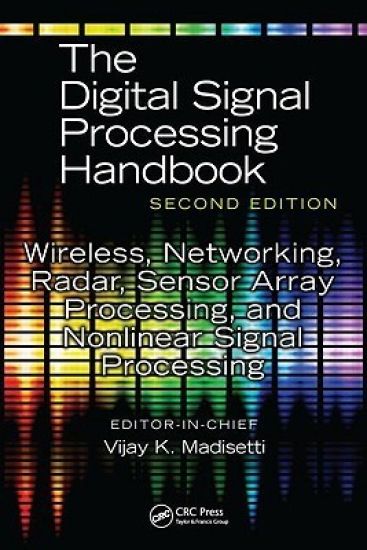
Wireless, Networking, Radar, Sensor Array Processing, and Nonlinear Signal Processing
Vijay Madisetti
CRC Press Inc
2009
sidottu
Now available in a three-volume set, this updated and expanded edition of the bestselling The Digital Signal Processing Handbook continues to provide the engineering community with authoritative coverage of the fundamental and specialized aspects of information-bearing signals in digital form. Encompassing essential background material, technical details, standards, and software, the second edition reflects cutting-edge information on signal processing algorithms and protocols related to speech, audio, multimedia, and video processing technology associated with standards ranging from WiMax to MP3 audio, low-power/high-performance DSPs, color image processing, and chips on video. Drawing on the experience of leading engineers, researchers, and scholars, the three-volume set contains 29 new chapters that address multimedia and Internet technologies, tomography, radar systems, architecture, standards, and future applications in speech, acoustics, video, radar, and telecommunications.This volume, Wireless, Networking, Radar, Sensor Array Processing, and Nonlinear Signal Processing, provides complete coverage of the foundations of signal processing related to wireless, radar, space–time coding, and mobile communications, together with associated applications to networking, storage, and communications.
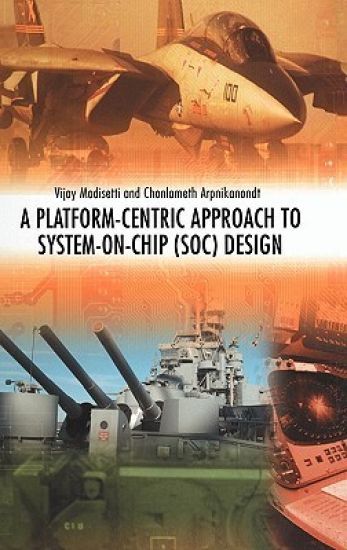
A Platform-Centric Approach to System-on-Chip (SOC) Design
Vijay Madisetti; Chonlameth Arpnikanondt
Springer-Verlag New York Inc.
2004
sidottu
Increasing system complexity has created a pressing need for better design tools and associated methodologies and languages for meeting the stringent time to market and cost constraints. Platform-centric and platfo- based system-on-chip (SoC) design methodologies, based on reuse of software and hardware functionality, has also gained increasing exposure and usage within the Electronic System-Level (ESL) design communities. The book proposes a new methodology for realizing platform-centric design of complex systems, and presents a detailed plan for its implementation. The proposed plan allows component vendors, system integrators and product developers to collaborate effectively and efficiently to create complex products within budget and schedule constraints. This book focuses more on the use of platforms in the design of products, and not on the design of platforms themselves. Platform-centric design is not for everyone, as some may feel that it does not allow them to differentiate their offering from competitors to a significant degree. However, its proponents may claim that the time-- market and cost advantages of platform-centric design more than compensate for any drawbacks.
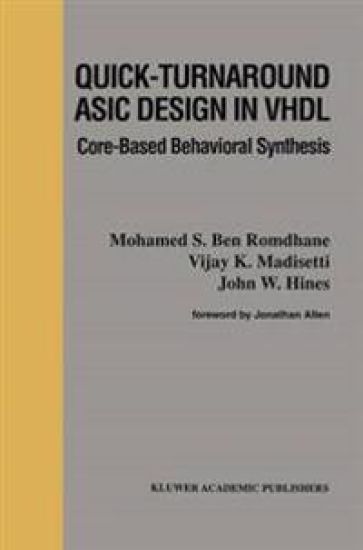
Quick-Turnaround ASIC Design in VHDL
N. Bouden-Romdhane; Vijay Madisetti; J.W. Hines
Springer
1996
sidottu
From the Foreword..... Modern digital signal processing applications provide a large challenge to the system designer. Algorithms are becoming increasingly complex, and yet they must be realized with tight performance constraints. Nevertheless, these DSP algorithms are often built from many constituent canonical subtasks (e.g., IIR and FIR filters, FFTs) that can be reused in other subtasks. Design is then a problem of composing these core entities into a cohesive whole to provide both the intended functionality and the required performance. In order to organize the design process, there have been two major approaches. The top-down approach starts with an abstract, concise, functional description which can be quickly generated. On the other hand, the bottom-up approach starts from a detailed low-level design where performance can be directly assessed, but where the requisite design and interface detail take a long time to generate. In this book, the authors show a way to effectively resolve this tension by retaining the high-level conciseness of VHDL while parameterizing it to get good fit to specific applications through reuse of core library components. Since they build on a pre-designed set of core elements, accurate area, speed and power estimates can be percolated to high- level design routines which explore the design space. Results are impressive, and the cost model provided will prove to be very useful. Overall, the authors have provided an up-to-date approach, doing a good job at getting performance out of high-level design. The methodology provided makes good use of extant design tools, and is realistic in terms of the industrial design process. The approach is interesting in its own right, but is also of direct utility, and it will give the existing DSP CAD tools a highly competitive alternative. The techniques described have been developed within ARPAs RASSP (Rapid Prototyping of Application Specific SignalProcessors) project, and should be of great interest there, as well as to many industrial designers. Professor Jonathan Allen, Massachusetts Institute of Technology