Kirjailija
Vikram Sampath
Kirjat ja teokset yhdessä paikassa: 11 kirjaa, julkaisuja vuosilta 2012-2024, suosituimpien joukossa Savarkar: A Contested Legacy from A Forgotten Past. Vertaile teosten hintoja ja tarkista saatavuus suomalaisista kirjakaupoista.
11 kirjaa
Kirjojen julkaisuhaarukka 2012-2024.


In 1902 The Gramophone Company in London sent out recording experts on "expeditions" across the world to record voices from different cultures and backgrounds. All over India, it was women who embraced the challenge of overcoming numerous social taboos and aesthetic handicaps that came along with this nascent technology. Women who took the plunge and recorded largely belonged to the courtesan community, called tawaifs and devadasis, in North and South India, respectively. Recording brought with it great fame, brand recognition, freedom from exploitative patrons, and monetary benefits to the women singers. They were to become pioneers of the music industry in the Indian sub-continent. However, despite the pioneering role played by these women, their stories have largely been forgotten. Contemporaneous with the courtesan women adapting to recording technology was the anti-nautch campaign that sought to abolish these women from the performing space and brand them as common prostitutes. A vigorous renaissance and arts revival movement followed, leading to the creation of a new classical paradigm in both North Indian (Hindustani) and South Indian (Carnatic) classical music. This resulted in the standardization, universalization, and institutionalization of Indian classical music. This newly created classical paradigm impacted future recordings of The Gramophone Company in terms of a shift in genres and styles. Vikram Sampath sheds light on the role and impact of The Gramophone Company’s early recording expeditions on Indian classical music by examining the phenomenon through a sociocultural, historical and musical lens. The book features the indefatigable stories of the women and their experiences in adapting to recording technology. The artists from across India featured are: Gauhar Jaan of Calcutta, Janki Bai of Allahabad, Zohra Bai of Agra, Malka Jaan of Agra, Salem Godavari, Bangalore Nagarathnamma, Coimbatore Thayi, Dhanakoti of Kanchipuram, Bai Sundarabai of Pune, and Husna Jaan of Banaras.

In 1902 The Gramophone Company in London sent out recording experts on "expeditions" across the world to record voices from different cultures and backgrounds. All over India, it was women who embraced the challenge of overcoming numerous social taboos and aesthetic handicaps that came along with this nascent technology. Women who took the plunge and recorded largely belonged to the courtesan community, called tawaifs and devadasis, in North and South India, respectively. Recording brought with it great fame, brand recognition, freedom from exploitative patrons, and monetary benefits to the women singers. They were to become pioneers of the music industry in the Indian sub-continent. However, despite the pioneering role played by these women, their stories have largely been forgotten. Contemporaneous with the courtesan women adapting to recording technology was the anti-nautch campaign that sought to abolish these women from the performing space and brand them as common prostitutes. A vigorous renaissance and arts revival movement followed, leading to the creation of a new classical paradigm in both North Indian (Hindustani) and South Indian (Carnatic) classical music. This resulted in the standardization, universalization, and institutionalization of Indian classical music. This newly created classical paradigm impacted future recordings of The Gramophone Company in terms of a shift in genres and styles. Vikram Sampath sheds light on the role and impact of The Gramophone Company’s early recording expeditions on Indian classical music by examining the phenomenon through a sociocultural, historical and musical lens. The book features the indefatigable stories of the women and their experiences in adapting to recording technology. The artists from across India featured are: Gauhar Jaan of Calcutta, Janki Bai of Allahabad, Zohra Bai of Agra, Malka Jaan of Agra, Salem Godavari, Bangalore Nagarathnamma, Coimbatore Thayi, Dhanakoti of Kanchipuram, Bai Sundarabai of Pune, and Husna Jaan of Banaras.

Savarkar: A Contested Legacy from A Forgotten Past
Vikram Sampath
Penguin Random House India
2022
tuotepaketti
As the intellectual fountainhead of the ideology of Hindutva, which is in political ascendancy in India today, Vinayak Damodar Savarkar is undoubtedly one of the most contentious political thinkers and leaders of the twentieth century. From the heady days of revolution and generating international support for the cause of India's freedom as a law student in London, Savarkar found himself arrested, unfairly tried for sedition, transported and incarcerated at the Cellular Jail, in the Andamans, for over a decade, where he underwent unimaginable torture. Decades after his death, Savarkar continues to uniquely influence India's political scenario. An optimistic advocate of Hindu-Muslim unity in his treatise on the 1857 War of Independence, what was it that transformed him into a proponent of 'Hindutva'? What was it that transformed him in the Cellular Jail to a proponent of 'Hindutva', which viewed Muslims with suspicion? This two-volume biography series, exploring a vast range of original archival documents from across India and outside it, in English and several Indian languages, historian Vikram Sampath brings to light the life and works of Vinayak Damodar Savarkar, one of the most contentious political thinkers and leaders of the twentieth century. Comprehensive, definitive and absolutely unputdownable, this two-volume biography opens a window to previously unknown untold life of Vinayak Damodar Savarkar.
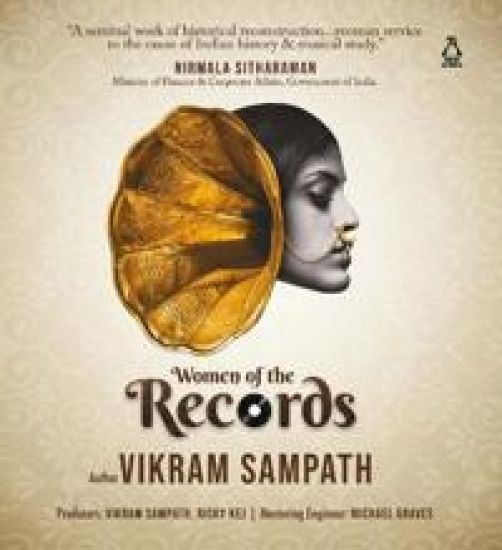
Across India women, mostly from the courtesan community, were the stellar pioneers of recording technology in the early twentieth-century. Yet, their stories have been completely lost in the sands of time. This book revisits their lives & features the indefatigable saga of 25 inspiring Indian women musicians from across the country, from 1902 to 1947. Also, hear their original voices that have been restored & reconstructed in the accompanying CD.