Kirjojen hintavertailu. Mukana 12 281 450 kirjaa ja 12 kauppaa.

Kirjailija

Viktor Freiman

Kirjat ja teokset yhdessä paikassa: 11 kirjaa, julkaisuja vuosilta 2010-2024, suosituimpien joukossa Fostering Collateral Creativity in School Mathematics. Vertaile teosten hintoja ja tarkista saatavuus suomalaisista kirjakaupoista.

11 kirjaa

Kirjojen julkaisuhaarukka 2010-2024.

Fostering Collateral Creativity in School Mathematics

Fostering Collateral Creativity in School Mathematics

Sergei Abramovich; Viktor Freiman

Springer International Publishing AG
2024
nidottu
This book explores the topic of using technology, both physical and digital, to motivate creative mathematical thinking among students who are not considered ‘mathematically advanced.’ The book reflects the authors’ experience of teaching mathematics to Canadian and American teacher candidates and supervising several field-based activities by the candidates. It consists of eight chapters and an Appendix which includes details of constructing computational learning environments.Specifically, the book demonstrates how the appropriate use of technology in the teaching of mathematics can create conditions for the emergence of what may be called ‘collateral creativity,’ a notion similar to Dewey’s notion of collateral learning. Just as collateral learning does not result from the immediate goal of the traditional curriculum, collateral creativity does not result from the immediate goal of traditional problem solving. Rather, mathematical creativity emerges as a collateral outcomeof thinking afforded by the use of technology. Furthermore, collateral creativity is an educative outcome of one’s learning experience with pedagogy that motivates students to ask questions about computer-generated or tactile-derived information and assists them in finding answers to their own or the teacher’s questions. This book intends to provide guidance to teachers for fostering collateral creativity in their classrooms.
Fostering Collateral Creativity in School Mathematics

Fostering Collateral Creativity in School Mathematics

Sergei Abramovich; Viktor Freiman

Springer International Publishing AG
2023
sidottu
This book explores the topic of using technology, both physical and digital, to motivate creative mathematical thinking among students who are not considered ‘mathematically advanced.’ The book reflects the authors’ experience of teaching mathematics to Canadian and American teacher candidates and supervising several field-based activities by the candidates. It consists of eight chapters and an Appendix which includes details of constructing computational learning environments.Specifically, the book demonstrates how the appropriate use of technology in the teaching of mathematics can create conditions for the emergence of what may be called ‘collateral creativity,’ a notion similar to Dewey’s notion of collateral learning. Just as collateral learning does not result from the immediate goal of the traditional curriculum, collateral creativity does not result from the immediate goal of traditional problem solving. Rather, mathematical creativity emerges as a collateral outcomeof thinking afforded by the use of technology. Furthermore, collateral creativity is an educative outcome of one’s learning experience with pedagogy that motivates students to ask questions about computer-generated or tactile-derived information and assists them in finding answers to their own or the teacher’s questions. This book intends to provide guidance to teachers for fostering collateral creativity in their classrooms.

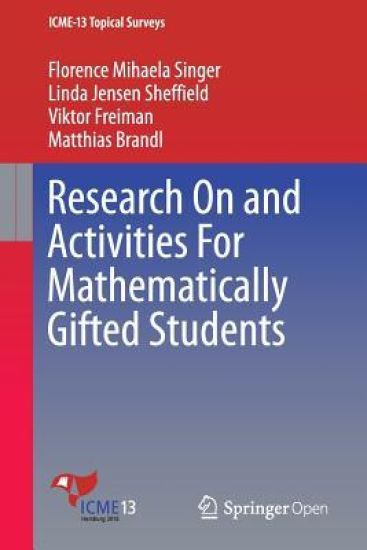
Research On and Activities For Mathematically Gifted Students

Research On and Activities For Mathematically Gifted Students

Florence Mihaela Singer; Linda Jensen Sheffield; Viktor Freiman; Matthias Brandl

Springer International Publishing AG
2016
nidottu
This open access Topical Survey offers a brief overview of the current state of research on and activities for mathematically gifted students around the world. This is of interest to a broad readership, including educational researchers, research mathematicians, mathematics teachers, teacher educators, curriculum designers, doctoral students, and other stakeholders. It first discusses research concerning the nature of mathematical giftedness, including theoretical frameworks and methodologies that are helpful in identifying and/or creating mathematically gifted students, which is described in this section. It also focuses on research on and the development of mathematical talent and innovation in students, including connections between cognitive, social and affective aspects of mathematically gifted students. Exemplary teaching and learning practices, curricula and a variety of programs that contribute to the development of mathematical talent, gifts, and passion are described as well as the pedagogy and mathematics content suitable for educating pre-service and in-service teachers of mathematically gifted students. The final section provides a brief summary of the paper along with suggestions for the research, activities, and resources that should be available to support mathematically gifted students and their teachers, parents, and other stakeholders.