Kirjojen hintavertailu. Mukana 12 595 353 kirjaa ja 12 kauppaa.

Kirjailija

Vilmos Totik

Kirjat ja teokset yhdessä paikassa: 8 kirjaa, julkaisuja vuosilta 1992-2024, suosituimpien joukossa Weighted Approximation with Varying Weight. Vertaile teosten hintoja ja tarkista saatavuus suomalaisista kirjakaupoista.

8 kirjaa

Kirjojen julkaisuhaarukka 1992-2024.

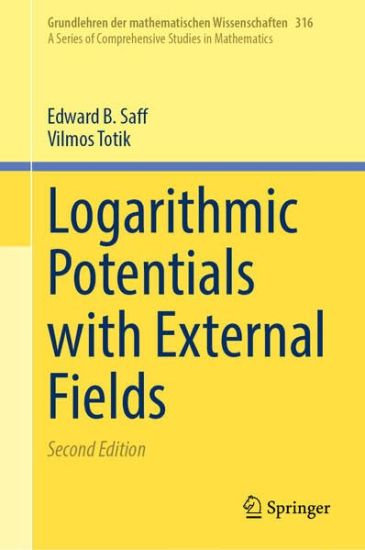
Logarithmic Potentials with External Fields

Logarithmic Potentials with External Fields

Edward B. Saff; Vilmos Totik

Springer International Publishing AG
2024
sidottu
This is the second edition of an influential monograph on logarithmic potentials with external fields, incorporating some of the numerous advancements made since the initial publication. As the title implies, the book expands the classical theory of logarithmic potentials to encompass scenarios involving an external field. This external field manifests as a weight function in problems dealing with energy minimization and its associated equilibria. These weighted energies arise in diverse applications such as the study of electrostatics problems, orthogonal polynomials, approximation by polynomials and rational functions, as well as tools for analyzing the asymptotic behavior of eigenvalues for random matrices, all of which are explored in the book. The theory delves into diverse properties of the extremal measure and its logarithmic potentials, paving the way for various numerical methods. This new, updated edition has been thoroughly revised and is reorganized into three parts, Fundamentals, Applications and Generalizations, followed by the Appendices. Additions to the new edition include: new material on the following topics: analytic and C² weights, differential and integral formulae for equilibrium measures, constrained energy problems, vector equilibrium problems, and a probabilistic approach to balayage and harmonic measures;a new chapter entitled Classical Logarithmic Potential Theory, which conveniently summarizes the main results for logarithmic potentials without external fields;several new proofs and sharpened forms of some main theorems;expanded bibliographic and historical notes with dozens of additional references. Aimed at researchers and students studying extremal problems and their applications, particularly those arising from minimizing specific integrals in the presence of an external field, this book assumes a firm grasp of fundamental real and complex analysis. It meticulously develops classical logarithmic potential theory alongside the more comprehensive weighted theory.
Logarithmic Potentials with External Fields

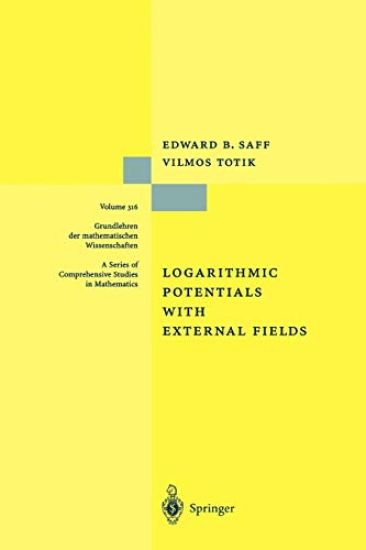
Logarithmic Potentials with External Fields

Edward B. Saff; Vilmos Totik

Springer-Verlag Berlin and Heidelberg GmbH Co. K
2010
nidottu
In recent years approximation theory and the theory of orthogonal polynomials have witnessed a dramatic increase in the number of solutions of difficult and previously untouchable problems. This is due to the interaction of approximation theoretical techniques with classical potential theory (more precisely, the theory of logarithmic potentials, which is directly related to polynomials and to problems in the plane or on the real line). Most of the applications are based on an exten­ sion of classical logarithmic potential theory to the case when there is a weight (external field) present. The list of recent developments is quite impressive and includes: creation of the theory of non-classical orthogonal polynomials with re­ spect to exponential weights; the theory of orthogonal polynomials with respect to general measures with compact support; the theory of incomplete polynomials and their widespread generalizations, and the theory of multipoint Pade approximation. The new approach has produced long sought solutions for many problems; most notably, the Freud problems on the asymptotics of orthogonal polynomials with a respect to weights of the form exp(-Ixl ); the "l/9-th" conjecture on rational approximation of exp(x); and the problem of the exact asymptotic constant in the rational approximation of Ixl. One aim of the present book is to provide a self-contained introduction to the aforementioned "weighted" potential theory as well as to its numerous applications. As a side-product we shall also fully develop the classical theory of logarithmic potentials.
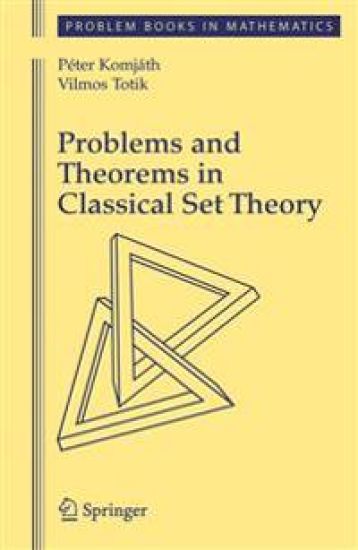
Problems and Theorems in Classical Set Theory

Problems and Theorems in Classical Set Theory

Peter Komjath; Vilmos Totik

Springer-Verlag New York Inc.
2010
nidottu
Although the ?rst decades of the 20th century saw some strong debates on set theory and the foundation of mathematics, afterwards set theory has turned into a solid branch of mathematics, indeed, so solid, that it serves as the foundation of the whole building of mathematics. Later generations, honest to Hilbert’s dictum, “No one can chase us out of the paradise that Cantor has created for us” proved countless deep and interesting theorems and also applied the methods of set theory to various problems in algebra, topology, in?nitary combinatorics, and real analysis. The invention of forcing produced a powerful, technically sophisticated tool for solving unsolvable problems. Still, most results of the pre-Cohen era can be digested with just the knowledge of a commonsense introduction to the topic. And it is a worthy e?ort, here we refer not just to usefulness, but, ?rst and foremost, to mathematical beauty. In this volume we o?er a collection of various problems in set theory. Most of classical set theory is covered, classical in the sense that independence methods are not used, but classical also in the sense that most results come fromtheperiod,say,1920–1970.Manyproblemsarealsorelatedtoother?elds of mathematics such as algebra, combinatorics, topology, and real analysis. We do not concentrate on the axiomatic framework, although some - pects, such as the axiom of foundation or the role ˆ of the axiom of choice, are elaborated.
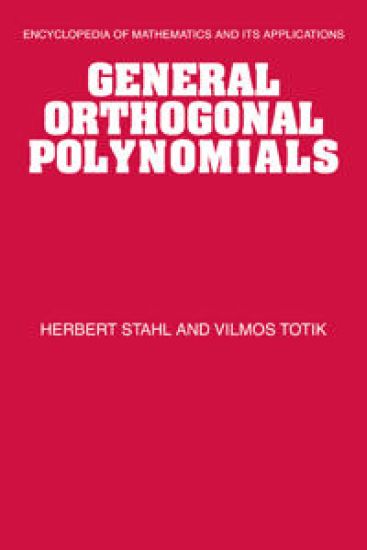
General Orthogonal Polynomials

General Orthogonal Polynomials

Herbert Stahl; Vilmos Totik

Cambridge University Press
2010
pokkari
In this treatise, the authors present the general theory of orthogonal polynomials on the complex plane and several of its applications. The assumptions on the measure of orthogonality are general, the only restriction is that it has compact support on the complex plane. In the development of the theory the main emphasis is on asymptotic behaviour and the distribution of zeros. In the following chapters, the author explores the exact upper and lower bounds are given for the orthonormal polynomials and for the location of their zeros; regular n-th root asymptotic behaviour; and applications of the theory, including exact rates for convergence of rational interpolants, best rational approximants and non-diagonal Pade approximants to Markov functions (Cauchy transforms of measures). The results are based on potential theoretic methods, so both the methods and the results can be extended to extremal polynomials in norms other than L2 norms. A sketch of the theory of logarithmic potentials is given in an appendix.
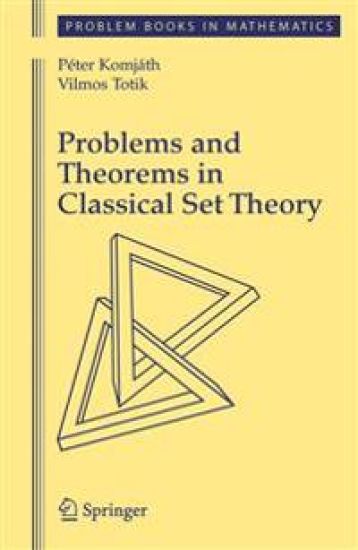
Problems and Theorems in Classical Set Theory

Problems and Theorems in Classical Set Theory

Peter Komjath; Vilmos Totik

Springer-Verlag New York Inc.
2006
sidottu
Although the ?rst decades of the 20th century saw some strong debates on set theory and the foundation of mathematics, afterwards set theory has turned into a solid branch of mathematics, indeed, so solid, that it serves as the foundation of the whole building of mathematics. Later generations, honest to Hilbert’s dictum, “No one can chase us out of the paradise that Cantor has created for us” proved countless deep and interesting theorems and also applied the methods of set theory to various problems in algebra, topology, in?nitary combinatorics, and real analysis. The invention of forcing produced a powerful, technically sophisticated tool for solving unsolvable problems. Still, most results of the pre-Cohen era can be digested with just the knowledge of a commonsense introduction to the topic. And it is a worthy e?ort, here we refer not just to usefulness, but, ?rst and foremost, to mathematical beauty. In this volume we o?er a collection of various problems in set theory. Most of classical set theory is covered, classical in the sense that independence methods are not used, but classical also in the sense that most results come fromtheperiod,say,1920–1970.Manyproblemsarealsorelatedtoother?elds of mathematics such as algebra, combinatorics, topology, and real analysis. We do not concentrate on the axiomatic framework, although some - pects, such as the axiom of foundation or the role ˆ of the axiom of choice, are elaborated.
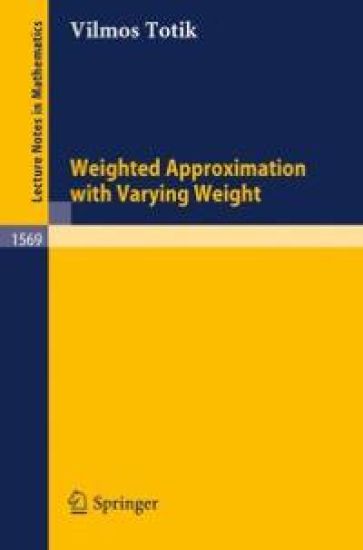
Weighted Approximation with Varying Weight

Weighted Approximation with Varying Weight

Vilmos Totik

Springer-Verlag Berlin and Heidelberg GmbH Co. K
1994
nidottu
A new construction is given for approximating a logarithmic potential by a discrete one. This yields a new approach to approximation with weighted polynomials of the form w"n"(" "= uppercase)P"n"(" "= uppercase). The new technique settles several open problems, and it leads to a simple proof for the strong asymptotics on some L p(uppercase) extremal problems on the real line with exponential weights, which, for the case p=2, are equivalent to power- type asymptotics for the leading coefficients of the corresponding orthogonal polynomials. The method is also modified toyield (in a sense) uniformly good approximation on the whole support. This allows one to deduce strong asymptotics in some L p(uppercase) extremal problems with varying weights. Applications are given, relating to fast decreasing polynomials, asymptotic behavior of orthogonal polynomials and multipoint Pade approximation. The approach is potential-theoretic, but the text is self-contained.
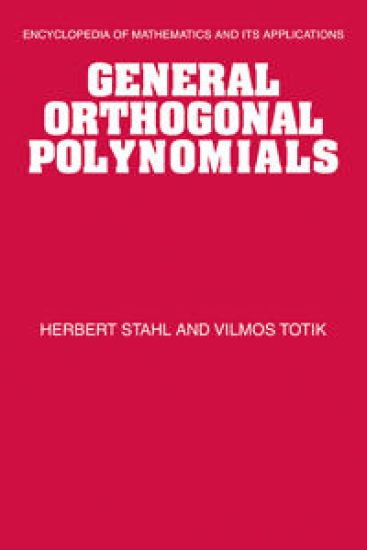
General Orthogonal Polynomials

General Orthogonal Polynomials

Herbert Stahl; Vilmos Totik

Cambridge University Press
1992
sidottu
In this treatise, the authors present the general theory of orthogonal polynomials on the complex plane and several of its applications. The assumptions on the measure of orthogonality are general, the only restriction is that it has compact support on the complex plane. In the development of the theory the main emphasis is on asymptotic behaviour and the distribution of zeros. In the following chapters, the author explores the exact upper and lower bounds are given for the orthonormal polynomials and for the location of their zeros; regular n-th root asymptotic behaviour; and applications of the theory, including exact rates for convergence of rational interpolants, best rational approximants and non-diagonal Pade approximants to Markov functions (Cauchy transforms of measures). The results are based on potential theoretic methods, so both the methods and the results can be extended to extremal polynomials in norms other than L2 norms. A sketch of the theory of logarithmic potentials is given in an appendix.