Kirjojen hintavertailu. Mukana 12 390 323 kirjaa ja 12 kauppaa.
Kirjailija
Vincent P. O'Hara
Kirjat ja teokset yhdessä paikassa: 8 kirjaa, julkaisuja vuosilta 2013-2023, suosituimpien joukossa The Royal Navy's Revenge and Other Little-Known Encounters of the War at Sea. Vertaile teosten hintoja ja tarkista saatavuus suomalaisista kirjakaupoista.
The first book to describe the infamously difficult task of fighting in the dark at sea. Written by a team of internationally renowned naval historians. A fine blend of technical developments and battle histories.
Clash of Fleets is an operational history that records every naval engagement fought between major surface warships during World War I. Much more than a catalog of combat facts, Clash of Fleets explores why battles occurred; how the different navies fought; and how combat advanced doctrine and affected the development and application of technology. The result is a holistic overview of the war at sea as it affected all nations and all theaters of war. A work of this scope is unprecedented.Organized into seven chapters, the authors first introduce the technology, weapons, ships, and the doctrine that governed naval warfare in 1914. The next five chapters explore each year of the war and are subdivided into sections corresponding to major geographic areas. This arrangement allows the massive sweep of action to be presented in a structured and easy to follow format that includes engagements fought by the Austro-Hungarian, British, French, German, Ottoman, and Russian Navies in the Adriatic, Aegean, Baltic, Black, Mediterranean, and North Seas as well as the Atlantic, India, and Pacific Oceans. The role of surface combat in the Great War is analyzed and these actions are compared to major naval wars before and after. In addition to providing detailed descriptions of actions in their historical perspectives, O'Hara and Heinz advance several themes, including the notion that World War I was a war of navies as much as a war of armies. They explain that surface combat had a major impact on all aspects of the naval war and on the course of the war in general. Finally, Clash of Fleets illustrates that systems developed in peace do not always work as expected in war, that some are not used as anticipated, and that others became unexpectedly important. There is much for today's naval professional to consider in the naval conflict that occurred a century ago.
Clash of Fleets is an operational history that records every naval engagement fought between major surface warships during World War I. Much more than a catalog of combat facts, Clash of Fleets explores why battles occurred; how the different navies fought; and how combat advanced doctrine and affected the development and application of technology. The result is a holistic overview of the war at sea as it affected all nations and all theaters of war. A work of this scope is unprecedented.Organized into seven chapters, the authors first introduce the technology, weapons, ships, and the doctrine that governed naval warfare in 1914. The next five chapters explore each year of the war and are subdivided into sections corresponding to major geographic areas. This arrangement allows the massive sweep of action to be presented in a structured and easy to follow format that includes engagements fought by the Austro-Hungarian, British, French, German, Ottoman, and Russian Navies in the Adriatic, Aegean, Baltic, Black, Mediterranean, and North Seas as well as the Atlantic, India, and Pacific Oceans. The role of surface combat in the Great War is analyzed and these actions are compared to major naval wars before and after. In addition to providing detailed descriptions of actions in their historical perspectives, O’Hara and Heinz advance several themes, including the notion that World War I was a war of navies as much as a war of armies. They explain that surface combat had a major impact on all aspects of the naval war and on the course of the war in general. Finally, Clash of Fleets illustrates that systems developed in peace do not always work as expected in war, that some are not used as anticipated, and that others became unexpectedly important. There is much for today’s naval professional to consider in the naval conflict that occurred a century ago.
The Mediterranean Sea was the most intensely contested body of water in World War II. As the maritime crossroads where Europe, Asia, and Africa meet, more major naval actions were fought in the Mediterranean than in the Atlantic or Pacific. Despite its importance, remarkably little has been written about the subject, and what exists is largely one-sided and outdated. This fresh study of the naval war in the Mediterranean analyses the actions and performances of the five major navies—British, Italian, French, German, and American—during the entire five-year campaign and objectively examines the national imperatives that drove each nation’s maritime strategy.Struggle for the Middle Sea sidesteps the myths that haunt this campaign, such as Great Britain enjoying a moral advantage over Italy, or the French being Germany’s puppet, or the North African campaign significantly contributing to the eventual Allied victory. The book documents how the British Royal Navy, despite brilliant victories, was bled white in a campaign with questionable strategic goals; how Italy followed its own coherent naval strategy, much to the frustration of its German ally; and how the Marine Nationale was the strength of the independent French state and how it fought the Allies—and rejected the Axis—to maintain that independence.Most World War II histories tell the story of the Mediterranean War from a limited national point of view. Other works also end the story in 1943. Struggle for the Middle Sea provides a complete history of the entire campaign from all perspectives and covers Germany’s largely unknown—and remarkably successful—struggle to employ sea power in the Mediterranean after the Italian armistice.The book’s perspective and depth of detail is unmatched by other works, and its fresh viewpoints, supported by extensive research in Italian and French sources, are certain to provoke controversy. Its lessons about coastal warfare, the use of the sea, and the difficulty of sea denial have particular application today.
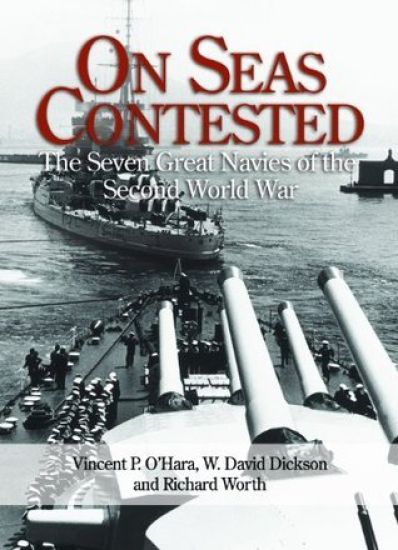
On Seas Contested is an in-depth analysis of the Second World War's seven major navies. A team of expert naval historians have contributed chapters outlining the navies of the United States, the United Kingdom and Commonwealth, Japan, Germany, Italy, France, and the Soviet Union. Each chapter consistently details key features such as weaponry, training, logistics, and doctrine. This definitive work will be a standard reference for years to come.