Kirjojen hintavertailu. Mukana 12 390 323 kirjaa ja 12 kauppaa.

Kirjailija

Vladimir I. Danilov

Kirjat ja teokset yhdessä paikassa: 2 kirjaa, julkaisuja vuosilta 2002-2010, suosituimpien joukossa Social Choice Mechanisms. Vertaile teosten hintoja ja tarkista saatavuus suomalaisista kirjakaupoista.

2 kirjaa

Kirjojen julkaisuhaarukka 2002-2010.

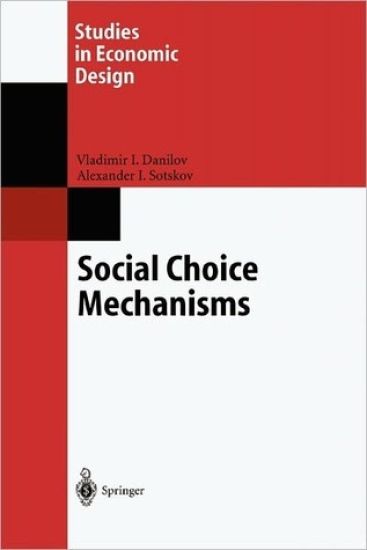
Social Choice Mechanisms

Social Choice Mechanisms

Vladimir I. Danilov; Alexander I. Sotskov

Springer-Verlag Berlin and Heidelberg GmbH Co. K
2010
nidottu
The theory of social choice deals with both the processes and results of col­ lective decision making. In this book, we explore some issues in the theory of social choice and mechanism design. We examine the premises of this theory, the axiomatic approach, and the mechanism design approach. The main questions are what is collective interest, how is it related to individuals' interests, how should one design social interactions, laws, and in­ stitutions? These questions are not new. Philosophers, social scientists have indeed pondered upon them for years. And, in fact, the organizational struc­ tures of many social institutions -courts, parliaments, committees and reg­ ulatory boards -often lack a sound theoretical base. This is not surprising, as it is, indeed, difficult to provide for a comprehensive formalization of the activities of such organizations. Nevertheless, there has been a definite trend towards providing clear and unambiguous rules for collective decision mak­ ing. These very rules constitute the body of social choice theory and its main object. The basic problem of social choice We explain here more precisely what a problem of social choice is, what approaches might be used to tackle it, and what kind of solutions it leads to. We introduce a few basic notions in preliminarily fashion and, in doing so, we stress both motivations and explanations.
Social Choice Mechanisms

Social Choice Mechanisms

Vladimir I. Danilov; Alexander I. Sotskov

Springer-Verlag Berlin and Heidelberg GmbH Co. K
2002
sidottu
The theory of social choice deals with both the processes and results of col­ lective decision making. In this book, we explore some issues in the theory of social choice and mechanism design. We examine the premises of this theory, the axiomatic approach, and the mechanism design approach. The main questions are what is collective interest, how is it related to individuals' interests, how should one design social interactions, laws, and in­ stitutions? These questions are not new. Philosophers, social scientists have indeed pondered upon them for years. And, in fact, the organizational struc­ tures of many social institutions -courts, parliaments, committees and reg­ ulatory boards -often lack a sound theoretical base. This is not surprising, as it is, indeed, difficult to provide for a comprehensive formalization of the activities of such organizations. Nevertheless, there has been a definite trend towards providing clear and unambiguous rules for collective decision mak­ ing. These very rules constitute the body of social choice theory and its main object. The basic problem of social choice We explain here more precisely what a problem of social choice is, what approaches might be used to tackle it, and what kind of solutions it leads to. We introduce a few basic notions in preliminarily fashion and, in doing so, we stress both motivations and explanations.