Kirjailija
Vladimir Shlapentokh
Kirjat ja teokset yhdessä paikassa: 15 kirjaa, julkaisuja vuosilta 1984-2021, suosituimpien joukossa Feudal America. Vertaile teosten hintoja ja tarkista saatavuus suomalaisista kirjakaupoista.
15 kirjaa
Kirjojen julkaisuhaarukka 1984-2021.
Do Americans live in a liberal capitalist society, where evenhanded competition rules the day, or a society in which big money, private security, and personal relations determine key social outcomes? Vladimir Shlapentokh and Joshua Woods argue that the answer to these questions cannot be found among the conventional models used to describe the nation. Offering a new analytical tool, the authors present a provocative explanation of the nature of contemporary society by comparing its essential characteristics to those of medieval European societies. Their feudal model emphasizes five elements: the weakness of the state and its inability to protect its territory, guarantee the security of its citizens, and enforce laws; conflicts and collusions between and within organizations that involve corruption and other forms of illegal or semilegal actions; the dominance of personal relations in political and economic life; the prevalence of an elitist ideology; and the use of private agents and organizations for the provision of safety and security. Feudal America urges readers to suspend their forward-thinking and futurist orientations, question linear notions of social and historical progression, and look for explanations of contemporary social problems in medieval European history.

State Organized Terror
P. Timothy Bushnell; Vladimir Shlapentokh; Christopher Vanderpool; Jeyaratnam Sundram
Routledge
2021
nidottu
This book, an outcome of an international conference entitled "State Organized Terror: The Case of Violent Internal Repression", addresses the antecedent structural factors conducive to state organized terror and provides insights into the political and social psychology of state terror.
Soviet Intellectuals and Political Power: The Post-Stalin Era
Vladimir Shlapentokh
PRINCETON UNIVERSITY PRESS
2016
sidottu
In this unprecedented work on the status and role of intellectuals in Soviet political life, a former Soviet sociologist maps out the delicate, often paradoxical, ties between the political regime and the creative thinkers who play a major part in the movement toward modernization. Beginning with Stalin, Vladimir Shlapentokh explores the mutual need and antagonism that have existed between political leaders and intellectuals. What emerges is a fascinating portrayal of the Soviet intellectual network since the 1950s, which touches on such topics as the role of literature and film in political opposition, levels of opposition (open, legal, and private), and the spread of paranoia as fueled by the KGB. Throughout he shows how the intellectual communityusually a cohesive, liberal grouphas fared under Khrushchev's cautious tolerance, Brezhnev's repressions, and now Gorbachev's Glasnost. Shlapentokh maintains, however, that under Glasnost freer speech has revealed a more pronounced divergence between liberal and conservative thinkers, and has allowed for open conservative opposition to the reformatory measures of Gorbachev and the liberals. He argues that one of the strongest checks on reform is the growing presence of Russophilism--a movement supporting Russian nationalism and Stalin's concept of socialism--among the political elite and the masses. Although the role of the liberal intellectuals in the late 1980s was less prominent than it was in the 1960s, Shlapentokh asserts that they remain the major agent of modernization in the Soviet Union, as well as in other socialist countries. Originally published in 1990. The Princeton Legacy Library uses the latest print-on-demand technology to again make available previously out-of-print books from the distinguished backlist of Princeton University Press. These editions preserve the original texts of these important books while presenting them in durable paperback and hardcover editions. The goal of the Princeton Legacy Library is to vastly increase access to the rich scholarly heritage found in the thousands of books published by Princeton University Press since its founding in 1905.
Soviet Intellectuals and Political Power
Vladimir Shlapentokh
Princeton University Press
2014
pokkari
In this unprecedented work on the status and role of intellectuals in Soviet political life, a former Soviet sociologist maps out the delicate, often paradoxical, ties between the political regime and the creative thinkers who play a major part in the movement toward modernization. Beginning with Stalin, Vladimir Shlapentokh explores the mutual need and antagonism that have existed between political leaders and intellectuals. What emerges is a fascinating portrayal of the Soviet intellectual network since the 1950s, which touches on such topics as the role of literature and film in political opposition, levels of opposition (open, legal, and private), and the spread of paranoia as fueled by the KGB. Throughout he shows how the intellectual communityusually a cohesive, liberal grouphas fared under Khrushchev's cautious tolerance, Brezhnev's repressions, and now Gorbachev's Glasnost.Shlapentokh maintains, however, that under Glasnost freer speech has revealed a more pronounced divergence between liberal and conservative thinkers, and has allowed for open conservative opposition to the reformatory measures of Gorbachev and the liberals. He argues that one of the strongest checks on reform is the growing presence of Russophilism--a movement supporting Russian nationalism and Stalin's concept of socialism--among the political elite and the masses. Although the role of the liberal intellectuals in the late 1980s was less prominent than it was in the 1960s, Shlapentokh asserts that they remain the major agent of modernization in the Soviet Union, as well as in other socialist countries.Originally published in 1990.The Princeton Legacy Library uses the latest print-on-demand technology to again make available previously out-of-print books from the distinguished backlist of Princeton University Press. These editions preserve the original texts of these important books while presenting them in durable paperback and hardcover editions. The goal of the Princeton Legacy Library is to vastly increase access to the rich scholarly heritage found in the thousands of books published by Princeton University Press since its founding in 1905.
Freedom, Repression, and Private Property in Russia
Vladimir Shlapentokh; Anna Arutunyan
Cambridge University Press
2013
sidottu
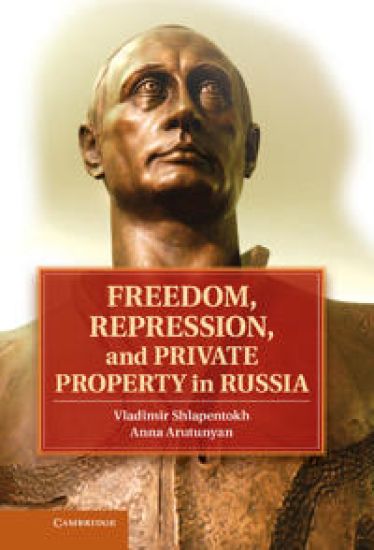
This study demonstrates how the emergence of private property and a market economy after the Soviet Union's collapse enabled a degree of freedom while simultaneously supporting authoritarianism. Based on case studies, Vladimir Shlapentokh and Anna Arutunyan analyze how private property and free markets spawn feudal elements in society. These elements are so strong in post-Communist Russia that they prevent the formation of a true democratic society, while making it impossible to return to totalitarianism. The authors describe the resulting Russian society as having three types of social organization: authoritarian, feudal and liberal. The authors examine the adaptation of Soviet-era institutions like security forces, the police and the army to free market conditions and how they generated corruption; the belief that the KGB was relatively free from corruption; how large property holdings merge with power and necessitate repression; and how property relations affect government management and suppression.
The New Elite in Post-Communist Eastern Europe
Vladimir Shlapentokh
Texas A M University Press
1999
sidottu
With the collapse of the Soviet Union, a radical metamorphosis took place in Eastern Europe as major power structures were replaced by new systems of power and authority. With new power systems came new types of dominant elites. The New Elite in Post-Communist Eastern Europe identifies those elites who have gained control of the political, economic, cultural, and scientific institutions of the new state systems and examines the nature of power in the post-Communist world and the relationships between the old and new elite. This study of the new elite in Eastern Europe developed from a 1994 conference on the subject, attended by scholars, sociologists, representatives from major national and international government organizations, European state leaders, and those considered members of the new elite. Twenty-six of those participants have now contributed their experiences and their definitions of the new elite to this book, edited by Vladimir Shlapentokh, Christopher Vanderpool, and Boris Doktorov, resulting in a global intellectual effort to define the political and social processes of post-Communist society. The New Elite in Post-Communist Eastern Europe contains analysis from members of nearly every post-Soviet republic. Many contributors conducted direct sociological research on their respective issues, which along with polls and other data sources, developed a strong empirical base for the work. In addition to an introduction by Shlapentokh and Vanderpool, chapters appear under four main sections: "Post-Communist Elites: An Overview"; "Elites in Post-Soviet Republics"; "The Regional Elite in Russia"; and "Types of the Elite." Eastern Europe is a hotbed of unrest, revolution, and change. Understanding those who are in power is vital to understanding the countries in that region and their potential impact on global politics, economy, and society. The New Elite in Post-Communist Eastern Europe offers that understanding.
In the wake of the USSR's collapse, more than 25 million Russians found themselves living outside Russian territory, their status ambiguous. Equally uncertain is the role they will play as a factor in Russian politics, local politics and relations among the newly independent states of the former Soviet Union. This volume, prepared under the sponsorship of the Kennan Institute, offers a comprehensive and amply documented examination of these issues.
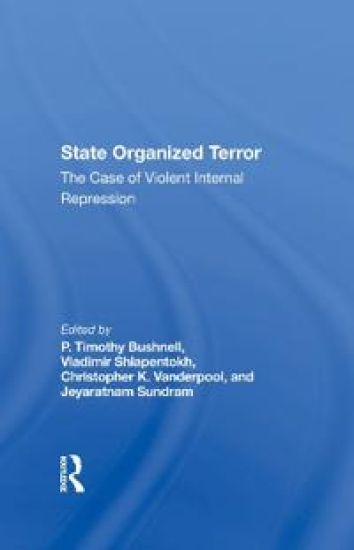
State Organized Terror
P. Timothy Bushnell; Vladimir Shlapentokh; Christopher Vanderpool; Jeyaratnam Sundram
Routledge
2019
sidottu
This book, an outcome of an international conference entitled "State Organized Terror: The Case of Violent Internal Repression", addresses the antecedent structural factors conducive to state organized terror and provides insights into the political and social psychology of state terror.
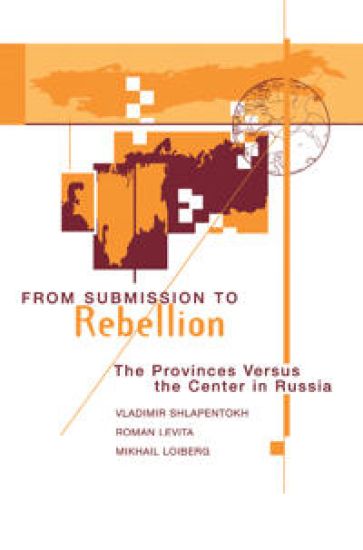
From Submission To Rebellion
Vladimir Shlapentokh; Roman Levita; Mikhail Loiberg
Routledge
2019
sidottu
Written in the spirit of comparative and historical analysis, this book addresses the relationship between the center and its provinces?an important issue in any society?using Russia as a case study. The authors investigate the historical stages of Russia's past with a special focus on the postcommunist era, a time when the movement toward regional autonomy (regionalization) is extremely important as a molder of political and economic life. In addition, the book shows how historical traditions, on the one hand, and the new market economy and democratization, on the other, will shape the relationship between the center and provinces in the coming decades.Shlapentokh, Levita, and Loiberg direct their attention not only to factors which shape regionalization, but also to the effects of this process on many different facets of Russian life. They argue that regionalization in Russia, as well as in other countries, is a contradictory process that has both benefits and drawbacks for social and economic progress.The solid research foundation draws from a rich body of sources, including Russian periodicals, statistical yearbooks, work by Russian and Western authors, data gathered in nationwide surveys conducted specifically for this project, and insightful observations made by the authors during their numerous visits to various regions in Russia.
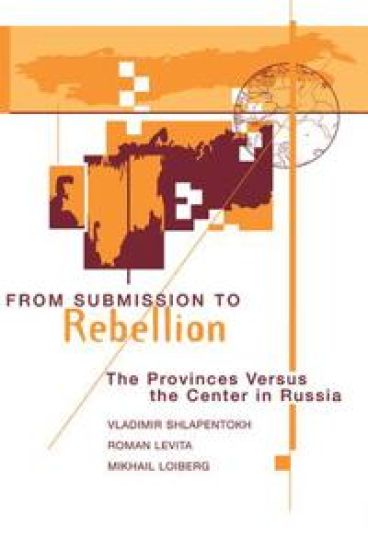
From Submission To Rebellion
Vladimir Shlapentokh; Roman Levita; Mikhail Loiberg
Westview Press Inc
1998
nidottu
Written in the spirit of comparative and historical analysis, this book addresses the relationship between the center and its provinces?an important issue in any society?using Russia as a case study. The authors investigate the historical stages of Russia's past with a special focus on the postcommunist era, a time when the movement toward regional autonomy (regionalization) is extremely important as a molder of political and economic life. In addition, the book shows how historical traditions, on the one hand, and the new market economy and democratization, on the other, will shape the relationship between the center and provinces in the coming decades.Shlapentokh, Levita, and Loiberg direct their attention not only to factors which shape regionalization, but also to the effects of this process on many different facets of Russian life. They argue that regionalization in Russia, as well as in other countries, is a contradictory process that has both benefits and drawbacks for social and economic progress.The solid research foundation draws from a rich body of sources, including Russian periodicals, statistical yearbooks, work by Russian and Western authors, data gathered in nationwide surveys conducted specifically for this project, and insightful observations made by the authors during their numerous visits to various regions in Russia.
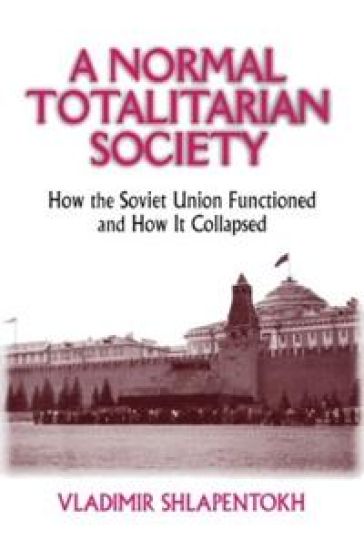
Shlapentokh undertakes a dispassionate analysis of the ordinary functioning of the Soviet system from Stalin's death through the Soviet collapse and Russia's first post-communist decade. Without overlooking its repressive character, he treats the USSR as a "normal" system that employed both socialist and nationalist ideologies for the purposes of technological and military modernization, preservation of empire, and expansion of its geopolitical power. Foregoing the projection of Western norms and assumptions, he seeks to achieve a clearer understanding of a civilization that has perplexed its critics and its champions alike.
This is the first book to view Soviet ideology and public opinion from the perspective of Soviet mythology. The author puts forth the idea that mythology in Soviet life is one of the most important variables determining the path of Soviet history and examines how Soviet society adjusts to the important role of mythology in its life. In this connection, the author introduces the concept of a party ideology as it differs from public ideology. Original and provocative, Soviet Public Opinion and Ideology is an enlightening work for sociologists, political scientists, social psychologists, and experts on the Soviet Union.
Love, Marriage, and Friendship in the Soviet Union
Vladimir Shlapentokh
Praeger Publishers Inc
1984
sidottu
Based on Soviet sociological studies, Soviet fiction and film, and mass media reports, this volume explores the ways in which Soviet attitudes about love, sex, marriage, friendship, and children have been influenced by the evolution of Soviet ideology, politics, and economy since the Bolshevik revolution.