Kirjojen hintavertailu. Mukana 12 595 353 kirjaa ja 12 kauppaa.

Kirjailija

Vladimir V. Mitin

Kirjat ja teokset yhdessä paikassa: 7 kirjaa, julkaisuja vuosilta 2001-2019, suosituimpien joukossa Introduction to Nanoelectronics. Vertaile teosten hintoja ja tarkista saatavuus suomalaisista kirjakaupoista.

7 kirjaa

Kirjojen julkaisuhaarukka 2001-2019.

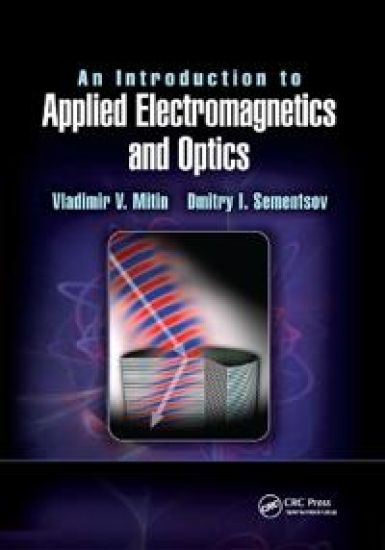
An Introduction to Applied Electromagnetics and Optics

An Introduction to Applied Electromagnetics and Optics

Vladimir V. Mitin; Dmitry I. Sementsov

CRC Press
2019
nidottu
Modern technology is rapidly developing and for this reason future engineers need to acquire advanced knowledge in science and technology, including electromagnetic phenomena. This book is a contemporary text of a one-semester course for junior electrical engineering students. It covers a broad spectrum of electromagnetic phenomena such as, surface waves, plasmas, photonic crystals, negative refraction as well as related materials including superconductors. In addition, the text brings together electromagnetism and optics as the majority of texts discuss electromagnetism disconnected from optics. In contrast, in this book both are discussed. Seven labs have been developed to accompany the material of the book.
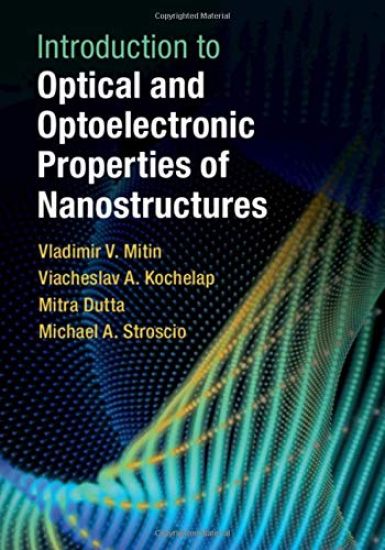
Introduction to Optical and Optoelectronic Properties of Nanostructures

Introduction to Optical and Optoelectronic Properties of Nanostructures

Vladimir V. Mitin; Viacheslav A. Kochelap; Mitra Dutta; Michael A. Stroscio

Cambridge University Press
2019
sidottu
Get to grips with the fundamental optical and optoelectronic properties of nanostructures. This comprehensive guide makes a wide variety of modern topics accessible, and includes up-to-date material on the optical properties of monolayer crystals, plasmonics, nanophotonics, UV quantum well lasers, and wide bandgap materials and heterostructures. The unified, multidisciplinary approach makes it ideal for those in disciplines spanning nanoscience, physics, materials science, and optical, electrical and mechanical engineering. Building on work first presented in Quantum Heterostructures (Cambridge, 1999), this volume draws on years of research and teaching experience. Rigorous coverage of basic principles makes it an excellent resource for senior undergraduates, and detailed mathematical derivations illuminate concepts for graduate students, researchers and professional engineers. The examples with solutions included in the text and end-of-chapter problems allows the students to use this text to enhance their understanding.
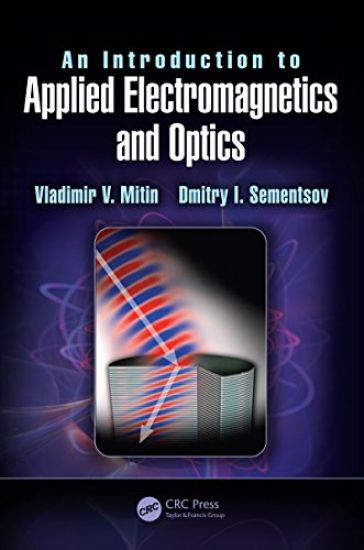
An Introduction to Applied Electromagnetics and Optics

An Introduction to Applied Electromagnetics and Optics

Vladimir V. Mitin; Dmitry I. Sementsov

Productivity Press
2016
sidottu
Modern technology is rapidly developing and for this reason future engineers need to acquire advanced knowledge in science and technology, including electromagnetic phenomena. This book is a contemporary text of a one-semester course for junior electrical engineering students. It covers a broad spectrum of electromagnetic phenomena such as, surface waves, plasmas, photonic crystals, negative refraction as well as related materials including superconductors. In addition, the text brings together electromagnetism and optics as the majority of texts discuss electromagnetism disconnected from optics. In contrast, in this book both are discussed. Seven labs have been developed to accompany the material of the book.
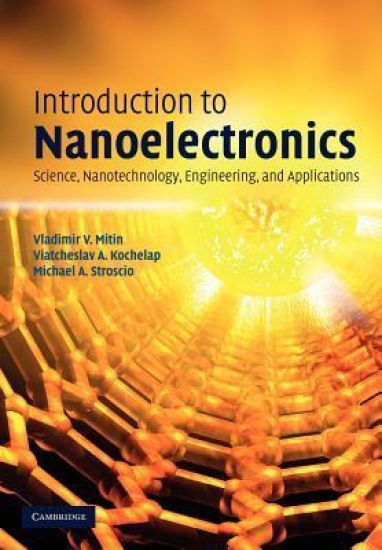
Introduction to Nanoelectronics

Introduction to Nanoelectronics

Vladimir V. Mitin; Viatcheslav A. Kochelap; Michael A. Stroscio

Cambridge University Press
2012
pokkari
Increasing miniaturization of devices, components, and integrated systems requires developments in the capacity to measure, organize, and manipulate matter at the nanoscale. This textbook, first published in 2007, is a comprehensive, interdisciplinary account of the technology and science that underpin nanoelectronics, covering the underlying physics, nanostructures, nanomaterials, and nanodevices. Without assuming prior knowledge of quantum physics, this book provides a unifying framework for the basic ideas needed to understand the recent developments in the field. Numerous illustrations, homework problems and interactive Java applets help the student to appreciate the basic principles of nanotechnology, and to apply them to real problems. Written in a clear yet rigorous and interdisciplinary manner, this textbook is suitable for advanced undergraduate and graduate students in electrical and electronic engineering, nanoscience, materials, bioengineering, and chemical engineering.
Quantum Mechanics for Nanostructures

Quantum Mechanics for Nanostructures

Vladimir V. Mitin; Dmitry I. Sementsov; Nizami Z. Vagidov

Cambridge University Press
2010
sidottu
The properties of new nanoscale materials, their fabrication and applications, as well as the operational principles of nanodevices and systems, are solely determined by quantum-mechanical laws and principles. This textbook introduces engineers to quantum mechanics and the world of nanostructures, enabling them to apply the theories to numerous nanostructure problems. The textbook covers the fundamentals of quantum mechanics, including uncertainty relations, the Schrödinger equation, perturbation theory, and tunneling. These are then applied to a quantum dot, the smallest artificial atom, and compared to hydrogen, the smallest atom in nature. Nanoscale objects with higher dimensionality, such as quantum wires and quantum wells, are introduced, as well as nanoscale materials and nanodevices. Numerous examples throughout the text help students to understand the material.
Introduction to Nanoelectronics

Introduction to Nanoelectronics

Vladimir V. Mitin; Viatcheslav A. Kochelap; Michael A. Stroscio

Cambridge University Press
2007
sidottu
Increasing miniaturization of devices, components, and integrated systems requires developments in the capacity to measure, organize, and manipulate matter at the nanoscale. This textbook, first published in 2007, is a comprehensive, interdisciplinary account of the technology and science that underpin nanoelectronics, covering the underlying physics, nanostructures, nanomaterials, and nanodevices. Without assuming prior knowledge of quantum physics, this book provides a unifying framework for the basic ideas needed to understand the recent developments in the field. Numerous illustrations, homework problems and interactive Java applets help the student to appreciate the basic principles of nanotechnology, and to apply them to real problems. Written in a clear yet rigorous and interdisciplinary manner, this textbook is suitable for advanced undergraduate and graduate students in electrical and electronic engineering, nanoscience, materials, bioengineering, and chemical engineering.
Modern Advanced Mathematics for Engineers

Modern Advanced Mathematics for Engineers

Vladimir V. Mitin; Dmitri A. Romanov; Michael P. Polis

John Wiley Sons Inc
2001
sidottu
A convenient single source for vital mathematical concepts, written by engineers and for engineers Almost every discipline in electrical and computer engineering relies heavily on advanced mathematics. Modern Advanced Mathematics for Engineers builds a strong foundation in modern applied mathematics for engineering students, and offers them a concise and comprehensive treatment that summarizes and unifies their mathematical knowledge using a system focused on basic concepts rather than exhaustive theorems and proofs. The authors provide several levels of explanation and exercises involving increasing degrees of mathematical difficulty to recall and develop basic topics such as calculus, determinants, Gaussian elimination, differential equations, and functions of a complex variable. They include an assortment of examples ranging from simple illustrations to highly involved problems as well as a number of applications that demonstrate the concepts and methods discussed throughout the book. This broad treatment also offers: *Key mathematical tools needed by engineers working in communications, semiconductor device simulation, and control theory *Concise coverage of fundamental concepts such as sets, mappings, and linearity *Thorough discussion of topics such as distance, inner product, and orthogonality *Essentials of operator equations, theory of approximations, transform methods, and *partial differential equations *A treatment that is adaptable for use with computer systems Modern Advanced Mathematics for Engineers gives students a strong foundation in modern applied mathematics and the confidence to apply it across diverse engineering disciplines. It makes an excellent companion to less general engineering texts and a useful reference for practitioners.