Kirjojen hintavertailu. Mukana 12 595 353 kirjaa ja 12 kauppaa.

Kirjailija

Volker Halbach

Kirjat ja teokset yhdessä paikassa: 5 kirjaa, julkaisuja vuosilta 2010-2025, suosituimpien joukossa The Road to Paradox. Vertaile teosten hintoja ja tarkista saatavuus suomalaisista kirjakaupoista.

5 kirjaa

Kirjojen julkaisuhaarukka 2010-2025.

The Definition of Logical Validity

The Definition of Logical Validity

Volker Halbach

Oxford University Press
2025
sidottu
According to the semantic definition of logical consequence or validity, an argument is logically valid if, and only if, the conclusion is true under all interpretations under which also all premisses are true. The semantic definition is only a general pattern, and Volker Halbach presents a specific way of spelling out this definition. In contrast to the predominant approaches, truth is taken to be a primitive notion, which is not reduced away by a mathematical definition. An interpretation of a sentence is obtained by replacing non-logical terms uniformly with arbitrary other terms of the same grammatical kind. This conception of interpretations is in line with naïve and straightforward understandings of interpretations that hark back at least to the middle ages. The resulting definition of logical validity combines two advantages: first, it is universal in the sense that it applies not only to a restricted language, but to the entire in which the definition is stated. This is in contrast to definitions of logical validity in higher-order languages. Secondly, it admits the intended interpretation, that is, the interpretation of sentences at their face value without any re-interpretation. Thus, logical consequence is trivial preserving truth. The usual model-theoretic definition lacks this property, although it has always taken to be fundamental to logical consequence and warrants its usefulness in philosophy.
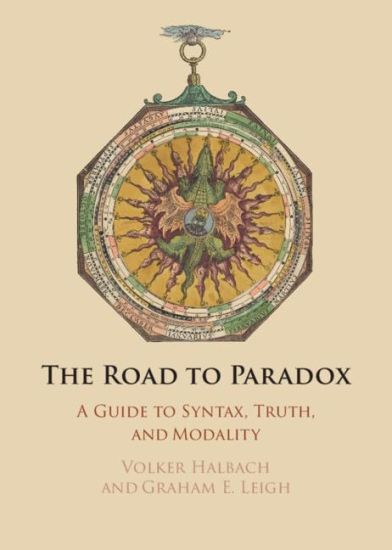
The Road to Paradox

The Road to Paradox

Volker Halbach; Graham E. Leigh

Cambridge University Press
2024
sidottu
Truth, provability, necessity, and other concepts are fundamental to many branches of philosophy, mathematics, computer science, and linguistics. Their study has led to some of the most celebrated achievements in logic, such as Gödel's incompleteness theorems, Tarski's theorem on the undefinability of truth, and numerous accounts of the paradoxes associated with these concepts. This book provides a clear and direct introduction to the theory of paradoxes and the Gödel incompleteness theorems. It offers new analyses of the ideas of self-reference, circularity, and the semantic paradoxes, and helps readers to see both how paradoxes arise and what their common features are. It will be valuable for students and researchers with a minimal background in logic and will equip them to understand and discuss a wide variety of topics in philosophical logic.
Axiomatic Theories of Truth

Axiomatic Theories of Truth

Volker Halbach

Cambridge University Press
2014
pokkari
At the centre of the traditional discussion of truth is the question of how truth is defined. Recent research, especially with the development of deflationist accounts of truth, has tended to take truth as an undefined primitive notion governed by axioms, while the liar paradox and cognate paradoxes pose problems for certain seemingly natural axioms for truth. In this book, Volker Halbach examines the most important axiomatizations of truth, explores their properties and shows how the logical results impinge on the philosophical topics related to truth. In particular, he shows that the discussion on topics such as deflationism about truth depends on the solution of the paradoxes. His book is an invaluable survey of the logical background to the philosophical discussion of truth, and will be indispensable reading for any graduate or professional philosopher in theories of truth.
The Logic Manual

The Logic Manual

Volker Halbach

Oxford University Press
2010
nidottu
The Logic Manual is a clear and concise introduction to logic for beginning philosophy students. It offers a complete introductory course, guiding the reader carefully through the topics in logic that are most important for the study of philosophy. It covers propositional and predicate logic with and without identity. It includes an account of the semantics of these languages including definitions of truth and satisfaction. Natural deduction is used as a proof system. Volker Halbach introduces the essential concepts through examples and informal explanations as well as through abstract definitions. The Logic Manual provides the best entry to the general abstract way of thinking about language, logic, and semantics which is characteristic of contemporary philosophy. Exercises, examples, and sample examination papers are provided on an accompanying website.
The Logic Manual

The Logic Manual

Volker Halbach

Oxford University Press
2010
sidottu
The Logic Manual is a clear and concise introduction to logic for beginning philosophy students. It offers a complete introductory course, guiding the reader carefully through the topics in logic that are most important for the study of philosophy. It covers propositional and predicate logic with and without identity. It includes an account of the semantics of these languages including definitions of truth and satisfaction. Natural deduction is used as a proof system. Volker Halbach introduces the essential concepts through examples and informal explanations as well as through abstract definitions. The Logic Manual provides the best entry to the general abstract way of thinking about language, logic, and semantics which is characteristic of contemporary philosophy. Exercises, examples, and sample examination papers are provided on an accompanying website.