
Kirjailija
W Derham
Kirjat ja teokset yhdessä paikassa: 33 kirjaa, julkaisuja vuosilta 1967-2018, suosituimpien joukossa The Artificial Clock-Maker. a Treatise of Watch and Clock-Work. Vertaile teosten hintoja ja tarkista saatavuus suomalaisista kirjakaupoista.
Mukana myös kirjoitusasut: W. Derham
33 kirjaa
Kirjojen julkaisuhaarukka 1967-2018.
Astro-theology Or, a Demonstration of the Being and Attributes of God from a Survey of the Heavens
W. Derham
Kessinger Pub
2007
sidottu
Physico-theology Or, a Demonstration of the Being and Attributes of God from His Works of Creation
W. Derham
Kessinger Pub
2007
sidottu
Physico-theology Or, a Demonstration of the Being and Attributes of God from His Works of Creation
W. Derham
Kessinger Pub
2007
pokkari
Astro-theology Or, a Demonstration of the Being and Attributes of God from a Survey of the Heavens
W. Derham
Kessinger Pub
2007
pokkari
The Artificial Clock-maker. A Treatise of Watch and Clock-work, Shewing to the Meanest Capacities the art of Calculating Numbers to all Sorts of Movements
W Derham
Gale Ecco, Print Editions
2018
sidottu
The 18th century was a wealth of knowledge, exploration and rapidly growing technology and expanding record-keeping made possible by advances in the printing press. In its determination to preserve the century of revolution, Gale initiated a revolution of its own: digitization of epic proportions to preserve these invaluable works in the largest archive of its kind. Now for the first time these high-quality digital copies of original 18th century manuscripts are available in print, making them highly accessible to libraries, undergraduate students, and independent scholars.Medical theory and practice of the 1700s developed rapidly, as is evidenced by the extensive collection, which includes descriptions of diseases, their conditions, and treatments. Books on science and technology, agriculture, military technology, natural philosophy, even cookbooks, are all contained here.++++The below data was compiled from various identification fields in the bibliographic record of this title. This data is provided as an additional tool in helping to insure edition identification: ++++British LibraryT061546W. D. = William Derham.London: printed for James Knapton, 1714. 16],140p., plates: music; 12
The 18th century was a wealth of knowledge, exploration and rapidly growing technology and expanding record-keeping made possible by advances in the printing press. In its determination to preserve the century of revolution, Gale initiated a revolution of its own: digitization of epic proportions to preserve these invaluable works in the largest archive of its kind. Now for the first time these high-quality digital copies of original 18th century manuscripts are available in print, making them highly accessible to libraries, undergraduate students, and independent scholars.The Age of Enlightenment profoundly enriched religious and philosophical understanding and continues to influence present-day thinking. Works collected here include masterpieces by David Hume, Immanuel Kant, and Jean-Jacques Rousseau, as well as religious sermons and moral debates on the issues of the day, such as the slave trade. The Age of Reason saw conflict between Protestantism and Catholicism transformed into one between faith and logic -- a debate that continues in the twenty-first century.++++The below data was compiled from various identification fields in the bibliographic record of this title. This data is provided as an additional tool in helping to insure edition identification: ++++British LibraryN004306With an index.Edinburgh: printed by Alex. M'Caslan, Crosscausey. For R. Clark and A. M'Caslan, 1769. 6],10, 1],14-216, 12]p., plates; 8
The 18th century was a wealth of knowledge, exploration and rapidly growing technology and expanding record-keeping made possible by advances in the printing press. In its determination to preserve the century of revolution, Gale initiated a revolution of its own: digitization of epic proportions to preserve these invaluable works in the largest archive of its kind. Now for the first time these high-quality digital copies of original 18th century manuscripts are available in print, making them highly accessible to libraries, undergraduate students, and independent scholars.The Age of Enlightenment profoundly enriched religious and philosophical understanding and continues to influence present-day thinking. Works collected here include masterpieces by David Hume, Immanuel Kant, and Jean-Jacques Rousseau, as well as religious sermons and moral debates on the issues of the day, such as the slave trade. The Age of Reason saw conflict between Protestantism and Catholicism transformed into one between faith and logic -- a debate that continues in the twenty-first century.++++The below data was compiled from various identification fields in the bibliographic record of this title. This data is provided as an additional tool in helping to insure edition identification: ++++British LibraryN004303Edinburgh: printed by J. Gray, for John Wood, 1775. 16],196, 8]p., plates; 12
The 18th century was a wealth of knowledge, exploration and rapidly growing technology and expanding record-keeping made possible by advances in the printing press. In its determination to preserve the century of revolution, Gale initiated a revolution of its own: digitization of epic proportions to preserve these invaluable works in the largest archive of its kind. Now for the first time these high-quality digital copies of original 18th century manuscripts are available in print, making them highly accessible to libraries, undergraduate students, and independent scholars.The Age of Enlightenment profoundly enriched religious and philosophical understanding and continues to influence present-day thinking. Works collected here include masterpieces by David Hume, Immanuel Kant, and Jean-Jacques Rousseau, as well as religious sermons and moral debates on the issues of the day, such as the slave trade. The Age of Reason saw conflict between Protestantism and Catholicism transformed into one between faith and logic -- a debate that continues in the twenty-first century.++++The below data was compiled from various identification fields in the bibliographic record of this title. This data is provided as an additional tool in helping to insure edition identification: ++++British LibraryN016209With an index.London: printed for J. Richardson, 1758. 16], lvi, 8],246, 10]p., plates; 8
The 18th century was a wealth of knowledge, exploration and rapidly growing technology and expanding record-keeping made possible by advances in the printing press. In its determination to preserve the century of revolution, Gale initiated a revolution of its own: digitization of epic proportions to preserve these invaluable works in the largest archive of its kind. Now for the first time these high-quality digital copies of original 18th century manuscripts are available in print, making them highly accessible to libraries, undergraduate students, and independent scholars.The Age of Enlightenment profoundly enriched religious and philosophical understanding and continues to influence present-day thinking. Works collected here include masterpieces by David Hume, Immanuel Kant, and Jean-Jacques Rousseau, as well as religious sermons and moral debates on the issues of the day, such as the slave trade. The Age of Reason saw conflict between Protestantism and Catholicism transformed into one between faith and logic -- a debate that continues in the twenty-first century.++++The below data was compiled from various identification fields in the bibliographic record of this title. This data is provided as an additional tool in helping to insure edition identification: ++++British LibraryT030707With a half-title.London: printed for W. Innys, 1730. 28p.; 8
The 18th century was a wealth of knowledge, exploration and rapidly growing technology and expanding record-keeping made possible by advances in the printing press. In its determination to preserve the century of revolution, Gale initiated a revolution of its own: digitization of epic proportions to preserve these invaluable works in the largest archive of its kind. Now for the first time these high-quality digital copies of original 18th century manuscripts are available in print, making them highly accessible to libraries, undergraduate students, and independent scholars.The Age of Enlightenment profoundly enriched religious and philosophical understanding and continues to influence present-day thinking. Works collected here include masterpieces by David Hume, Immanuel Kant, and Jean-Jacques Rousseau, as well as religious sermons and moral debates on the issues of the day, such as the slave trade. The Age of Reason saw conflict between Protestantism and Catholicism transformed into one between faith and logic -- a debate that continues in the twenty-first century.++++The below data was compiled from various identification fields in the bibliographic record of this title. This data is provided as an additional tool in helping to insure edition identification: ++++British LibraryT070256Glasgow: printed by William Duncan junior, 1755. 12], xxxix, 1],169, 13]p., plates; 12
Shortly after Hooke died in 1703, his miscellaneous papers and unpublished manuscripts were entrusted to Richard Waller, who edited and published some of them in a volume titled The Posthumous Works of Robert Hooke (1705; reprinted, Frank Cass, 1968). Waller himself died, however, before he was able to complete the task of republishing Hooke’s papers and they were eventually handed on to William Derham. After delaying for what some of Hooke’s followers thought to be a scandalously long time, Derham finally published this volume in 1726. It contains numerous papers and notes by Hooke as well as a number of important papers and letters written by Hooke’s contemporaries and found, evidently, among Hooke’s literary remains.This is an exact facsimile reproduction of Derham’s edition of the Philosophical experiments and Observations of the late Eminent Dr. Rober Hooke (1726) except that an analytical table of contents, prepared by the General Editor, has been added.First Published in 1967. Routledge is an imprint of Taylor & Francis, an informa company.
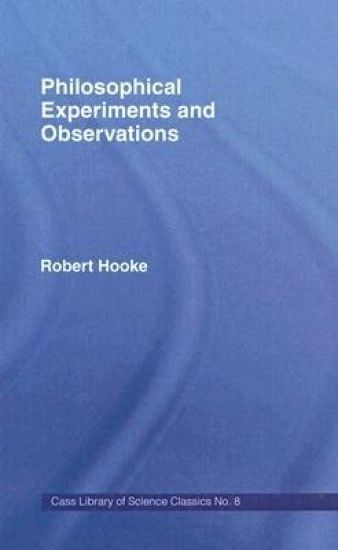
Shortly after Hooke died in 1703, his miscellaneous papers and unpublished manuscripts were entrusted to Richard Waller, who edited and published some of them in a volume titled The Posthumous Works of Robert Hooke (1705; reprinted, Frank Cass, 1968). Waller himself died, however, before he was able to complete the task of republishing Hooke’s papers and they were eventually handed on to William Derham. After delaying for what some of Hooke’s followers thought to be a scandalously long time, Derham finally published this volume in 1726. It contains numerous papers and notes by Hooke as well as a number of important papers and letters written by Hooke’s contemporaries and found, evidently, among Hooke’s literary remains. This is an exact facsimile reproduction of Derham’s edition of the Philosophical experiments and Observations of the late Eminent Dr. Rober Hooke (1726) except that an analytical table of contents, prepared by the General Editor, has been added.First Published in 1967. Routledge is an imprint of Taylor & Francis, an informa company.