Kirjojen hintavertailu. Mukana 12 484 899 kirjaa ja 12 kauppaa.

Kirjailija

W. G. Beasley

Kirjat ja teokset yhdessä paikassa: 7 kirjaa, julkaisuja vuosilta 1972-2023, suosituimpien joukossa The Meiji Restoration. Vertaile teosten hintoja ja tarkista saatavuus suomalaisista kirjakaupoista.

Mukana myös kirjoitusasut: W G Beasley, W.G. Beasley

7 kirjaa

Kirjojen julkaisuhaarukka 1972-2023.

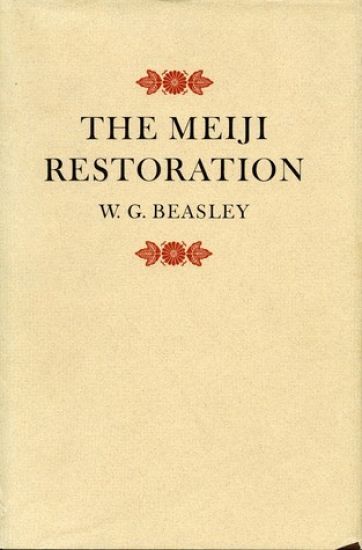
The Meiji Restoration

The Meiji Restoration

W. G. Beasley; Michael R. Auslin

Stanford University Press
1972
sidottu
For Japan, the Meiji Restoration of 1868 has something of the significance that the French Revolution has for France: it is the point from which modern history begins. In this now classic work of Japanese history, the late W. G. Beasley offers a comprehensive account of the origins, development, and immediate aftermath of the events that restored Imperial rule to Japan. He makes the case that the origins of the Meiji Restoration are not found in economic distress or class struggle, but in a growing sense of national danger and national pride spurred by Japan's contacts with the West. Nationalism provided the impetus for overthrowing the Tokugawa military government and reuniting Japan under the Emperor Meiji. Only when the Tokugawa were gone did their successors turn, of necessity, to the making of modern Japan, seeking strength and stability in new social patterns. Originally published in 1972, this new paperback edition contains a foreword written by Michael R. Auslin that celebrates Beasley's legacy.
The Meiji Restoration

The Meiji Restoration

W. G. Beasley; Michael R. Auslin

Stanford University Press
2018
pokkari
For Japan, the Meiji Restoration of 1868 has something of the significance that the French Revolution has for France: it is the point from which modern history begins. In this now classic work of Japanese history, the late W. G. Beasley offers a comprehensive account of the origins, development, and immediate aftermath of the events that restored Imperial rule to Japan. He makes the case that the origins of the Meiji Restoration are not found in economic distress or class struggle, but in a growing sense of national danger and national pride spurred by Japan's contacts with the West. Nationalism provided the impetus for overthrowing the Tokugawa military government and reuniting Japan under the Emperor Meiji. Only when the Tokugawa were gone did their successors turn, of necessity, to the making of modern Japan, seeking strength and stability in new social patterns. Originally published in 1972, this new paperback edition contains a foreword written by Michael R. Auslin that celebrates Beasley's legacy.

The Rise of Modern Japan, 3rd Edition

The Rise of Modern Japan, 3rd Edition

W.G. Beasley

Palgrave Macmillan
2000
sidottu
This clear and authoritative book surveys the history of Japan from the mid 19th century up to the present day. It charts the spectacular rise of Japan, a society which leapt in little more than a generation from the feudal to early industrial forms of organisation - an exceptionally disturbing experience for the Japanese as they left behind the traditional and Asian and moved towards the modern and Western. It examines the turbulent 1930s and an empire won and lost between 1937 and 1945, and investigates the major changes after 1945 including the astonishing economic growth that has been achieved since the 1950s. This revised editon covers the economic recession and the dramatic political upheavals of the 1990s, taking the history of Japan up to the end of the 20th century.
Japan Encounters the Barbarian

Japan Encounters the Barbarian

W. G. Beasley

Yale University Press
1995
sidottu
For over a hundred years the Japanese have looked to the West for ideas, institutions, and technology that would help them achieve the goal of "national wealth and strength." In this book a distinguished historian of Japan discusses Japan's "cultural borrowing" from America and Europe. W.G. Beasley focuses on the mid-nineteenth century, when Japan's rulers dispatched diplomatic missions to the West to discover what Japan needed to learn, sent students to learn it, and invited foreign experts to Japan to help put the knowledge to practical use. Beasley examines the origins of the decision to initiate direct study of the West, at a time when western countries counted as "barbarian" by Confucian standards. Next, drawing on many colorful letters, diaries, memoirs, and reports, he describes the missions sent overseas in 1860 and 1862, in 1865-1867, and in the years after 1868, in particular the prestigious embassy led by Iwakura in 1871-1873. He also tells the story of the several hundred students who went abroad in this period. He concludes by assessing the impact of the encounters on the subsequent development of Japan, first by examining the later careers of the travelers and the influence they exercised (they included no fewer than six prime ministers of the late nineteenth and early twentieth centuries), and then by considering the nature of the ideas they brought home.
Japanese Imperialism, 1894-1945

Japanese Imperialism, 1894-1945

W. G. Beasley

Clarendon Press
1991
nidottu
This is a study of the origins and nature of Japanese imperialism from the Sino-Japanese war of 1894-1895 through to 1945. Japan is the only Asian country in modern times to have built both a successful industrial economy and an empire, and it is Professor Beasley's contention that these two phenomena are closely related. Japan's aims were influenced by its experience of western imperialism and its own growing industrialization, but as external circumstances changed and Japan's capacity grew, so did its needs and ambitions. The creation of the Japanese empire is one of the most remarkable exploits of the twentieth century. Professor Beasley has provided a much-needed scholarly investigation into its development, expansion, and eventual destruction.