Kirjojen hintavertailu. Mukana 12 595 353 kirjaa ja 12 kauppaa.

Kirjailija

W. H. G. Armytage

Kirjat ja teokset yhdessä paikassa: 12 kirjaa, julkaisuja vuosilta 1970-2024, suosituimpien joukossa The Russian Influence on English Education. Vertaile teosten hintoja ja tarkista saatavuus suomalaisista kirjakaupoista.

Mukana myös kirjoitusasut: W.H.G. Armytage

12 kirjaa

Kirjojen julkaisuhaarukka 1970-2024.

Yesterday's Tomorrows

Yesterday's Tomorrows

W. H. G. Armytage

TAYLOR FRANCIS LTD
2024
nidottu
First published in 1968, Yesterday’s Tomorrows elucidates on the favourite occupation of man: forecasting the future. By man’s predictions, he mirrors his own wish-fulfilments, displacements, projections, denials, evasions and withdrawals. These predications can take the form of countries of the imagination, ‘mirror worlds’ like Rabelais’ Ever-Ever lands or the Erewhon of Butler. Alternatively, they may spring from panic, reflecting fear rather than hope, often manifesting themselves, in our technological age, as reports of ‘flying saucers’ or invasions from another planet. In either form, they provide philosophers, scientists, doctors and sociologists with material for evaluating man’s future needs, offering both criticism of our present society, plans for our future, and release from tension and disequilibrium.Professor Armytage shows in this book how such ‘visions’ can, and do, refresh minds for renewed grappling with the present by arming them with ideas for man’s future needs. He indicates that, out of an apparent welter of futuristic fantasies, a constructive debate about tomorrow is emerging, providing us with operational models of what tomorrow could be. This book will hold special interest for students of philosophy and of English literature.

Yesterday's Tomorrows

Yesterday's Tomorrows

W. H. G. Armytage

TAYLOR FRANCIS LTD
2021
sidottu
First published in 1968, Yesterday’s Tomorrows elucidates on the favourite occupation of man: forecasting the future. By man’s predictions, he mirrors his own wish-fulfilments, displacements, projections, denials, evasions and withdrawals. These predications can take the form of countries of the imagination, ‘mirror worlds’ like Rabelais’ Ever-Ever lands or the Erewhon of Butler. Alternatively, they may spring from panic, reflecting fear rather than hope, often manifesting themselves, in our technological age, as reports of ‘flying saucers’ or invasions from another planet. In either form, they provide philosophers, scientists, doctors and sociologists with material for evaluating man’s future needs, offering both criticism of our present society, plans for our future, and release from tension and disequilibrium.Professor Armytage shows in this book how such ‘visions’ can, and do, refresh minds for renewed grappling with the present by arming them with ideas for man’s future needs. He indicates that, out of an apparent welter of futuristic fantasies, a constructive debate about tomorrow is emerging, providing us with operational models of what tomorrow could be. This book will hold special interest for students of philosophy and of English literature.
A.J. Mundella, 1825-1897; the Liberal Background to the Labour Movement; 1825-1897
This work has been selected by scholars as being culturally important and is part of the knowledge base of civilization as we know it.This work is in the public domain in the United States of America, and possibly other nations. Within the United States, you may freely copy and distribute this work, as no entity (individual or corporate) has a copyright on the body of the work.Scholars believe, and we concur, that this work is important enough to be preserved, reproduced, and made generally available to the public. To ensure a quality reading experience, this work has been proofread and republished using a format that seamlessly blends the original graphical elements with text in an easy-to-read typeface.We appreciate your support of the preservation process, and thank you for being an important part of keeping this knowledge alive and relevant.
The Russian Influence on English Education
Originally published in 1969. British merchants first penetrated to Moscow in the early 16th century. From that time until today developments in Russia have influenced Britain in innumerable ways - sometimes unexpectedly. In this volume Professor Armytage traces this influence, showing how Tolstoy, Kropotkin and others better known for their activities in fields other than education, have, in fact, had their effect on education in Britain. The lively account of the way in which these ideas have found their way into the British system shows that recent influences have been more direct. In particular the rapid development of higher technological education owes a great deal to the Russian example.
The Russian Influence on English Education
Originally published in 1969. British merchants first penetrated to Moscow in the early 16th century. From that time until today developments in Russia have influenced Britain in innumerable ways - sometimes unexpectedly. In this volume Professor Armytage traces this influence, showing how Tolstoy, Kropotkin and others better known for their activities in fields other than education, have, in fact, had their effect on education in Britain. The lively account of the way in which these ideas have found their way into the British system shows that recent influences have been more direct. In particular the rapid development of higher technological education owes a great deal to the Russian example.
The Rise of the Technocrats

The Rise of the Technocrats

W.H.G. Armytage

Routledge
2013
nidottu
First published in 2006. The ambitious role cast for scientists in public affairs has been matched by an equal coyness on the part of scientists to play it. Yet in spite of themselves, they have been virtually dragged on to the political stage because of their 'collectivities' - groups formed over the last four centuries often more fugitive than institutional - which have helped modify the human environment, thereby enabling men to emancipate themselves from the tyranny of the present and plan for the future. The byproducts of such plans, from the great botanical gardens to the seed beds of physical scientists like the Ecole Polytechnique, have also incubated further ideas about the relation of science and society that are ecumenical in scope. Indeed the positivist overtones of the Polytechnique herald the transition from platocracy to technocracy, for the technical intelligentsia trained its German, Russian and American counterparts have effected a quasi-religious synthesis of physics and politics. In this 'planning' was the central theme. The social history of such planning (with the concomitant views on the social organisation of science) is the subject of the bookPressurising it is the conviction that we can identify a particular thing only by pointing to the various things it successively was before it became that particular thing that it will presently cease to be, and the story, which begins four hundred years ago and ends in 1964.
Heavens Below

Heavens Below

W.H.G. Armytage

Routledge
2013
nidottu
First published in 2006. This book tells a number of plain tales of those who tried to save the English behind their collective backs under the term of Utopian Experiments in England between 1560 and 1960. It looks at the influences of the church to community experiments and groups, the ideas of Robert Owen, William Allen, George Mudie, Abraham Combe and more.
The Rise of the Technocrats

The Rise of the Technocrats

W.H.G. Armytage

Routledge
2006
sidottu
First published in 2006. The ambitious role cast for scientists in public affairs has been matched by an equal coyness on the part of scientists to play it. Yet in spite of themselves, they have been virtually dragged on to the political stage because of their 'collectivities' - groups formed over the last four centuries often more fugitive than institutional - which have helped modify the human environment, thereby enabling men to emancipate themselves from the tyranny of the present and plan for the future. The byproducts of such plans, from the great botanical gardens to the seed beds of physical scientists like the Ecole Polytechnique, have also incubated further ideas about the relation of science and society that are ecumenical in scope.Indeed the positivist overtones of the Polytechnique herald the transition from platocracy to technocracy, for the technical intelligentsia trained its German, Russian and American counterparts have effected a quasi-religious synthesis of physics and politics. In this 'planning' was the central theme. The social history of such planning (with the concomitant views on the social organisation of science) is the subject of the bookPressurising it is the conviction that we can identify a particular thing only by pointing to the various things it successively was before it became that particular thing that it will presently cease to be, and the story, which begins four hundred years ago and ends in 1964.
Heavens Below

Heavens Below

W.H.G. Armytage

Routledge
2006
sidottu
First published in 2006. This book tells a number of plain tales of those who tried to save the English behind their collective backs under the term of Utopian Experiments in England between 1560 and 1960. It looks at the influences of the church to community experiments and groups, the ideas of Robert Owen, William Allen, George Mudie, Abraham Combe and more.
A Social History of Engineering

A Social History of Engineering

W. H. G. Armytage

MIT Press
2003
pokkari
How social and economic conditions have precipitated advances in engineering. A Social History of Engineering shows how social and economic conditions in each age have precipitated advances in engineering. There are, in short, economic, political, and philosophical implications in changing technologies. While the book begins with the Stone Age, the Greeks, and the Romans, the bulk of the volume concentrates on the nineteenth and twentieth centuries. A Social History of Engineering reflects Professor Armytage's special subject area interests, namely nineteenth-century industrial society, radical and socialist movements, the history of professional organization, and the study of higher and technical education.
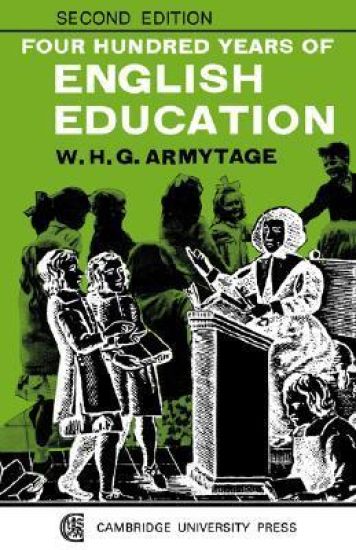
Four Hundred Years of English Education

Four Hundred Years of English Education

W. H. G. Armytage

Cambridge University Press
1970
pokkari
Professor Armytage's well-known book has become established as a very useful guide to the history of education in England. Not only does it provide a thorough and detailed account of the subject itself, but it also explains how education was shaped by the political, religious and economic background of the times. In this edition the final chapter has been extended and revised to take account of developments in education since the book first appeared.